Time to read: 8 min
Bead Blasting vs Sandblasting: Which Surface Finish Should You Choose for CNC Parts?
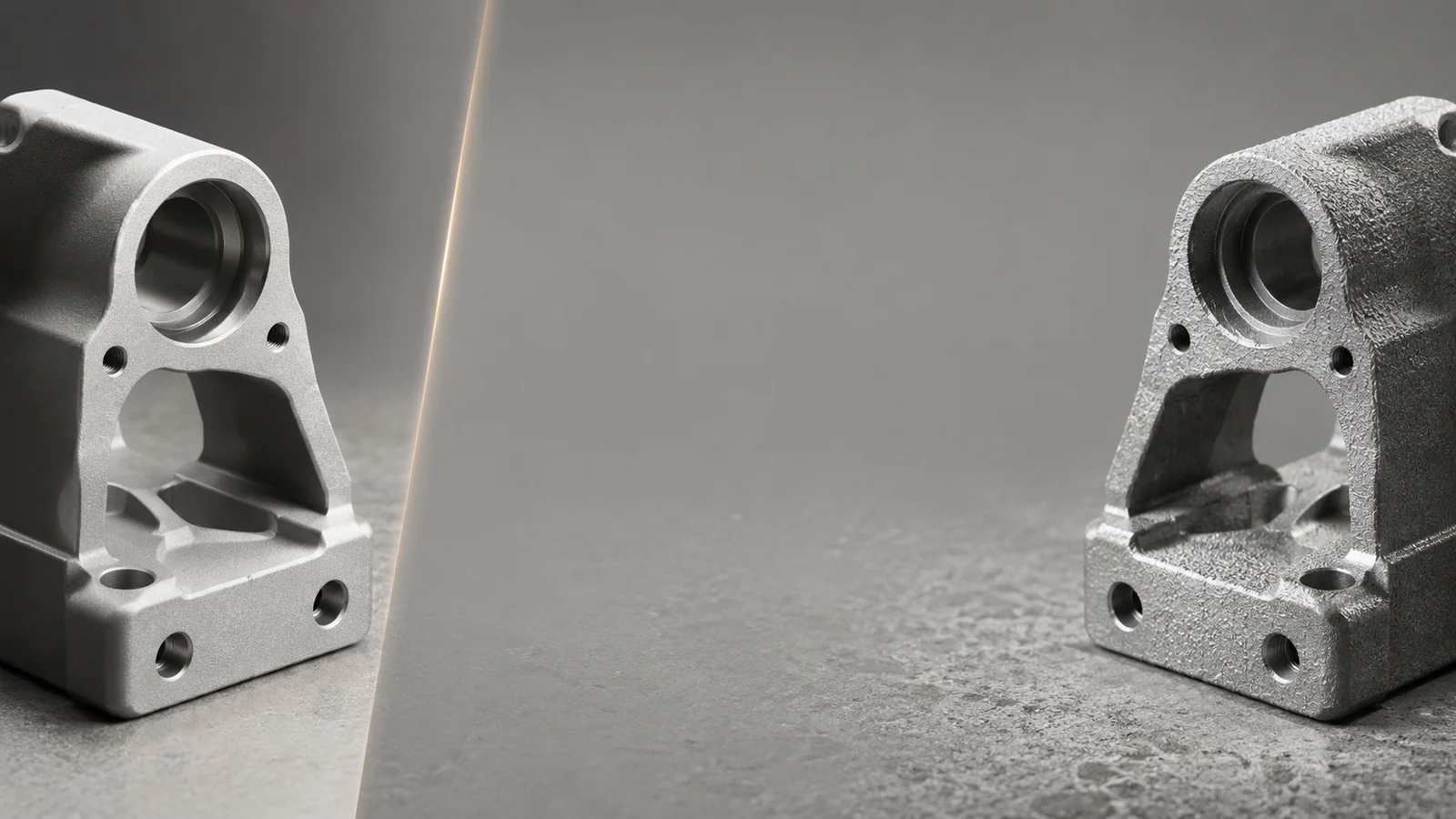
Bead blasting and sandblasting are both abrasive blasting processes used to clean, texture, or prepare CNC-machined parts. Because both processes propel small particles against a surface, they are frequently treated as interchangeable finishing options. In practice, they can create very different results.
Bead blasting normally uses spherical glass beads or another rounded medium to produce a uniform satin or matte appearance with relatively limited cutting action. Sandblasting is a less precise term. It may literally mean blasting with silica sand, but many manufacturers use it as a general name for abrasive blasting with angular media such as aluminum oxide, garnet, crushed glass, or steel grit.
This terminology matters when ordering CNC parts. A drawing note that says only “sandblast” does not define the abrasive material, particle shape, particle size, pressure, surface roughness, cleaning level, or acceptable dimensional change. One supplier may use fine aluminum oxide and produce a controlled matte texture. Another may use a coarser aggressive medium and create a much deeper profile.
The correct choice depends on what the surface treatment must accomplish. Bead blasting is often selected for cosmetic uniformity, removal of light machining marks, and preparation before anodizing. More aggressive abrasive blasting is better suited to removing rust, scale, old coatings, oxidation, or creating a strong anchor profile before paint and other thick coatings.
This guide compares bead blasting and sandblasting from the perspective of CNC part design, materials, roughness, dimensional control, coating preparation, contamination, inspection, and supplier selection.
First, What Does “Sandblasting” Actually Mean?
The term sandblasting is widely understood but technically ambiguous. Before comparing processes, designers and buyers should clarify whether “sandblasting” means actual silica sand or abrasive blasting with another angular medium.
Sandblasting Is Often Used as a General Term
In commercial manufacturing, suppliers may use “sandblasting” to describe almost any compressed-air blasting operation. The actual media may include:
- Fused aluminum oxide
- Garnet
- Crushed glass
- Silicon carbide
- Steel grit
- Stainless steel grit
- Coal or mineral slag
- Ceramic abrasive
These media differ significantly in hardness, shape, density, durability, contamination risk, and cutting behavior. The word “sandblast” alone therefore does not reliably predict the finished surface.
Actual Silica Sand Creates Serious Health Risks
Silica sand contains crystalline silica. OSHA states that abrasive blasting with sand can generate respirable crystalline silica exposure, and its abrasive-blasting guidance identifies risks including silicosis, lung cancer, and breathing problems. NIOSH has recommended replacing blasting abrasives containing more than 1% crystalline silica with less hazardous materials.
For this reason, many modern CNC finishing operations use silica-free media even when the process is still casually called sandblasting.
This does not mean every alternative abrasive is harmless. Blasting any medium creates airborne dust from the abrasive, the substrate, and removed coatings. Enclosure, ventilation, protective equipment, media handling, and local regulations remain necessary.
The Useful Comparison Is Round Beads vs Angular Abrasives
For CNC parts, the most useful technical comparison is normally:
- Bead blasting: usually spherical glass beads, selected for a smoother satin texture and comparatively limited cutting.
- Angular abrasive blasting: media such as aluminum oxide, garnet, or grit, selected for stronger cutting, cleaning, and profile generation.
The final purchase specification should name the actual abrasive instead of relying only on bead blasting or sandblasting terminology.
| Term used on RFQ or drawing | Possible interpretation | Main risk |
|---|---|---|
| Bead blast | Usually spherical glass beads | Bead size, pressure, and finish still remain undefined |
| Glass bead blast | More specific rounded glass media | Grade and acceptable roughness still need definition |
| Sandblast | Silica sand or a general abrasive-blasting process | Medium and surface profile are ambiguous |
| Abrasive blast | Any suitable metallic or nonmetallic medium | Must identify media and performance requirement |
| Aluminum oxide blast | Angular fused-alumina abrasive | Particle size, purity, and cutting intensity must be controlled |
| Garnet blast | Angular mineral abrasive | Grade, soluble contamination, and final profile require control |
| Shot blast | Often metallic round shot in wheel or air equipment | May be confused with glass beads or shot peening |
How Do Bead Blasting and Angular Abrasive Blasting Work?
Both processes accelerate abrasive particles toward the workpiece. The particles strike the CNC part and change the surface through impact, cutting, fracture, cleaning, or a combination of these actions.
Beads Impact and Peen the Surface
Glass beads are generally rounded. Instead of presenting sharp cutting edges, they strike the surface through many small impacts. This action can:
- Remove light oxidation and contamination
- Blend minor visual differences
- Reduce the visibility of fine tool marks
- Create a uniform satin or matte appearance
- Slightly round microscopic projections
Bead blasting still changes the surface. It is not a zero-removal process, especially when high pressure, large beads, long exposure, or a soft substrate is involved.
Angular Media Cut into the Surface
Aluminum oxide, garnet, steel grit, and similar media contain angular or irregular particles. Their edges cut, plow, and fracture surface material more aggressively.
This makes angular blasting suitable for:
- Removing rust
- Removing heat scale
- Stripping paint or old coatings
- Cleaning castings
- Creating a deeper coating anchor profile
- Etching hard metals
The same cutting action can damage a precision part if pressure, particle size, dwell time, and nozzle distance are not controlled.
Equipment and Process Settings Matter as Much as Media
The surface result also depends on:
- Air pressure
- Nozzle diameter
- Nozzle distance
- Impact angle
- Traverse speed
- Dwell time
- Media flow rate
- Media age and breakdown
- Manual or automated operation
A fine aluminum oxide medium used at low pressure may be less aggressive than large glass beads used too close to a thin aluminum wall. Media name alone does not define process severity.
What Surface Finish Does Each Process Produce?
Appearance is one of the main reasons CNC parts are bead blasted, but descriptions such as “matte,” “satin,” and “uniform” are subjective unless they are connected to a reference sample or measured roughness.
Bead Blasting Produces a Softer Satin Texture
Fine glass beads commonly create a smooth-looking, diffuse, non-directional finish. The process can visually blend milling and turning marks without creating the sharp anchor pattern associated with angular abrasive blasting.
The result is popular for:
- Aluminum electronics housings
- Optical instrument parts
- Robot components
- Medical equipment housings
- Consumer product hardware
- Decorative stainless steel parts
Bead blasting does not remove deep scratches or heavy chatter. If the incoming machining quality varies, blasting may reduce visual contrast without making every defect disappear.
Angular Blasting Produces a Sharper and Rougher Profile
Angular particles create a more distinct etched surface. Depending on grade and pressure, the finish may range from a fine matte texture to a visibly rough profile.
This profile can improve mechanical keying for:
- Paint
- Powder coating
- Thermal spray
- Bonded linings
- Adhesives
- Some conversion or protective systems
However, a profile that is too deep can remain visible through thin coatings, increase coating consumption, trap contamination, or create premature peaks through the finished coating.
Neither Process Guarantees a Specific Ra
Surface roughness after blasting depends on the complete process. It cannot be predicted reliably from bead mesh or abrasive grit alone.
ASTM D4417-21 provides methods for measuring the surface profile of blast-cleaned steel, while ASTM previously published D7127 for portable stylus measurement of abrasive-blast-cleaned metal surfaces. ASTM noted that numerical profile values obtained by different methods should not be compared directly without understanding how each method defines roughness.
For CNC parts, a supplier should validate the actual material and geometry using representative samples rather than promising one universal Ra for all alloys.
Bead Blasting vs Sandblasting: Main Differences
The table below summarizes the general tendencies of glass-bead blasting and angular abrasive blasting. These are not absolute rules because process settings can shift the result.
| Comparison factor | Glass-bead blasting | Angular abrasive blasting |
|---|---|---|
| Typical media shape | Spherical or rounded | Angular or irregular |
| Primary action | Impact, peening, and light cleaning | Cutting, etching, and aggressive cleaning |
| Typical appearance | Smooth satin or fine matte | Sharper matte or rough anchor profile |
| Material removal | Usually lower | Usually higher |
| Deep rust or scale removal | Limited | Better suited |
| Cosmetic blending | Strong application | Possible but often more aggressive |
| Preparation before thick coating | May not create enough profile | Often preferred |
| Risk to precision edges | Lower under controlled conditions | Higher |
| Risk of embedding abrasive | Possible | Possible and media-dependent |
| Common CNC use | Final appearance and light surface preparation | Cleaning, coating preparation, and heavier texture |
| Typical reusable media behavior | Beads gradually fracture and become more angular | Durability depends on abrasive type |
| Need for an approved finish sample | High for cosmetic parts | High when profile or appearance is critical |
Which Finish Should You Choose for Aluminum CNC Parts?
Aluminum is one of the most common materials for bead-blasted CNC components. It is also relatively soft, so an uncontrolled abrasive process can alter edges, thin walls, threads, and cosmetic consistency.
Choose Bead Blasting for Uniform Cosmetic Aluminum
Glass-bead blasting is commonly selected when an aluminum part needs:
- A uniform matte or satin appearance
- Reduced visibility of light machining marks
- A non-directional texture
- Preparation before clear or colored anodizing
- Appearance matching across milled and turned surfaces
For visible housings and instrument components, a controlled bead-blast sample is usually more useful than a roughness value alone because color and texture depend on alloy, heat treatment, tool marks, media condition, and anodizing.
Choose Angular Blasting for Stronger Cleaning or Coating Adhesion
Angular abrasive may be appropriate when an aluminum part has:
- Heavy oxidation
- Old paint or powder coating
- Casting residue
- A need for a stronger adhesive profile
- Surface damage that must be stripped before repair
The supplier must avoid excessive pressure and coarse media because aluminum can erode quickly. Precision surfaces may need masking.
Blasting Before Anodizing Requires Consistency
Anodizing does not hide blasting variation. Instead, differences in media condition, dwell time, and starting material can become visible after anodizing.
Common risks include:
- Patchy color
- Different gloss between faces
- Visible hand-blast overlap
- Dark areas caused by overblasting
- Different appearance between alloy batches
- Embedded contamination affecting the anodized surface
For repeat production, media grade, process parameters, fixture orientation, and acceptance samples should be controlled.
Which Finish Should You Choose for Stainless Steel Parts?
Stainless steel can be bead blasted for appearance or abrasively blasted for cleaning, but contamination control is especially important.
Bead Blasting Can Create a Uniform Stainless Satin Finish
Glass beads can reduce directional grinding marks and create a diffuse surface on:
- Medical equipment components
- Food machinery covers
- Laboratory fixtures
- Optical equipment hardware
- Stainless enclosures
- Architectural and visible mechanical parts
The finish may look cleaner and more uniform, but blasting normally increases microscopic surface texture compared with a polished finish. A blasted surface should not automatically be described as hygienic or easier to clean.
Carbon-Steel Media Can Contaminate Stainless Steel
Using carbon-steel shot, grit, tools, or dirty blasting equipment on stainless steel can introduce free iron. The transferred iron may later produce orange rust spots even when the stainless substrate is correct.
For corrosion-sensitive stainless parts, suppliers may use:
- Dedicated glass beads
- Stainless steel shot or irregular stainless media
- Dedicated cabinets and hoses
- Controlled cleaning after blasting
- Passivation when specified
ISO 11124-6:2025 specifies requirements for stainless steel shot and irregulars supplied for blast-cleaning, including particle size, hardness, density, structure, and chemical composition.
Blasting Is Not the Same as Passivation or Electropolishing
Bead blasting changes texture through impact. Passivation removes free iron and supports a clean passive surface with minimal intended material removal. Electropolishing electrochemically removes metal to smooth and passivate the surface.
For stainless parts requiring low roughness, high cleanability, or product-contact surfaces, electropolishing or mechanical polishing may be more appropriate than blasting. Bead blasting is mainly a texturing and light-cleaning process.
How Do These Processes Affect Other CNC Materials?
The same abrasive process can produce different results on steel, titanium, brass, copper, zinc alloys, and engineering plastics.
Carbon Steel and Tool Steel
Angular abrasive blasting is often chosen to remove:
- Rust
- Mill scale
- Heat-treatment oxide
- Old coatings
- Welding residue
Bead blasting may be selected when a smoother cosmetic steel finish is desired, but bare carbon steel can flash-rust after blasting. Cleaning, coating, oiling, or packaging should follow promptly.
Titanium, Brass, and Copper
Bead blasting can create a controlled matte appearance on titanium and copper alloys, but the medium and pressure must be compatible with the softer or more reactive surface.
Abrasive contamination can matter in medical, aerospace, electrical, and vacuum applications. Media should be qualified for the intended service rather than selected only for appearance.
Angular media can rapidly roughen brass and copper. It may be useful for coating preparation but is often too aggressive for final cosmetic surfaces.
Plastics and Thin-Wall Components
Engineering plastics can be blasted with soft or fine media for light cleaning or texture, but high pressure can:
- Round features
- Expose glass fibers
- Create stress whitening
- Generate heat
- Distort thin walls
- Produce an uneven finish
Thin metal walls can also distort or peen unevenly. Trial parts should be used before production.
| Material | Bead-blasting tendency | Angular-blasting tendency | Main risk |
|---|---|---|---|
| Aluminum | Good cosmetic satin finish | Strong cleaning and etching | Fast erosion and color variation after anodizing |
| Stainless steel | Uniform matte appearance | Scale removal and coating preparation | Free-iron contamination and increased roughness |
| Carbon steel | Light cleaning and satin texture | Effective rust and scale removal | Flash rust after blasting |
| Tool steel | Surface blending | Oxide removal and coating preparation | Damage to precision edges |
| Titanium | Controlled matte finish | Aggressive texturing | Media contamination for medical or aerospace use |
| Brass or copper | Soft matte appearance | Rapid cutting and roughening | Edge erosion and embedded abrasive |
| Zinc alloy | Possible at low intensity | Often too aggressive | Soft substrate erosion |
| Engineering plastic | Application-dependent | Usually high risk | Fiber exposure, whitening, heat, and distortion |
How Do Particle Size and Shape Change the Finish?
The abrasive grade has a direct effect on impact energy, cleaning speed, texture scale, and media retention.
Fine Media Produces a Finer Texture
Fine beads or grit generally produce a finer, more uniform finish and reach smaller features more easily. They may be selected for:
- Small CNC parts
- Precision cosmetic surfaces
- Thin walls
- Fine engraving
- Reduced visual roughness
Fine media can also create more dust and may require longer processing to remove heavy contamination.
Coarse Media Creates Greater Impact and Profile
Larger particles carry more impact energy at the same velocity. They can clean faster and generate a deeper profile but create greater risk of:
- Edge rounding
- Dimensional change
- Surface pitting
- Visible texture
- Damage to threads and thin features
Used Media Does Not Behave Like New Media
Glass beads fracture during use and gradually become smaller and more angular. The same cabinet can therefore produce a different finish as the media ages.
Recycled angular abrasive can also accumulate:
- Broken particles
- Dust
- Removed coating
- Metal contamination
- Moisture or oil
Media separation, replenishment, cleanliness checks, and replacement schedules are necessary for consistent production.
How Do Pressure, Distance, and Angle Affect CNC Parts?
Process parameters determine how much energy reaches the surface. Small changes can produce visible differences on aluminum and other cosmetic parts.
Higher Pressure Increases Cleaning and Damage Risk
Higher pressure generally increases particle velocity and impact severity. It may shorten processing time but can increase:
- Roughness
- Material removal
- Edge rounding
- Media breakdown
- Thin-wall distortion
- Appearance variation
The correct pressure should be established through a validated process rather than maximized for speed.
Nozzle Distance and Dwell Control Uniformity
A nozzle held close to one region creates a more concentrated blast. Long dwell at corners or around holes can produce darker or rougher areas.
Automated blasting can improve repeatability by controlling:
- Nozzle path
- Part rotation
- Distance
- Angle
- Traverse speed
- Exposure time
Manual blasting can still produce high-quality results, but approved samples and operator training are especially important.
Impact Angle Changes Cutting Behavior
Normal impact tends to maximize direct impact and peening. Lower angles can increase directional cutting or reduce direct indentation depending on media and substrate.
Complex CNC geometry receives different impact angles across the same part. Recesses, sidewalls, and undercuts may therefore show different color or roughness from directly exposed faces.
Will Blasting Change CNC Dimensions and Tolerances?
Bead blasting and sandblasting are often described as cosmetic finishes, but both can remove or displace material. Precision features need explicit protection.
Bead Blasting Usually Has Lower Dimensional Impact
Under controlled conditions, fine glass beads normally remove less material than aggressive angular abrasive. This makes bead blasting more suitable for completed CNC components.
Nevertheless, repeated impact can still affect:
- Sharp edges
- Small pins
- Thin walls
- Knife features
- Soft aluminum surfaces
- Fine text and engraving
Angular Abrasives Can Alter Fits and Edge Geometry
Angular media can cut external diameters, enlarge openings, round thread crests, and change sealing surfaces. The effect is difficult to predict on complex geometry because exposure is not uniform.
Precision areas commonly masked during blasting include:
- Bearing seats
- Press-fit diameters
- Precision bores
- O-ring grooves
- Ground sealing faces
- Threads
- Optical interfaces
- Electrical contacts
Final Dimensions Should Be Verified After Blasting
When a critical surface is exposed, the finished dimension should be checked after blasting. The inspection plan should consider:
- Incoming machining tolerance
- Average material removal
- Variation caused by geometry and manual exposure
- Subsequent anodizing, painting, or coating thickness
Blasting allowance is rarely controlled as precisely as electroplating or PVD thickness. Masking is often safer than attempting to compensate by a fixed dimensional value.
Which Process Is Better Before Anodizing, Painting, or Powder Coating?
The best blasting method depends on the next finishing operation. A surface optimized for cosmetic anodizing is not necessarily suitable for a thick industrial coating.
Before Anodizing
Fine bead blasting is frequently used before anodizing aluminum to create a uniform matte appearance. It can blend light machining marks and reduce directional reflection.
Important controls include:
- Consistent alloy and temper
- Clean, noncontaminating media
- Uniform blasting exposure
- Limited delay before pretreatment
- Approved samples after anodizing, not only before it
Aggressive angular blasting may create a rough texture that remains visible after anodizing and may make thin cosmetic edges look uneven.
Before Paint and Powder Coating
Paint and powder coating often require a clean surface with sufficient profile for adhesion. Angular abrasive blasting is generally better suited to creating this profile and removing rust, scale, and old coating.
ISO 8504-2:2019 describes abrasive blast-cleaning methods for preparing steel before paints and related products. The required cleanliness and profile should be matched to the coating system rather than selected independently.
Bead blasting may be too gentle when a coating supplier requires a defined anchor profile.
Before Adhesive Bonding or Thermal Spray
Adhesive and thermal-spray processes can be highly sensitive to surface profile, cleanliness, and contamination. Angular media may be necessary, but the correct abrasive must be approved for the bonding system.
Glass beads can leave a peened surface that is visually clean but lacks sufficient sharp profile. The process should be qualified through bond-strength or coating-performance tests.
What Contamination Risks Must Be Controlled?
A freshly blasted part has a highly exposed surface. Contaminated abrasive, compressed air, gloves, racks, or packaging can immediately compromise it.
Oil and Water in Compressed Air
ASTM D4285-24 is used to indicate oil or water in compressed air for abrasive blast cleaning, air cleaning, and coating application. The standard emphasizes that clean, dry air is required to prevent contamination of prepared surfaces and coating materials.
Oil contamination may reduce paint adhesion, create staining, or interfere with anodizing and passivation. Water can contribute to flash rust on steel.
Soluble Salts and Dirty Abrasive
Mineral and reused abrasives can contain water-soluble ionic contamination. ASTM D4940-25 addresses conductimetric analysis of water-soluble ionic contamination in blast-cleaning abrasives and notes that contaminants can originate from manufacturing, transport, storage, or reuse.
ISO 11127-6:2022 provides a conductivity method for water-soluble contaminants in nonmetallic abrasive, while ISO 11127-8:2020 addresses field determination of water-soluble chlorides.
For corrosion-sensitive components, abrasive purity should be considered rather than assuming all media of the same name are equivalent.
Cross-Contamination Between Materials
A cabinet used for carbon steel can contaminate stainless steel, aluminum, titanium, or copper parts. Contamination can come from:
- Residual media
- Dust in the recovery system
- Cabinet walls
- Hoses and nozzles
- Racks and gloves
- Recycled abrasive
Dedicated equipment or thoroughly controlled changeover procedures may be necessary for medical, aerospace, semiconductor, electrical, and high-corrosion-resistance applications.
What Are Common Bead-Blasting and Sandblasting Defects?
Most blasting defects can be traced to incoming surface condition, media selection, parameter variation, contamination, geometry, or poor handling.
Uneven Color or Patchy Texture
Common causes include:
- Inconsistent nozzle distance
- Uneven dwell time
- Hand-blast overlap
- Mixed new and worn media
- Different incoming machining finishes
- Shielded geometry
- Oil or fingerprints
Cosmetic production should use approved samples, controlled lighting, and consistent media maintenance.
Excessive Roughness or Edge Damage
Possible causes include:
- Media that is too coarse
- Excessive pressure
- Nozzle held too close
- Long dwell time
- Angular media used where beads were expected
- Soft or thin substrate
Once a precision edge has been eroded, blasting cannot restore it.
Embedded Media, Rust Spots, or Coating Failure
Embedded particles and contamination may appear as:
- Dark spots after anodizing
- Orange rust on stainless steel
- Pits or stains
- Adhesion loss under paint
- Blisters during environmental exposure
- Electrical-contact problems
The corrective action should address the contamination source. Reblasting with the same dirty system may worsen the defect.
| Observed defect | Likely cause | Corrective direction |
|---|---|---|
| Patchy matte appearance | Uneven exposure or mixed starting finishes | Control nozzle path and incoming machining quality |
| Finish becomes rougher during production | Glass beads have fractured and become angular | Separate, replenish, or replace media |
| Dark areas after anodizing | Overblasting, contamination, or alloy variation | Validate the complete blast-and-anodize sequence |
| Rust spots on stainless steel | Carbon-steel contamination | Use dedicated media and equipment; clean and passivate as required |
| Paint peels from blasted surface | Oil, salts, wrong profile, or delayed coating | Verify air, abrasive, cleanliness, and coating specification |
| Rounded thread or tight fit | Critical feature was not masked | Protect the feature and inspect after blasting |
| Visible pits | Coarse aggressive media or exposed base defects | Reduce process severity and inspect the substrate |
| Media trapped in holes | Poor drainage and inadequate cleaning | Improve masking, flushing, air cleaning, and inspection |
How Should a Blasted CNC Surface Be Inspected?
Inspection should reflect why the part was blasted. Cosmetic blending, coating preparation, rust removal, and measured roughness require different acceptance criteria.
Visual Appearance Inspection
For visible CNC parts, inspection may define:
- Approved master sample
- Viewing distance
- Lighting condition
- Permitted directional variation
- Limits for stains, spots, scratches, and overlap
- Acceptable rack or masking boundaries
Descriptions such as “uniform matte” are difficult to enforce without a physical or documented visual reference.
Surface Roughness or Profile Measurement
When profile affects coating performance, measurement may use:
- Replica tape
- Depth micrometers
- Stylus profilometers
- Optical profilometry
- Comparative profile standards
ASTM D4417-21 describes field methods for blast-cleaned steel. Results from different measurement principles should not be assumed to be directly equivalent.
For small curved CNC parts, the available inspection method may be limited by probe access and feature size.
Cleanliness, Dimensions, and Downstream Performance
Inspection may also include:
- Critical dimensions after blasting
- Thread gauges
- Compressed-air cleanliness checks
- Abrasive contamination tests
- Water-break or surface-cleanliness checks
- Coating adhesion tests
- Anodized appearance samples
- Corrosion or environmental testing
The strongest validation is often the performance of the complete downstream finish rather than the blasted surface alone.
How Should Bead Blasting or Sandblasting Be Specified on a Drawing?
A useful drawing note should define the expected result and the process variables that materially affect it.
Name the Abrasive and Grade
The specification should state:
- Glass bead, aluminum oxide, garnet, stainless steel media, or another approved abrasive
- Particle-size range or supplier grade
- New or controlled recycled media when relevant
- Restrictions on silica, iron, chlorides, or other contaminants
- Dedicated equipment requirements for sensitive materials
ISO 11126-7:2018 specifies requirements for fused aluminum oxide supplied for blast cleaning. ISO 11126-10:2025 specifies requirements for almandite garnet, including particle size, density, hardness, moisture, conductivity, and water-soluble chlorides. These standards illustrate why a media name alone does not fully define abrasive quality.
Define the Finished Surface
Depending on the application, the drawing may include:
- Target Ra or profile range
- Approved appearance sample
- Required cleaning level
- Maximum edge rounding
- Maximum permitted material removal
- Surfaces to remain unblasted
- Acceptable color or gloss after downstream finishing
Identify Masking and Process Sequence
The drawing should clearly identify:
- Threads
- Bearing fits
- Sealing faces
- Ground datum surfaces
- Electrical contacts
- Laser-marked areas
- Cosmetic Class-A surfaces
It should also state whether blasting occurs before anodizing, passivation, painting, powder coating, plating, or assembly.
Example bead-blasting note: Glass-bead blast identified exterior surfaces using approved bead grade [grade]. Produce a uniform non-directional satin finish matching approved sample. Mask threads, bearing bores, sealing surfaces, and electrical contacts. No embedded media, oil staining, visible overlap, or deep pitting permitted. Final cosmetic acceptance applies after anodizing.
Example angular-blasting note: Abrasive blast identified steel surfaces using approved fused aluminum oxide [grade] to achieve the specified surface profile before coating. Use clean, dry compressed air and abrasive meeting the stated contamination limits. Protect machined fits and threads. Apply the specified coating within the approved time after blasting.
How Can You Choose Between Bead Blasting and Sandblasting?
The selection can be reduced to a series of practical questions.
Choose Bead Blasting When Appearance Is the Priority
Bead blasting is generally the better choice when the part needs:
- A fine satin or matte appearance
- Visual blending of minor tool marks
- Lower material-removal risk
- Preparation for cosmetic anodizing
- A non-directional visible finish
It is especially common for aluminum housings, optical parts, medical equipment components, consumer products, and visible automation hardware.
Choose Angular Abrasive Blasting When Cleaning or Adhesion Is the Priority
Angular blasting is usually the better choice when the part needs:
- Rust or scale removal
- Old coating removal
- A stronger anchor profile
- Preparation before paint or powder coating
- Aggressive etching of hard material
The medium should be selected according to substrate hardness, downstream coating, cleanliness, and contamination limits.
Use Samples When Both Appearance and Function Matter
A prototype or witness coupon can verify:
- Visual texture
- Ra or profile
- Edge condition
- Material removal
- Anodized or painted appearance
- Coating adhesion
- Cleaning and contamination performance
For cosmetic production, the approved sample should use the same alloy, machining finish, abrasive, blasting process, and downstream coating as the production part.
How Does RapidMFGPro Support Blasted CNC Part Projects?
Blasting quality depends on more than finding a supplier with a blast cabinet. The media, equipment cleanliness, CNC surface condition, material, masking, downstream finish, and inspection criteria must be coordinated.
RapidMFGPro operates as a manufacturing resource and supplier-matching platform. It helps connect CNC projects with machining and finishing resources suited to the required material, appearance, roughness, coating sequence, and quality documentation.
Reviewing the Real Surface Requirement
A project review can clarify:
- Whether bead blasting or angular abrasive blasting is needed
- Whether “sandblast” is being used only as a general term
- Whether the goal is cosmetic blending, cleaning, or coating adhesion
- Which surfaces must be masked
- Whether roughness or profile must be measured
- Whether stainless or medical parts need dedicated media
- Whether appearance is accepted before or after anodizing or coating
Matching the Machining and Finishing Route
The selected route may require:
- Consistent CNC tool-path finish
- Controlled glass-bead blasting
- Fused aluminum oxide or garnet blasting
- Dedicated stainless or nonferrous blasting equipment
- Precision masking
- Anodizing, passivation, painting, or powder coating
- Surface-profile and contamination inspection
- Clean packaging after finishing
The objective is to match the complete process rather than choose a finish from a general service list.
Validating Samples Before Repeat Production
Initial samples can be used to verify:
- Media grade and process settings
- Appearance under controlled lighting
- Surface roughness or profile
- Masking boundaries
- Final dimensions
- Appearance after anodizing or coating
- Required inspection records
Once approved, the sample, parameters, and inspection method can become part of the production control plan.
Frequently Asked Questions About Bead Blasting and Sandblasting
Is Bead Blasting the Same as Sandblasting?
Both are abrasive-blasting processes, but bead blasting normally uses rounded glass beads. Sandblasting may mean actual silica sand or may be used as a general term for blasting with angular abrasive. The media should always be specified.
Which Process Produces a Smoother Finish?
Glass-bead blasting generally creates a smoother-looking satin finish. Angular media usually creates a sharper and deeper surface profile, although the result depends on particle size, pressure, distance, and substrate.
Is Bead Blasting Good Before Anodizing?
Yes. Fine glass beads are commonly used to create a uniform matte appearance before aluminum anodizing. The complete blasted-and-anodized sample should be approved because anodizing can reveal process variation.
Is Sandblasting Better Before Powder Coating?
Angular abrasive blasting is often better when powder coating requires rust removal and a defined anchor profile. The abrasive, profile, cleanliness, and coating system should be specified together.
Will Bead Blasting Remove CNC Tool Marks?
It can reduce the visibility of fine tool marks, but it does not reliably remove deep scratches, chatter, dents, or large machining defects.
Can Stainless Steel Be Bead Blasted?
Yes. Use clean media and equipment that will not introduce carbon-steel contamination. Passivation or another cleaning step may be required according to the application.
Does Bead Blasting Change Part Dimensions?
It normally has less dimensional effect than angular abrasive blasting, but it can still round edges, alter fine details, and affect soft or thin components. Critical surfaces should be masked and inspected.
Why Should Silica Sand Be Avoided?
Blasting with silica sand can generate respirable crystalline silica dust, which is associated with silicosis, lung cancer, and other serious health risks. Many modern processes use alternative media under controlled blasting systems.
Conclusion
Bead blasting is generally the better choice for CNC parts that need a fine satin appearance, light cleaning, and lower material-removal risk. Angular abrasive blasting is better for removing rust, scale, or coatings and for creating a stronger profile before paint, powder coating, adhesives, or other thick finishes.
The final result depends on media shape, size, purity, pressure, angle, distance, substrate, and downstream processing. Drawings should identify the actual abrasive, protected surfaces, acceptance sample or roughness, and finishing sequence rather than stating only “sandblast.”
RapidMFGPro helps review these requirements and match CNC projects with suitable machining, blasting, coating, and inspection resources.
Reference Sources
- OSHA — Protecting Workers from the Hazards of Abrasive Blasting Materials
- OSHA — Crystalline Silica Overview
- NIOSH — Silicosis Among Workers Involved in Abrasive Blasting
- ISO 8504-2:2019 — Abrasive Blast-Cleaning Methods
- ISO 11126-7:2018 — Fused Aluminum Oxide Blast-Cleaning Abrasives
- ISO 11126-10:2025 — Almandite Garnet Blast-Cleaning Abrasives
- ISO 11124-6:2025 — Stainless Steel Shot and Irregulars
- ASTM D4285-24 — Indicating Oil or Water in Compressed Air
- ASTM D4940-25 — Water-Soluble Ionic Contamination of Blast-Cleaning Abrasives
- ASTM D4417-21 — Field Measurement of Surface Profile of Blast-Cleaned Steel
Need Help Reviewing a Custom Part?
Share your CAD file and requirements to request supplier matching. Supplier capability and commercial terms must be verified before order placement.
Request Supplier Match