Time to read: 20 min
Can Plastic Be Used for Your CNC Parts?
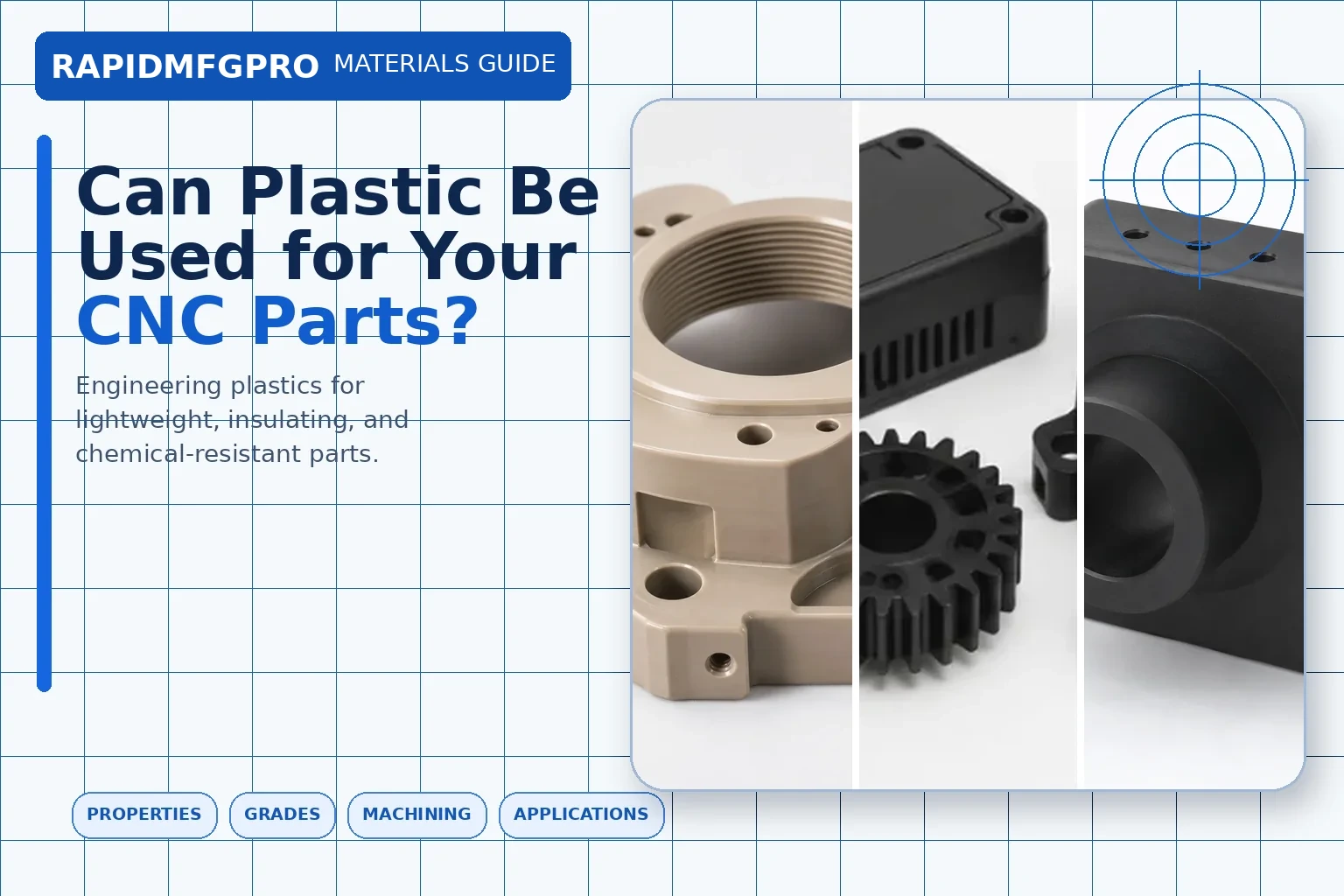
Plastic can be an excellent material for CNC parts when low weight, electrical insulation, corrosion resistance, chemical compatibility, low friction, or rapid prototyping is more important than maximum stiffness or temperature capability. CNC machining can produce plastic housings, insulators, manifolds, guides, bushings, medical components, optical mounts, test fixtures, fluid-handling parts, and low-volume production components without injection-molding tooling.
However, plastic is not one material family with one set of properties. ABS, acetal, nylon, polycarbonate, acrylic, PTFE, PEEK, PEI, PPS, UHMW-PE, PVC, and glass-filled polymers behave differently during cutting, clamping, inspection, assembly, and service. A plastic that machines cleanly may absorb moisture. A transparent plastic may crack around threads. A high-temperature polymer may be strong but expensive and abrasive to tools.
Plastic CNC parts also require different design rules from metal parts. Thermal expansion is higher, stiffness is lower, clamping pressure can distort the workpiece, and dimensional stability may depend on humidity, annealing, wall thickness, and storage temperature. These factors should be considered before a metal drawing is converted directly into plastic.
RapidMFGPro evaluates plastic CNC projects from a manufacturing supplier-matching perspective. The platform reviews the application, polymer grade, product form, quantity, geometry, tolerance, surface requirement, environmental exposure, inspection scope, and documentation before identifying suppliers with suitable plastic-machining, finishing, assembly, and quality-control capabilities.
This guide explains when plastic is suitable for CNC parts, which plastics are commonly machined, what design risks should be expected, and how engineers and buyers can prepare a practical plastic-part project.
Can Plastic Be Used for CNC Parts?
Yes. Thermoplastics, thermosets, reinforced polymers, and selected composite sheets can be machined into precision parts using CNC milling, turning, drilling, routing, and related processes. The material must still be selected according to the actual load and environment.
Prototype Parts
CNC machining is useful for plastic prototypes because it avoids mold tooling and can produce parts from production-intent materials. Engineers can test fit, assembly, chemical exposure, insulation, and mechanical function before committing to injection molding.
Machined prototypes may behave differently from molded parts because the material history, fiber orientation, residual stress, and surface condition are different. The prototype should be used to validate the correct functions.
Low-Volume Production
CNC machining can be economical for low-volume plastic production, especially when geometry changes frequently, annual demand is limited, or mold tooling cannot be justified.
Dedicated fixtures, bar-fed turning, sheet nesting, and repeatable deburring can support small production runs.
Precision Functional Parts
Plastic CNC parts can hold useful tolerances when material, geometry, temperature, and inspection methods are controlled. Precision is more difficult on thin, moisture-sensitive, highly stressed, or flexible components.
Critical dimensions should be selected according to function rather than applying metal-level tolerances to every feature.
When Is Plastic a Good Choice?
Plastic becomes a strong candidate when its low density, insulation, corrosion resistance, friction behavior, or chemical compatibility solves a clear design problem.
Weight Reduction
Most engineering plastics are much lighter than steel, stainless steel, copper, and titanium. Replacing a metal cover, guide, spacer, or housing with plastic can reduce moving mass and simplify handling.
Low weight is especially useful in robotics, medical equipment, portable instruments, drones, automation, and inspection systems.
Electrical Insulation
Many plastics provide strong electrical insulation and can separate conductive components without additional coatings. They are used for terminal blocks, standoffs, coil forms, sensor mounts, battery-system components, and electronics housings.
Dielectric strength, tracking resistance, flammability, humidity, and operating voltage should be reviewed for the exact grade.
Corrosion Resistance
Plastics do not rust like carbon steel. Selected polymers resist water, salt, cleaning chemicals, acids, alkalis, and process fluids.
Chemical resistance depends on concentration, temperature, exposure time, stress, and grade. A general chemical-resistance chart should not replace application testing for critical parts.
Low Friction
Acetal, PTFE, UHMW-PE, nylon, and specialty bearing plastics can reduce friction in guides, bushings, wear strips, and sliding components.
Load, speed, lubrication, moisture, temperature, and mating material determine whether the plastic will wear acceptably.
When Is Plastic Not the First Choice?
Plastic may be unsuitable when the part requires very high stiffness, concentrated thread load, high temperature, dimensional stability across a wide thermal range, or severe impact without sufficient support.
High Structural Load
Plastics generally have lower stiffness and strength than metals. A direct metal-to-plastic material substitution can produce excessive deflection even when the plastic does not fracture.
Larger sections, ribs, shorter spans, inserts, or a metal frame may be required.
High Service Temperature
Standard plastics can soften, creep, oxidize, or lose mechanical properties at elevated temperature. High-performance polymers such as PEEK, PEI, and PPS extend the operating range but increase material and machining cost.
Short-term peak temperature and continuous service temperature should be evaluated separately.
Extreme Dimensional Stability
Thermal expansion, moisture absorption, residual stress, and creep can change plastic dimensions after machining. Very tight fits over a wide environment may be difficult.
A metal, ceramic, filled polymer, or hybrid assembly may be more suitable for metrology-critical features.
High Wear Under Concentrated Contact
Soft plastics can deform under small contact areas. Hardened metal, carbide, ceramic, or a reinforced bearing polymer may provide longer life in heavily loaded interfaces.
Contact pressure should be evaluated, not only total load.
| Part Requirement | Plastic Suitability | Reason |
|---|---|---|
| Electrical insulator | High | Many plastics provide strong dielectric performance |
| Lightweight housing | High | Plastic reduces mass and avoids corrosion |
| High-load precision shaft | Low | Metal usually provides better stiffness and fatigue strength |
| Chemical manifold | Conditional | Compatibility depends on polymer, fluid, and temperature |
| Sliding guide | High | Low-friction plastics can reduce wear and noise |
| Part exposed to high heat | Conditional | High-performance polymer may be required |
How Do CNC Plastics Differ from Metals?
Plastic machining uses familiar CNC equipment, but the material response differs from metal in heat, stiffness, clamping, chip formation, and dimensional stability.
Lower Stiffness
Plastic workpieces deflect more easily under tool and fixture loads. Long walls, thin floors, slender shafts, and small tabs can move away from the cutting tool.
Supports, sharp tools, staged cuts, and reduced clamping pressure help maintain geometry.
Higher Thermal Expansion
Plastic dimensions change more with temperature than most metal dimensions. Heat from machining, inspection, storage, or service can affect measured size.
Tight-tolerance parts should be stabilized and inspected at a controlled temperature.
Lower Thermal Conductivity
Many plastics retain cutting heat near the tool and workpiece surface. Excessive heat can melt, smear, burn, or stress the material.
Sharp tooling, suitable cutting speed, chip evacuation, and controlled coolant or air are important.
Greater Sensitivity to Clamping
Hard jaws and point contact can dent or distort plastic. The part may appear accurate while clamped and move after release.
Soft jaws, vacuum fixtures, broad support, and low-force clamping are often preferred.
Which Plastic Families Are Commonly CNC Machined?
Machinable plastics range from economical general-purpose materials to high-temperature engineering polymers. Each family has a different balance of stiffness, wear, moisture, transparency, flame behavior, and cost.
General-Purpose Plastics
ABS, acrylic, PVC, HDPE, and polypropylene are used for covers, housings, fixtures, tanks, displays, and general prototypes.
They are cost-effective but may have limited temperature, stiffness, or dimensional stability.
Engineering Plastics
Acetal, nylon, polycarbonate, PET, and UHMW-PE provide improved strength, wear, toughness, or stability.
They are used for gears, guides, rollers, bushings, housings, and machine components.
High-Performance Plastics
PEEK, PEI, PPS, PAI, and selected fluoropolymers serve demanding thermal, chemical, electrical, and mechanical applications.
Material cost, machining stress, certification, and stock availability require closer control.
| Plastic | Main Advantage | Main Limitation | Typical CNC Part |
|---|---|---|---|
| ABS | Economical and impact resistant | Limited heat and chemical resistance | Housing or prototype |
| Acetal | Dimensional stability and low friction | Bonding can be difficult | Gear or guide |
| Nylon | Toughness and wear resistance | Moisture absorption | Bushing or roller |
| Polycarbonate | Impact resistance and transparency | Stress cracking and scratching | Guard or transparent housing |
| Acrylic | Optical clarity | Brittleness | Window or light guide |
| PTFE | Chemical resistance and low friction | Creep and low stiffness | Seal or insulator |
| PEEK | High temperature and chemical resistance | High cost | Medical or aerospace component |
| PEI | Heat and electrical performance | Chemical limitations | Electrical fixture |
When Should You Choose ABS?
ABS is an economical thermoplastic used for prototypes, housings, covers, fixtures, and consumer-product components. It machines easily when heat and burr formation are controlled.
Housing Applications
ABS is useful for low-load enclosures and covers that require impact resistance and moderate dimensional stability.
It can be painted, bonded, and assembled with inserts.
Prototype Applications
CNC-machined ABS can represent production plastic better than a different 3D-printing material.
It is suitable for fit checks, functional prototypes, and small production runs.
ABS Limitations
ABS has limited resistance to high heat, weathering, and some chemicals.
Outdoor or chemically exposed parts should use a verified grade or another polymer.
When Should You Choose Acetal?
Acetal is widely used for precision plastic parts because it provides low moisture absorption, good machinability, low friction, and useful dimensional stability.
Precision Components
Acetal is suitable for gears, guides, rollers, spacers, valve components, and instrument parts.
It generally holds dimensions more predictably than moisture-sensitive nylon.
Wear Components
Acetal provides low friction and useful wear performance against metal and plastic surfaces.
Load, speed, lubrication, and temperature should still be reviewed.
Acetal Limitations
Acetal can be difficult to bond and may not suit strong acids, high heat, or flame-sensitive applications.
Homopolymer and copolymer acetal should not be treated as identical.
When Should You Choose Nylon?
Nylon provides toughness, fatigue resistance, wear performance, and low friction. It is common in machine components but absorbs moisture.
Bushings
Nylon is used for bushings, bearings, rollers, gears, and wear pads.
It can reduce noise and eliminate lubrication in selected applications.
Impact Parts
Nylon can absorb impact and survive repeated movement better than more brittle plastics.
Reinforced grades provide higher stiffness but may become more abrasive and less impact tolerant.
Moisture Risk
Nylon absorbs moisture from the environment, which changes dimensions and mechanical properties.
Tolerance and conditioning should reflect the final operating humidity.
When Should You Choose Polycarbonate?
Polycarbonate is selected for transparent, impact-resistant parts such as guards, covers, windows, and instrument housings.
Impact Protection
Polycarbonate provides much greater impact resistance than acrylic.
It is useful for machine guards and protective windows.
Transparent Housings
Machined polycarbonate can produce clear covers, inspection windows, and light-transmitting components.
Tool marks and internal stress may require polishing or annealing.
Stress-Cracking Risk
Certain solvents, cleaners, coatings, and assembly stresses can cause crazing or cracking.
Chemical compatibility and thread torque should be controlled.
When Should You Choose Acrylic?
Acrylic is selected when optical clarity, appearance, UV resistance, and polished transparency are important.
Optical Components
Acrylic is used for windows, light guides, displays, covers, and optical prototypes.
Machined edges can be mechanically or vapor polished using suitable processes.
Decorative Components
Acrylic is available in clear, colored, opaque, and specialty sheet.
It is used in instruments, signs, fixtures, and consumer products.
Brittleness Risk
Acrylic is more brittle than polycarbonate and can crack around sharp corners, countersinks, and tight fasteners.
Generous radii and controlled assembly improve reliability.
When Should You Choose PTFE?
PTFE provides very low friction, broad chemical resistance, electrical insulation, and useful temperature performance. Its softness and creep must be considered.
Seals
PTFE is used for seals, seats, gaskets, backup rings, and chemically resistant fluid components.
Filled grades may improve wear, creep resistance, or thermal behavior.
Electrical Insulators
PTFE provides excellent dielectric performance and is used in high-frequency and high-voltage applications.
Geometry must account for low stiffness.
Creep Risk
PTFE deforms gradually under sustained load.
Threaded joints, press fits, and sealing preload require careful design.
When Should You Choose PEEK?
PEEK is a high-performance thermoplastic used when standard plastics cannot meet temperature, chemical, wear, or mechanical requirements.
High-Temperature Parts
PEEK retains useful properties at temperatures above the practical range of many common plastics.
It is used in aerospace, semiconductor, medical, oil and gas, and industrial equipment.
Chemical Parts
PEEK resists many chemicals and can be used in valves, manifolds, seals, and fluid-handling components.
Compatibility should still be confirmed for the exact fluid and temperature.
PEEK Limitations
PEEK is expensive, and reinforced grades can be abrasive to cutting tools.
Annealing, stock condition, and documentation may affect lead time and cost.
When Should You Choose PEI?
PEI is an amorphous high-temperature plastic known for electrical insulation, dimensional stability, flame performance, and transparency in selected grades.
Electrical Fixtures
PEI is used for test sockets, insulators, terminal components, and semiconductor fixtures.
Temperature, voltage, and certification requirements should be confirmed.
Medical Equipment
Selected PEI grades are used in reusable medical equipment and sterilization-compatible components.
Regulatory and cleaning requirements must match the exact grade.
PEI Limitations
PEI can be sensitive to certain chemicals and may develop stress cracking.
Internal stress and aggressive cleaning agents require review.
How Do Filled Plastics Change Performance?
Glass fiber, carbon fiber, PTFE, graphite, mineral, and other fillers change stiffness, wear, thermal expansion, conductivity, and machinability.
Glass-Filled Plastics
Glass fibers increase stiffness and reduce thermal expansion.
They also increase tool wear and can create rougher cut surfaces.
Carbon-Filled Plastics
Carbon fiber or carbon fillers can improve stiffness, wear, and dimensional stability.
Some grades become electrically conductive or static dissipative.
Bearing Fillers
PTFE, graphite, and lubricating fillers reduce friction and wear.
They may reduce strength or affect bonding.
Inspection Considerations
Filled plastics can be anisotropic, meaning properties differ by direction.
Stock orientation and fiber distribution may affect critical dimensions.
How Are Plastic Parts CNC Milled?
CNC milling is used for housings, manifolds, fixtures, plates, guides, medical parts, and complex plastic components.
Tool Selection
Sharp carbide or polished tools reduce heat and smearing. Single-flute and high-rake tools are common for soft plastics.
Filled plastics may require wear-resistant tooling.
Pocket Machining
Deep pockets trap heat and chips. Melted or recut chips can damage walls and floors.
Air blast, vacuum extraction, controlled engagement, and chip clearance improve results.
Thin-Wall Machining
Plastic walls deflect easily and may move after clamping is released.
Balanced roughing, rest periods, light finishing passes, and temporary supports help maintain geometry.
How Are Plastic Parts CNC Turned?
CNC turning produces bushings, rollers, seals, rings, insulators, guides, and cylindrical fluid components.
Bar Support
Plastic bar can bend or vibrate under cutting force.
Short stick-out, guide bushings, tailstock support, and sharp inserts improve stability.
Chip Control
Ductile plastics can create long continuous chips that wrap around the part.
Geometry, feed, chip breakers, and air assist should be selected for the polymer.
Surface Finish
Tool sharpness and heat determine whether the surface is clean, torn, fuzzy, or smeared.
A final sharp finishing pass may be required.
How Are Plastic Holes Machined?
Plastic holes require attention to heat, drill grabbing, exit burrs, dimensional recovery, and cracking.
Drilling
Sharp drills and suitable point geometry reduce heat and pushing force.
Peck drilling may be needed for deep holes.
Reaming
Reaming can improve bore size and finish, but flexible material may recover after the tool passes.
Process trials should establish the correct tool size.
Threaded Holes
Tapped plastic threads require appropriate engagement and torque.
Inserts may be more reliable for repeated assembly or higher load.
How Should Plastic Threads Be Designed?
Plastic threads can work well for light loads and limited assembly cycles, but material creep and local deformation must be considered.
Thread Engagement
Plastic often requires longer engagement than metal.
The exact length depends on material strength, thread diameter, and service load.
Thread Inserts
Heat-set, press-fit, ultrasonic, helical, and solid inserts improve durability.
Insert method should match thermoplastic type, wall thickness, and operating temperature.
Assembly Torque
Excessive torque strips threads or cracks bosses.
Torque limits should be defined and validated through assembly testing.
How Should Plastic Press Fits Be Designed?
Press fits in plastic require less interference than metal fits because the material deforms and creeps more easily.
Interference Amount
Excessive interference can crack the boss or permanently enlarge the hole.
Material stiffness, temperature, moisture, and wall thickness affect the fit.
Boss Geometry
Thick supported bosses distribute stress better than thin unsupported walls.
Radii reduce cracking at the boss base.
Retention Features
Knurls, barbs, undercuts, adhesives, and mechanical locks can improve retention.
The feature should not create excessive stress concentration.
How Should Plastic Tolerances Be Selected?
Plastic tolerances should reflect thermal expansion, moisture, residual stress, geometry, and measurement temperature.
Functional Tolerances
Tight tolerances should be limited to mating, sealing, bearing, alignment, or electrical features.
Cosmetic and nonfunctional surfaces can use broader limits.
Temperature Control
A part measured immediately after machining may change as it returns to room temperature.
Stabilization time and inspection temperature should be defined for precision parts.
Moisture Conditioning
Nylon and other moisture-sensitive plastics may change size after conditioning.
The drawing should identify whether dimensions apply dry, conditioned, or in service.
Why Does Plastic Warp After Machining?
Plastic can warp because machining releases residual stress, removes material asymmetrically, or introduces heat.
Stock Stress
Extruded, molded, and compression-formed stock may contain internal stress.
Removing the outer layer can release the stress and move the part.
Uneven Material Removal
Machining one side heavily before the other creates an unbalanced section.
Alternating sides and leaving roughing allowance reduce movement.
Machining Heat
Local heating causes temporary expansion and can create permanent stress.
Sharp tools and light engagement reduce thermal damage.
When Is Annealing Needed?
Annealing can reduce residual stress before or between machining operations. It is especially useful for thick, highly machined, or tight-tolerance plastic parts.
Pre-Machining Annealing
Stock may be annealed before roughing to reduce internal stress.
The process should match the polymer and stock supplier guidance.
Intermediate Annealing
A rough-machined part can be annealed before finish machining.
This allows stress movement to occur while finishing allowance remains.
Annealing Limitations
Improper heating or cooling can distort, oxidize, discolor, or damage the plastic.
Controlled ovens and documented cycles are required for critical parts.
How Does Moisture Affect Plastic Parts?
Moisture affects dimensions, stiffness, strength, impact resistance, and electrical behavior in selected polymers.
Nylon Moisture Absorption
Nylon absorbs moisture and expands.
Its toughness may increase while stiffness and dimensional stability change.
Storage Conditions
Dry storage, sealed packaging, and conditioning influence final part dimensions.
Inspection records should note conditioning state when required.
Service Environment
A part used in humid air, water, or dry vacuum may not remain at the same dimensions.
Material selection should reflect the actual environment.
How Does Temperature Affect Plastic Parts?
Temperature changes plastic dimensions, stiffness, strength, creep, friction, and chemical resistance.
Thermal Expansion
Plastic expands more than metal as temperature rises.
Mixed-material assemblies need clearance or compliant joints.
Softening
As temperature approaches the material’s softening region, stiffness falls.
A part can deform under loads that were safe at room temperature.
Thermal Cycling
Repeated heating and cooling can loosen fasteners, change fits, and create stress around metal inserts.
The complete assembly should be tested.
How Does Chemical Exposure Affect Plastic?
Plastic chemical resistance depends on polymer type, temperature, stress, concentration, and exposure time.
Swelling
Some chemicals enter the polymer and cause swelling or softening.
Dimensions and sealing force can change.
Stress Cracking
A chemical that causes little damage to an unstressed sample may crack a loaded part.
Threads, press fits, and bent regions are high-risk locations.
Material Testing
Critical parts should be tested using the actual fluid, temperature, stress, and exposure duration.
Generic compatibility charts are only an initial filter.
How Are CNC Plastic Parts Finished?
Plastic finishes are selected for appearance, transparency, bonding, cleanliness, friction, or identification.
Deburring
Burrs may be removed by hand tools, scraping, tumbling, blasting, or controlled thermal methods depending on the plastic.
Deburring should not round critical edges or contaminate clean parts.
Polishing
Acrylic and polycarbonate can be mechanically polished.
Some plastics can also be vapor polished using specialized controlled processes.
Painting
ABS and selected plastics can be painted after cleaning and pretreatment.
Adhesion and chemical compatibility should be verified.
Laser Marking
Laser marking can add identification without labels.
Contrast and surface damage depend on polymer and additives.
Can Plastic CNC Parts Be Bonded?
Plastic parts can be joined with adhesives, solvent cement, thermal welding, fasteners, or inserts.
Adhesive Bonding
Epoxy, acrylic, cyanoacrylate, and specialty adhesives serve different polymers and environments.
Surface preparation and joint design are critical.
Solvent Bonding
Acrylic, PVC, and selected thermoplastics can be joined by controlled solvent action.
Excess solvent can craze, distort, or weaken the part.
Mechanical Fastening
Screws, inserts, clamps, and snap features provide serviceable joints.
Local stress and creep must be controlled.
Which Process Fits the Quantity?
Quantity influences whether a plastic part should be CNC machined, injection molded, compression molded, extruded, thermoformed, or additively manufactured.
Prototype Quantity
CNC machining provides production-grade material without mold tooling.
It is suitable for functional validation and design changes.
Low-Volume Production
CNC machining remains competitive for complex parts with low annual demand.
Dedicated fixtures and nested sheet production can reduce cost.
High-Volume Production
Injection molding may become more economical when quantity justifies tooling and geometry is moldable.
CNC machining may remain necessary for critical secondary features.
| Process | Typical Quantity | Main Advantage | Main Limitation |
|---|---|---|---|
| CNC machining | Prototype to medium volume | No mold tooling | Material waste |
| Injection molding | Medium to very high volume | Fast repeat production | Tooling investment |
| Compression molding | Low to high volume | Filled and thermoset materials | Tooling and finish limits |
| Extrusion | Medium to high volume | Efficient constant profiles | Cross-section limitations |
| 3D printing | Prototype to low volume | Complex geometry | Material and surface differences |
Where Are CNC Plastic Parts Used?
CNC plastic parts are used in industries that need lightweight, insulating, low-friction, chemically resistant, clean, or rapidly produced components.
Medical Equipment
Plastic parts include instrument components, test fixtures, fluid manifolds, housings, guides, and sterilization-compatible parts.
Grade, biocompatibility, cleaning, traceability, and packaging may be required.
Electronics
Insulators, terminal blocks, sensor mounts, battery parts, test sockets, and housings use machined plastic.
Electrical, thermal, and flame requirements should be defined.
Semiconductor Equipment
PEEK, PEI, PTFE, PFA, and other specialty polymers are used for fixtures, wafer-handling parts, manifolds, and chemical components.
Cleanliness and contamination control are important.
Robotics
Robots use plastic for low-friction guides, lightweight links, covers, cable-management parts, and end-effector components.
Creep and stiffness should be checked.
Food Equipment
UHMW-PE, acetal, nylon, and approved specialty plastics are used for guides, wear strips, rollers, and machine components.
Food-contact compliance and cleaning chemistry should be confirmed.
Optical Equipment
Plastic is used for lens spacers, light guides, covers, optical mounts, and insulating structures.
Thermal stability, outgassing, and surface quality may be critical.
How Do You Select a CNC Plastic?
Plastic selection should begin with the controlling function and then account for temperature, load, chemical exposure, dimensional stability, wear, electrical behavior, quantity, and cost.
Define the Mechanical Requirement
Identify tension, compression, bending, impact, fatigue, creep, and contact pressure.
Stiffness and strength should be evaluated separately.
Define the Environment
State temperature, humidity, chemicals, UV exposure, vacuum, radiation, and cleaning conditions.
The exact grade should be checked against the complete environment.
Define the Precision Requirement
Identify dimensions that control fit, sealing, alignment, or assembly.
Material stability should match the tolerance.
Define the Regulatory Requirement
Food contact, medical use, flammability, electrical listing, RoHS, REACH, and customer standards may limit grades.
Documentation should be confirmed before quotation.
What Should Be Specified on the Drawing?
A plastic-part drawing should identify the exact material, grade, condition, tolerance basis, finish, and inspection requirements.
Material Grade
State the polymer, manufacturer grade when necessary, filler content, color, and applicable standard.
Notes such as nylon or PEEK may be too broad.
Condition
Define annealed, dry, conditioned, natural, black, glass-filled, carbon-filled, or another required condition.
Moisture-sensitive parts should identify the dimensional condition.
Tolerance Basis
State inspection temperature and conditioning when critical.
Tight tolerances should be limited to functional features.
Surface Requirement
Define roughness, transparency, polish, burr, scratch, tool mark, color, and cosmetic areas.
Optical parts may require approved samples.
What Should Be Included in the RFQ?
A complete RFQ helps suppliers quote the same plastic, process, quantity, finish, inspection, and documentation.
Technical Files
Provide the 3D model and controlled 2D drawing.
The drawing defines acceptance.
Quantity
State prototype quantity, initial order, and annual demand.
Quantity affects whether CNC machining or molding is more suitable.
Material Documentation
Specify certificates, lot traceability, flame rating, food-contact statement, medical documentation, or manufacturer grade.
Critical projects should avoid unidentified generic stock.
Packaging Requirement
Plastic parts can scratch, warp, absorb moisture, or become contaminated.
Packaging should protect geometry, cleanliness, and surface condition.
How Does RapidMFGPro Evaluate Plastic CNC Projects?
RapidMFGPro evaluates plastic CNC projects by identifying the application, material behavior, process, inspection, and supplier capabilities required for the actual part.
Application Review
The review begins with load, temperature, chemicals, moisture, insulation, wear, transparency, and service life.
This helps determine whether plastic is appropriate and which family should be considered.
Material Review
The material review confirms polymer grade, filler, color, product form, stock condition, certification, and availability.
Proposed substitutions are checked for dimensional and environmental impact.
Manufacturing Review
The manufacturing review considers wall thickness, pockets, threads, inserts, clamping, annealing, deburring, polishing, quantity, and inspection.
The goal is to prevent metal-based geometry from creating unnecessary plastic-machining risk.
Supplier Matching
Suppliers are compared according to plastic-machining experience, clean handling, annealing resources, optical finishing, insert installation, inspection equipment, and production capacity.
A supplier suitable for ABS prototypes may not be suitable for PEEK medical components or transparent polycarbonate optical parts.
How Should Plastic CNC Parts Be Inspected?
Plastic inspection should confirm material identity, dimensions, surface condition, inserts, function, and environmental state without deforming the part.
Material Verification
Certificates, lot records, filler content, color, grade, and stock form may be reviewed.
Critical parts may require traceability to the polymer manufacturer.
Dimensional Inspection
CMMs, optical systems, low-force gauges, micrometers, and custom fixtures may be used.
Probe force and inspection temperature should not distort the result.
Surface Inspection
Inspect burrs, scratches, tool marks, haze, melting, burns, cracks, discoloration, and contamination.
Cosmetic areas should have defined acceptance criteria.
Functional Inspection
Functional checks may include thread assembly, leak testing, dielectric testing, fit verification, friction testing, pull-out testing, or trial assembly.
Dimensional conformity alone may not prove plastic-part performance.
What Problems Commonly Occur?
Plastic CNC problems commonly involve warping, melted edges, burrs, moisture growth, thread damage, cracking, poor finish, or material substitution.
Warping
Residual stress and asymmetric material removal can move the part.
Annealing and balanced machining may be required.
Melted Surfaces
Dull tools, excessive speed, and poor chip evacuation generate heat.
The surface can smear or burn.
Heavy Burrs
Soft ductile plastics can form persistent burrs and fuzzy edges.
Tool geometry and secondary deburring should be planned.
Cracked Bosses
Tight inserts, tapered threads, sharp corners, and high assembly torque can crack plastic bosses.
Geometry and torque should be reviewed.
Moisture-Related Size Change
Nylon parts can pass dry inspection and change size after conditioning.
Acceptance condition should be defined.
Wrong Polymer Grade
Two visually similar plastics may have different heat, chemical, flame, or wear performance.
Substitution should require engineering approval.
Frequently Asked Questions
These questions address common decisions when considering plastic for a CNC part.
Is CNC Plastic Strong Enough for Functional Parts?
Yes, when the load, geometry, temperature, and material are appropriate. Plastic is not suitable for every high-load or high-stiffness application.
Which Plastic Is Easiest to Machine?
Acetal and ABS are commonly considered easy to machine. Exact behavior depends on grade, stock condition, tooling, and geometry.
Which Plastic Holds the Tightest Tolerance?
Acetal, PET, PEEK, and selected filled polymers can provide useful dimensional stability. Part geometry, temperature, moisture, and stress remain important.
Which Plastic Is Best for Wear?
Acetal, UHMW-PE, nylon, PTFE compounds, PEEK, and specialty bearing plastics serve different wear conditions. Load, speed, temperature, and mating material determine the best choice.
Which Plastic Is Best for High Temperature?
PEEK, PEI, PPS, and PAI are common high-temperature candidates. The exact continuous temperature and load should be verified.
Can Plastic Parts Use Metal Inserts?
Yes. Inserts improve thread durability, wear, electrical contact, and assembly strength. Installation method must match the plastic.
Can CNC Plastic Parts Be Transparent?
Acrylic and polycarbonate can be machined and polished for transparency. Tool marks, stress, and geometry affect optical quality.
Should a Plastic Prototype Be Injection Molded Later?
It may be, but the design must be reviewed for draft, uniform wall thickness, gates, ejectors, shrinkage, and molded material behavior before tooling.
Conclusion
Plastic can be an excellent material for CNC parts when low weight, insulation, corrosion resistance, chemical compatibility, low friction, transparency, or rapid low-volume production creates real value. It is less suitable when extreme stiffness, concentrated load, high temperature, or very stable dimensions across changing environments are required. Successful plastic CNC production depends on the exact polymer grade, filler, stock condition, geometry, tolerance, machining strategy, annealing, finish, inspection, and packaging. RapidMFGPro supports this decision by reviewing the project and matching it with suppliers whose plastic-machining, finishing, assembly, documentation, and quality capabilities fit the actual part.
Need Help Reviewing a Custom Part?
Share your CAD file and requirements to request supplier matching. Supplier capability and commercial terms must be verified before order placement.
Request Supplier Match