Time to read: 8 min
How Should You Compare CNC Machining Quotes Beyond Unit Price?
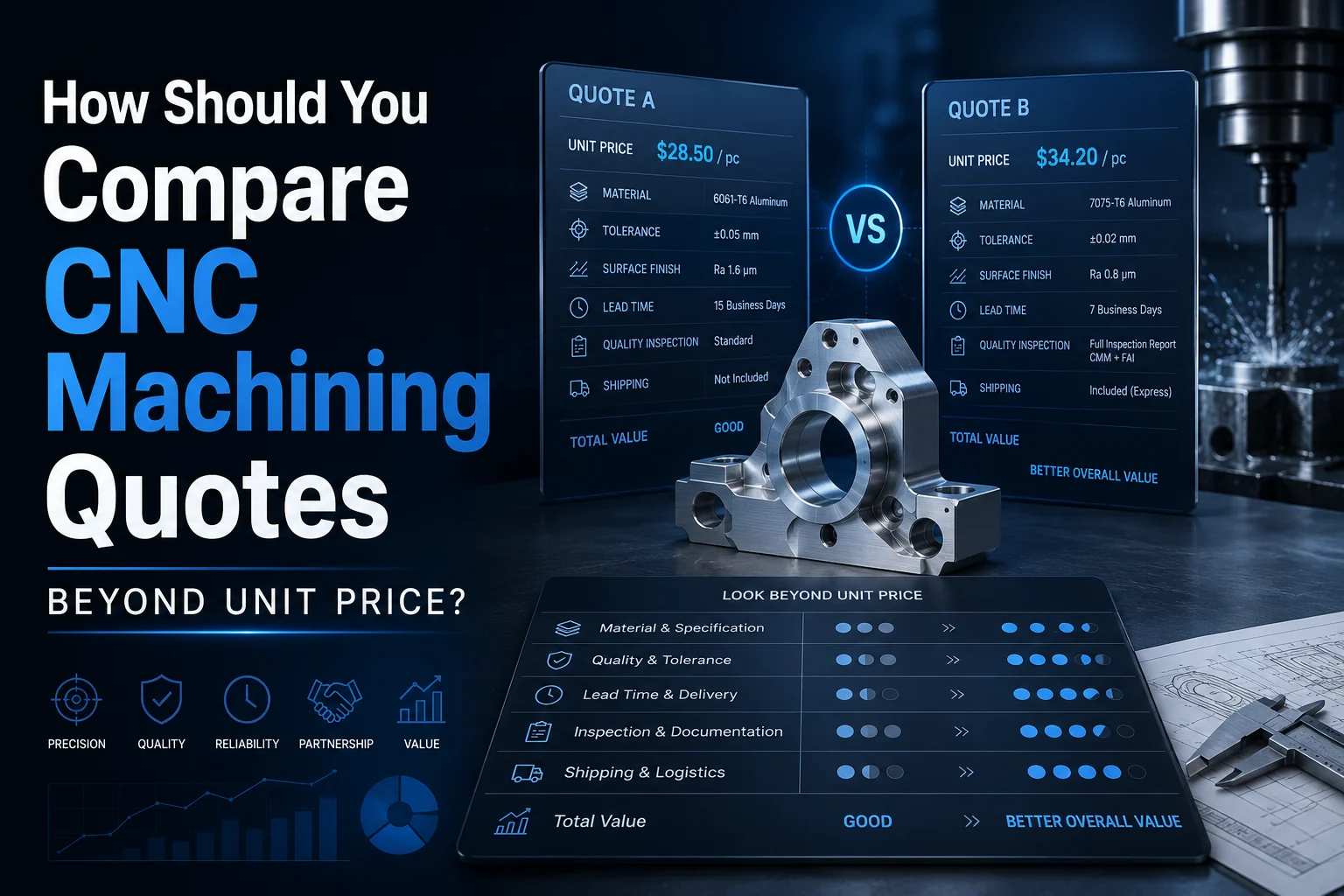
Comparing CNC machining quotes by unit price alone can lead to the most expensive purchasing decision. Two quotations may show the same part number and quantity while including different materials, tolerances, inspection levels, finishing processes, packaging, delivery terms, and responsibilities for nonconforming parts.
A low quotation may exclude material certificates, first-article inspection, thread gauges, masking, surface-treatment testing, export packaging, or freight. It may also be based on a different interpretation of the drawing. Another supplier may quote a higher unit price because the offer includes complete traceability, controlled subcontract processes, dimensional reports, and a shorter confirmed delivery schedule.
The buyer therefore needs to compare the total manufacturing offer rather than one number. The first task is to normalize the technical and commercial scope. The second is to evaluate whether each supplier can actually produce, inspect, finish, document, and deliver the part consistently. The third is to estimate the costs that appear after purchase order placement, including engineering clarification, late delivery, rework, rejected assemblies, freight, inventory, and supplier changes.
This guide presents a practical method for comparing CNC machining quotations beyond unit price. It covers quote normalization, material and process assumptions, quality documentation, supplier capability, lead-time credibility, logistics, payment terms, change management, nonconformance responsibility, and risk-adjusted supplier scoring.
Why Is Unit Price an Incomplete Comparison?
Unit price is useful only after the quoted scope has been made equivalent. Otherwise, the buyer may be comparing different products and different risk allocations.
A Quote Is Based on Assumptions
Every supplier must interpret:
- The controlling CAD model and drawing
- Material grade and condition
- General and specific tolerances
- Surface-finish requirements
- Deburring and cleaning expectations
- Inspection and documentation
- Packaging and delivery terms
If these assumptions are not stated, a lower price may result from a narrower interpretation rather than a more efficient process.
Visible Price Excludes Many Ownership Costs
The buyer may later pay for:
- Engineering time spent answering repeated questions
- Replacement parts
- Sorting or reinspection
- Assembly delays
- Premium freight
- Inventory caused by unreliable deliveries
- Qualification of a replacement supplier
These costs do not appear in the original unit-price column but affect the actual cost of sourcing the part.
The Lowest Price Can Carry the Highest Uncertainty
A quotation may appear attractive because it does not clearly state:
- Which operations are subcontracted
- Which dimensions are inspected
- Whether finishing is certified
- Whether delivery is confirmed or estimated
- Who pays when parts fail after coating
Unpriced uncertainty should be treated as a commercial and quality risk rather than ignored.
| Quote element | Supplier A may include | Supplier B may exclude | Comparison risk |
|---|---|---|---|
| Material | Certified specified alloy and temper | Commercially available equivalent | Different mechanical or finishing performance |
| Inspection | Full first-article report | Basic shop inspection only | Different verification and documentation cost |
| Surface treatment | Masking, testing, and certificate | Basic treatment without reporting | Different process control and acceptance evidence |
| Packaging | Individual protective packaging | Bulk packed parts | Different handling and cosmetic-damage risk |
| Delivery | Freight to named destination | Ex works collection | Freight, customs, risk, and insurance differ |
| Nonconformance | Replacement and corrective-action support | No stated remedy | Buyer may carry recovery cost |
Step 1: Normalize the Technical Scope
Before scoring suppliers, create one comparison sheet that confirms every quotation is based on the same product definition.
Confirm the Controlling Revision
Record the exact:
- Part number
- Drawing revision
- CAD-file revision
- Specification revisions
- Quantity and release schedule
A quotation based on an old revision should not be compared until it is updated.
List All Required Manufacturing Operations
The normalized scope may include:
- CNC milling or turning
- Heat treatment
- Grinding or lapping
- Deburring and cleaning
- Anodizing, plating, passivation, or coating
- Laser marking
- Assembly
- Final inspection
Ask each supplier to identify excluded operations and customer-supplied items.
Clarify the Finished Condition
Dimensions and tolerances may apply before or after:
- Heat treatment
- Anodizing
- Plating
- Polishing
- Assembly
The supplier must understand which condition is inspected and accepted.
Step 2: Compare Material Assumptions
Material differences can affect part performance, machining cost, lead time, surface treatment, and traceability.
Verify Grade, Form, and Condition
Compare:
- Alloy designation
- Temper or heat-treatment condition
- Bar, plate, tube, forging, or casting form
- Applicable material specification
- Country-of-origin requirements
For example, quoting 6061-T6 plate is not equivalent to quoting an unspecified 6000-series aluminum block.
Compare Certification and Traceability
Determine whether the quotation includes:
- Mill test reports
- Heat or batch traceability
- Material identity retained through production
- Positive material identification when required
- Certificate retention period
Evaluate Availability and Substitution Rules
A supplier using available standard stock may offer faster delivery. Another may quote the exact certified form with a longer procurement period.
Any substitution process should define:
- Who may propose an alternative
- What evidence is required
- Who provides engineering approval
- Whether price and lead time change
Step 3: Compare the Proposed Manufacturing Route
Suppliers may use different machines and process sequences to produce the same geometry. The route affects consistency, setup count, risk, and future scalability.
Review Machine and Setup Strategy
Ask whether the part will use:
- Three-axis milling
- Five-axis machining
- CNC turning with secondary milling
- Mill-turn production
- Multiple separate setups
- Custom fixtures
A higher-rate machine may produce a lower total risk by reducing setups and datum transfers.
Identify Subcontracted Processes
Subcontracting is common and not automatically negative. The buyer should understand:
- Which operations are outsourced
- Whether the subcontractor is approved
- Who controls the specification
- Who inspects the returned parts
- Who is responsible for failures
Assess Process Scalability
A flexible prototype route may not support future volume. Ask how the process would change for:
- Repeat orders
- Larger releases
- Automation
- Near-net blanks
- Dedicated fixtures
A supplier that can explain both the initial and future route may reduce later transfer cost.
Step 4: Compare Tolerance and Drawing Interpretations
A quotation may be lower because the supplier overlooked a tolerance, datum relationship, or note that requires a different process.
Request a Technical Assumption List
Ask suppliers to state assumptions about:
- General tolerances
- GD&T interpretation
- Thread acceptance
- Surface roughness
- Edge-break limits
- Cosmetic criteria
Identify Features That Drive the Quote
A strong supplier should be able to explain which requirements create:
- Grinding or lapping
- Special tooling
- CMM inspection
- Additional setups
- Higher scrap risk
This explanation is useful for DFM and future cost reduction.
Resolve Conflicts Before Award
If one supplier identifies a drawing conflict and another does not, do not assume the second supplier has solved it. The second supplier may simply have missed it.
Step 5: Compare Quality-Control Scope
Quality-system certification is valuable, but the quotation should also define the controls applied to the specific part.
Review the Project Quality Plan
ISO 10005:2018 provides guidance for establishing, reviewing, applying, and revising quality plans for products, processes, projects, and contracts.
A part-specific quality plan may include:
- Incoming material control
- First-piece inspection
- In-process checks
- Final inspection
- Sampling levels
- Special-process verification
- Nonconformance handling
Compare Inspection Equipment and Capability
Ask what will be used for:
- Dimensional inspection
- Threads
- Surface roughness
- Coating thickness
- Hardness
- Leak or functional testing
ISO/IEC 17025:2017 remains the current international standard for the competence and consistent operation of testing and calibration laboratories. When external laboratory testing is required, the applicable scope and accreditation should be reviewed.
Compare Sampling and Inspection Frequency
Determine whether the quote includes:
- 100% inspection
- First and last piece
- Fixed-frequency checks
- Risk-based sampling
- Automated in-process gauging
ISO 2859-1:2026 defines acceptance-sampling plans for inspection by attributes. A sampling plan should be agreed rather than inferred from a supplier’s normal practice.
| Quality item | Questions to ask | Why it changes quote value |
|---|---|---|
| First article | Full report, partial report, or dimensional sample only? | Changes inspection time and approval confidence |
| Production inspection | Which features, what frequency, and which instruments? | Determines ongoing control and detection risk |
| Calibration | Are gauges calibrated and traceable? | Affects confidence in reported measurements |
| Special processes | Are certificates and test results included? | Determines evidence of coating or heat-treatment conformity |
| Nonconformance | What containment, replacement, and corrective action are provided? | Changes the buyer’s recovery cost |
| Record retention | How long are material and inspection records retained? | Important for regulated and long-life products |
Step 6: Compare First-Article and Production-Approval Requirements
First-article documentation can represent a significant part of a prototype or low-volume quotation.
Define What “FAI” Means
It may mean:
- A dimensional inspection report
- A ballooned drawing
- A complete material and process package
- A formal aerospace first article
- A customer-specific approval package
SAE AS9102C, revised in June 2023, establishes aerospace first-article inspection requirements. A formal AS9102 package should not be compared with a basic dimensional report as though they are the same service.
Identify Requalification Triggers
Determine whether a new or partial first article is required after:
- Drawing revision
- Supplier transfer
- Process change
- Tooling change
- Long production interruption
Compare PPAP Requirements for Production Programs
AIAG describes PPAP as the industry standard for demonstrating that the actual production process consistently meets engineering design records and specifications.
A quotation that includes PPAP preparation, run-at-rate samples, measurement-system evidence, and control documentation should not be compared directly with a quote for parts only.
Step 7: Evaluate Lead-Time Credibility
The shortest quoted lead time has little value if it is based on unavailable material, unreserved capacity, or an unconfirmed subcontractor.
Separate Material, Production, and Transit Lead Time
Ask for a schedule showing:
- Material procurement
- Programming and fixture preparation
- Machining
- Special processing
- Inspection
- Shipping
Ask What the Lead Time Starts From
Possible starting points include:
- Purchase-order receipt
- Deposit payment
- Drawing approval
- Material receipt
- First-article approval
A “four-week lead time” is ambiguous without a defined starting event.
Review Capacity and Recovery Plans
Ask:
- Is machine capacity reserved?
- Is backup equipment available?
- What happens after tool failure or machine breakdown?
- Can partial delivery be provided?
- Which steps are outside the supplier’s control?
Step 8: Compare Delivery Terms and Logistics
A unit price may include very different delivery obligations.
Use a Named Incoterms Rule and Location
The ICC’s Incoterms 2020 rules allocate specified delivery obligations, costs, and risks between buyers and sellers. The quotation and purchase order should identify the rule and named place, for example:
- EXW supplier location
- FCA named terminal
- DAP buyer location
Writing only “FOB price” without the named port and transport context can create misunderstanding.
Compare Freight, Insurance, and Customs Responsibilities
Clarify who pays for:
- Export clearance
- International freight
- Insurance
- Import duties and taxes
- Customs brokerage
- Final local delivery
Compare Packaging Specifications
Packaging may need:
- Individual protection
- Corrosion-prevention material
- Clean-room-compatible bags
- Custom trays
- Maximum carton weight
- Barcodes and labels
Bulk packaging may reduce quote price and increase cosmetic or handling damage.
Step 9: Compare Payment and Commercial Terms
Payment timing, currency, quotation validity, and tooling ownership affect cash flow and risk.
Normalize Currency and Payment Timing
Compare:
- Quoted currency
- Deposit percentage
- Balance-payment event
- Credit terms
- Bank charges
- Exchange-rate exposure
Review Quote Validity and Price Adjustment
Material and freight prices may change. Determine:
- How long the quote is valid
- Whether material is locked after order
- Whether repeat-order pricing is guaranteed
- What volume assumptions support the price
Define Tooling Ownership
For fixtures, gauges, and special tools, clarify:
- Who pays
- Who owns the tooling
- Where it is stored
- Who maintains it
- Whether it can be transferred
- How design changes are charged
Step 10: Compare Nonconformance and Warranty Responsibility
The true value of a supplier becomes visible when something goes wrong.
Define the Acceptance and Claim Period
Clarify:
- How quickly incoming inspection must be completed
- How latent defects are handled
- What evidence is required for a claim
- Whether assembled or modified parts remain eligible
Review Replacement and Rework Terms
Determine who pays for:
- Replacement production
- Return freight
- Sorting
- Local rework
- Premium freight
- Damaged mating components
Review Corrective-Action Capability
A capable supplier should be able to provide:
- Immediate containment
- Root-cause analysis
- Corrective action
- Verification of effectiveness
- Process-document updates
A low replacement price does not compensate for recurring defects without root-cause control.
Step 11: Evaluate Supplier Capability and Business Risk
Supplier evaluation should include technical capability, operational stability, and continuity.
Confirm Relevant Experience
Review experience with:
- The specified material
- Similar tolerances and geometry
- The required surface treatment
- The target industry
- Comparable production volume
Review Quality-System Evidence
ISO 9001:2015 remains published with Amendment 1:2024 while a new edition is under development. Certification can provide evidence of a managed quality system, but the certificate scope, site, expiration, and relevance should be checked.
Assess Continuity and Capacity Risk
ISO 31000:2018 provides general guidance for identifying and managing organizational risk. For CNC sourcing, relevant risks include:
- Single-machine dependence
- Single-source material
- Uncontrolled subcontractors
- Financial instability
- Export restrictions
- Natural-disaster exposure
- Loss of key personnel
Calculate Total Landed and Total Ownership Cost
A normalized comparison should include costs beyond the supplier invoice.
Total Landed Cost
Total landed cost may include:
- Part price
- Tooling and setup
- Inspection reports
- Packaging
- Freight
- Insurance
- Duties and taxes
- Brokerage
Operational Ownership Cost
Also consider:
- Incoming inspection
- Supplier-management time
- Inventory and safety stock
- Line stoppage risk
- Warranty or field failure
- Supplier-transfer cost
Risk-Adjusted Cost
A practical estimate can assign an expected cost to major risks:
Risk-adjusted cost = quoted total cost + probability of failure × estimated consequence.
This is not a precise prediction. It makes hidden assumptions visible and supports consistent decision-making.
Use a Weighted CNC Quote Scorecard
A scorecard prevents price from dominating every decision and allows different stakeholders to compare suppliers using the same criteria.
Select Criteria Based on the Project
Possible categories include:
- Normalized total cost
- Technical understanding
- Quality-control scope
- Lead-time credibility
- Capacity and scalability
- Communication
- Commercial and logistics terms
- Risk and continuity
Change Weighting According to Failure Consequence
A prototype may place more weight on communication and speed. A medical, aerospace, or automotive production part may place more weight on traceability, process approval, and consistent production control.
Require Evidence for High Scores
Evidence may include:
- Process plan
- Sample inspection report
- Machine and measurement list
- Certificates
- Similar project examples
- Capacity plan
- Corrective-action example
| Evaluation category | Example weight | Evidence to review |
|---|---|---|
| Normalized total cost | 25% | Complete cost sheet and exclusions |
| Technical understanding | 20% | DFM comments, assumptions, and process route |
| Quality and traceability | 20% | Quality plan, inspection sample, certificates |
| Lead time and capacity | 15% | Detailed schedule and confirmed resources |
| Commercial and logistics terms | 10% | Incoterms rule, payment, packaging, warranty |
| Risk and continuity | 10% | Backup equipment, subcontract controls, contingency plan |
The weights above are illustrative. Each buyer should adjust them to the part’s technical and commercial risks.
How Should You Handle an Abnormally Low Quote?
A substantially lower quotation may reflect a real efficiency advantage, but it should trigger structured clarification.
Check for Missing Scope
Confirm material, finish, inspection, certificates, packaging, and delivery terms.
Check for Technical Misinterpretation
Ask the supplier to identify:
- Controlling tolerances
- Number of setups
- Critical features
- Special-process requirements
Check Whether the Price Is Sustainable
An introductory or mistaken price can lead to:
- Later surcharges
- Reduced quality effort
- Delayed production
- Refusal of repeat orders
A sustainable quotation should support the expected manufacturing route and supplier relationship.
How Should Prototype and Production Quotes Be Compared Differently?
The best quotation criteria change with the product stage.
Prototype Quote Priorities
Prioritize:
- Fast DFM communication
- Revision flexibility
- Material availability
- First-piece quality
- Short delivery
Production Quote Priorities
Prioritize:
- Process capability
- Tool-life management
- Control plans
- Capacity
- Repeat pricing
- Supply continuity
Compare the Cost of Transition
If the prototype and production suppliers differ, include:
- New first article or PPAP
- Fixture and gauge duplication
- Approved-sample transfer
- Engineering support
- Schedule overlap
Questions to Ask Before Awarding a CNC Order
A short clarification list can reveal major differences among quotations.
Technical Questions
- Which drawing and CAD revision did you quote?
- What material form and condition will you use?
- Which operations are subcontracted?
- What assumptions affect the price?
- Which features create the greatest manufacturing risk?
Quality Questions
- What inspection is included?
- Is first-article documentation included?
- How are special processes verified?
- What traceability will be provided?
- How are nonconforming parts handled?
Commercial Questions
- What starts the lead-time clock?
- Which Incoterms rule and named place apply?
- What is excluded from the price?
- Who owns tooling?
- How long is repeat pricing valid?
How Does RapidMFGPro Support CNC Quote Comparison?
RapidMFGPro operates as a manufacturing resource and supplier-matching platform. Its role is to help align project requirements with suitable supplier capabilities rather than comparing offers only through a headline unit price.
Normalizing Project Requirements
A review can clarify:
- Material and certification
- Machining and finishing scope
- Critical tolerances
- Inspection and documentation
- Packaging and delivery
Matching Technical and Quality Capability
Supplier matching can consider:
- Machine type
- Material experience
- Special-process resources
- Inspection capability
- Prototype or production suitability
- Available capacity
Supporting a More Transparent Decision
A structured comparison can identify:
- Scope differences
- Unpriced exclusions
- Lead-time assumptions
- Quality evidence
- Commercial and logistics risk
The objective is to select the quotation with the strongest total project value, not automatically the lowest initial unit price.
Frequently Asked Questions
Why Can Two CNC Quotes Differ So Much?
Suppliers may assume different material, machines, setups, tolerances, inspection, finishing, packaging, delivery terms, or risk. Normalize these items before comparing efficiency.
Should You Always Choose an ISO 9001-Certified Supplier?
Certification provides evidence of a quality-management system, but the certificate scope and the supplier’s part-specific technical, inspection, and process capability must also be evaluated.
Is a Full Dimensional Report Normally Included?
Not always. Some quotations include standard inspection only. State whether a ballooned report, first article, CMM report, PPAP, or other package is required.
How Do Incoterms Affect Quote Comparison?
They allocate specified delivery obligations, costs, and risks between buyer and seller. Two identical part prices under EXW and DAP do not represent the same landed cost or responsibility.
What Is Total Landed Cost?
It combines part price with relevant tooling, packaging, freight, insurance, customs, duties, taxes, and brokerage through delivery.
Should a More Expensive Supplier Be Chosen for Better Quality?
Only when evidence supports the difference. Compare process plans, inspection, traceability, capability, delivery, and risk rather than assuming price automatically indicates quality.
How Should an Extremely Low Quote Be Treated?
Verify scope, technical interpretation, material, inspection, delivery, and sustainability. The supplier may have a real advantage, but omissions or misunderstandings should be resolved before award.
Can RapidMFGPro Select the Cheapest Supplier?
The supplier-matching approach should consider project fit, quality, lead time, documentation, and risk alongside normalized cost. The cheapest offer is not always the best total-value match.
Reference Sources
- ISO 9001:2015 — Quality Management Systems Requirements
- ISO 9001:2015/Amd 1:2024 — Climate Action Changes
- ISO 10005:2018 — Guidelines for Quality Plans
- ISO 2859-1:2026 — Sampling Procedures for Inspection by Attributes
- ISO/IEC 17025:2017 — Competence of Testing and Calibration Laboratories
- ISO 31000:2018 — Risk Management Guidelines
- SAE AS9102C — Aerospace First Article Inspection Requirements
- AIAG — Production Part Approval Process
- ICC — Incoterms 2020 Rules
Conclusion
Compare CNC quotations only after material, manufacturing scope, tolerances, finishing, inspection, documentation, packaging, and delivery terms have been normalized. Then evaluate total landed cost, process capability, lead-time credibility, nonconformance responsibility, and supply risk.
A higher unit price may provide lower ownership cost when it includes stronger traceability, reliable capacity, qualified special processes, and clear recovery support. An unusually low quote should trigger clarification rather than automatic rejection or award.
RapidMFGPro helps structure these comparisons and match CNC projects with suppliers suited to the complete technical and commercial requirement.
Need Help Reviewing a Custom Part?
Share your CAD file and requirements to request supplier matching. Supplier capability and commercial terms must be verified before order placement.
Request Supplier Match