Time to read: 8 min
Powder Coating vs Painting: Which Finish Is Better for CNC Metal Parts?
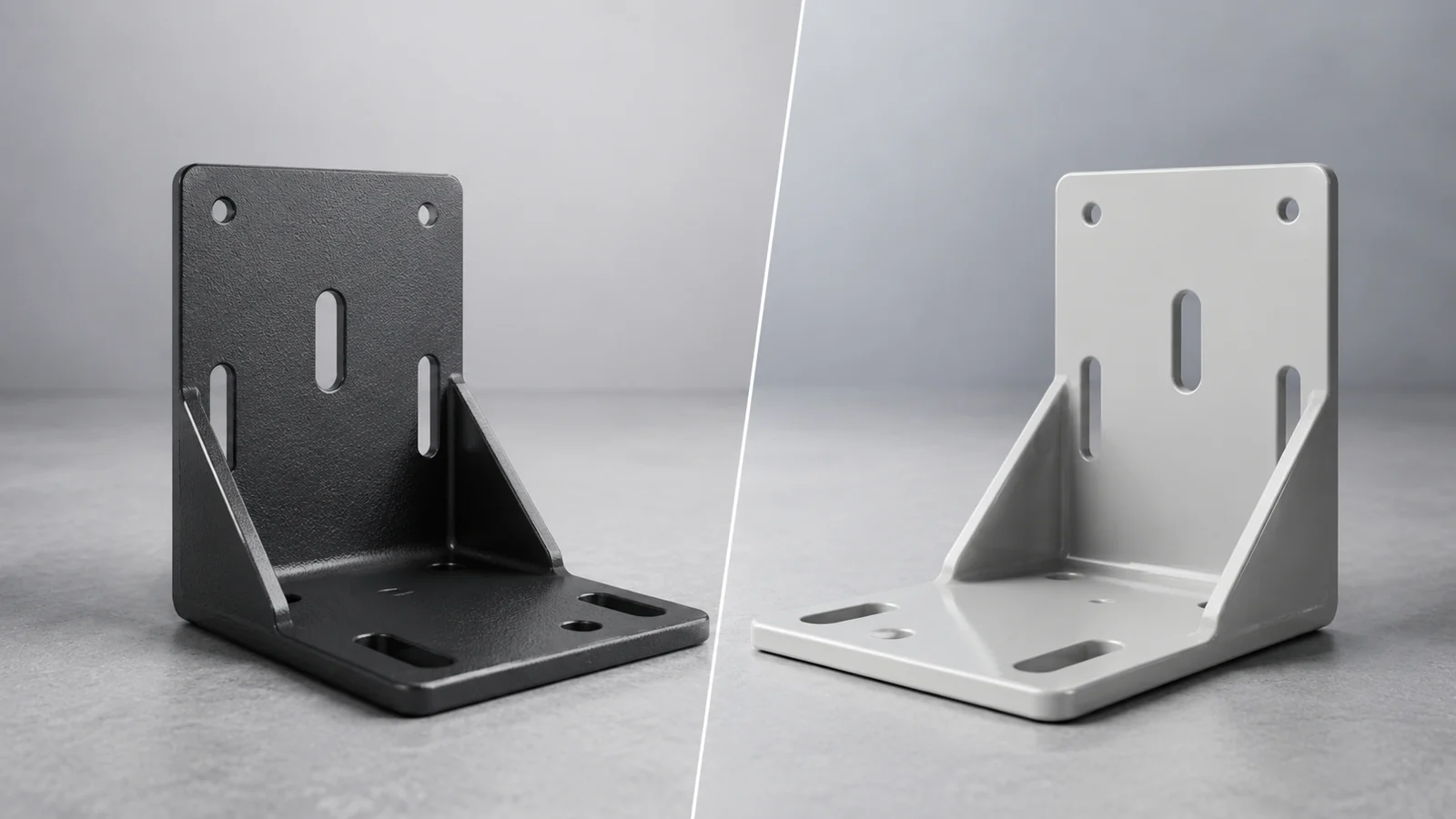
Powder coating and liquid painting are both widely used to protect and decorate CNC metal parts, but they are not interchangeable. Powder coating applies dry, electrically charged particles that are melted and cured into a continuous film. Liquid painting sprays or applies a resin, pigment, solvent, water, and additive system that dries or chemically cures into a coating.
Powder coating is often selected for durable, uniform, high-volume finishes on brackets, housings, frames, panels, guards, and industrial components. Liquid paint is often selected when the project requires thin film, precise color matching, low-temperature curing, local repair, multicolor graphics, or coverage inside features that are difficult to coat electrostatically.
The better finish depends on the base metal, corrosion exposure, operating temperature, UV light, chemical contact, desired texture, coating thickness, dimensional tolerances, grounding areas, masking, part size, annual volume, repair strategy, and cosmetic standard. A powder-coated steel enclosure and a painted magnesium optical housing may both be correct because they face different manufacturing and service requirements.
RapidMFGPro evaluates coated CNC-part projects from a supplier-matching perspective. The review considers the metal grade, pretreatment, geometry, coating chemistry, color, gloss, texture, film thickness, masking, curing temperature, inspection, packaging, and production quantity before identifying suppliers whose machining and finishing capabilities fit the actual project.
This guide compares powder coating and liquid painting for CNC metal parts and explains how engineers, designers, and buyers can select, specify, inspect, and source the more suitable finish.
Which Finish Is Better for CNC Metal Parts?
Powder coating is usually better for durable, efficient, single-color production finishes. Liquid painting is usually better for thin coatings, complex color requirements, lower curing temperatures, and repairable cosmetic surfaces.
Choose Powder Coating for Durable Production Finishes
Powder coating is commonly used on steel and aluminum brackets, housings, enclosures, frames, guards, and machine components. It provides a thick, continuous film with good impact, abrasion, and corrosion performance when pretreatment and curing are controlled.
It becomes especially attractive when parts repeat in consistent batches and the same color or texture is applied to many surfaces.
Choose Painting for Thin or Specialized Finishes
Liquid paint can be applied in thinner films and can support primers, topcoats, clear coats, metallic effects, camouflage, gradients, logos, and localized touch-up.
It is often preferred for prototypes, large assemblies, heat-sensitive parts, complex color systems, and components that require refinishing after service.
Choose by the Dominant Requirement
A project should not select powder coating only because it is durable or select paint only because it is familiar. Film thickness, curing temperature, corrosion system, appearance, repairability, and cost should be considered together.
| Part Requirement | Better Initial Choice | Main Reason |
|---|---|---|
| High-volume steel enclosure | Powder coating | Efficient durable single-color production |
| Thin-tolerance machined housing | Liquid paint | Thinner film is easier to control |
| Outdoor architectural bracket | Polyester powder coating | UV and weathering resistance |
| Multicolor branded component | Liquid paint | Easier masking, graphics, and color transitions |
| Heat-sensitive assembled part | Liquid paint | Lower-temperature cure options |
| Heavy-use machine guard | Powder coating | Thicker impact-resistant film |
What Is Powder Coating?
Powder coating is a dry finishing process in which polymer powder is applied to a grounded metal part and then heated until it melts, flows, and cures into a film.
Dry Powder Material
The coating powder contains resin, pigment, curing agents, flow modifiers, and other additives.
Common resin families include polyester, epoxy, epoxy-polyester hybrid, polyurethane, acrylic, and fluoropolymer systems.
Electrostatic Application
Powder particles receive an electrostatic charge and are attracted to the grounded metal surface.
Part grounding, gun settings, distance, booth airflow, and geometry affect transfer efficiency and coverage.
Thermal Cure
The coated part enters an oven where the powder melts and chemically cures.
The required metal temperature and time depend on the powder formulation and part mass.
What Is Liquid Painting?
Liquid painting applies a fluid coating containing resin, pigment, carrier, and additives. The carrier evaporates or reacts while the resin forms the final film.
Solvent-Borne Paint
Solvent-borne paint uses organic solvents to control viscosity, spray behavior, flow, and drying.
It can provide excellent appearance and broad chemistry options but requires emission and safety controls.
Water-Borne Paint
Water-borne systems use water as a major carrier and can reduce solvent emissions.
Drying, humidity, corrosion control, and substrate preparation still require careful management.
Single- and Two-Component Paint
Single-component paint dries or cures without mixing a separate hardener. Two-component systems combine resin and curing agent before application.
Two-component epoxy and polyurethane paints are common when chemical resistance and durability are required.
How Do the Application Processes Differ?
Powder coating and liquid painting use different equipment, transfer mechanisms, film-building behavior, and cure methods.
Powder Transfer
Powder relies on electrostatic attraction to the grounded part.
Recesses, corners, and shielded areas can receive less powder because of electrostatic field behavior.
Liquid Atomization
Liquid paint is atomized through conventional, HVLP, airless, air-assisted, or electrostatic spray equipment.
Spray angle, viscosity, pressure, operator technique, and booth airflow affect the finish.
Film Formation
Powder melts into a continuous film during cure. Liquid paint flows while solvent or water leaves the coating.
Runs and sags are more common with liquid paint, while orange peel and incomplete melt are common powder concerns.
Overspray Recovery
Uncontaminated powder overspray can often be collected and reused in controlled systems.
Liquid overspray is generally more difficult to recover and creates paint sludge or filter waste.
How Does Film Thickness Compare?
Powder coating usually produces a thicker film than liquid painting. This affects durability, edge coverage, threads, fits, lettering, and small features.
Powder-Coating Thickness
Powder coating commonly creates a robust film that can cover small surface irregularities and protect exposed metal.
Excess thickness can bridge slots, reduce hole size, soften sharp details, and interfere with assembly.
Liquid-Paint Thickness
Liquid painting can create thinner and more finely controlled layers through primers, color coats, and clear coats.
Thin film is useful around engraved features, threads, close fits, and detailed surfaces.
Multiple-Coat Systems
A primer, intermediate coat, topcoat, and clear coat can produce a total liquid-paint thickness similar to or greater than powder coating.
Total dry-film thickness, not the application method alone, should be specified.
How Does Dimensional Change Compare?
Both finishes build outward and can change the fit of precision features. Powder coating usually creates the greater dimensional effect.
External Features
Shafts, bosses, shoulders, and external threads become larger after coating.
Powder buildup can be significant on edges and grounded contact zones.
Internal Features
Bores, slots, grooves, and internal threads become smaller.
Liquid paint may pool inside recesses, while powder can be difficult to drive into deep features.
Tolerance Strategy
Critical dimensions should be masked, machined with allowance, or inspected after finishing.
The drawing should clearly identify dimensions that apply to the final coated part.
How Does Surface Appearance Compare?
Powder coating provides consistent industrial color and texture, while liquid paint offers broader cosmetic effects and finer appearance control.
Powder Appearance
Powder can produce smooth, matte, gloss, textured, wrinkle, hammertone, and metallic finishes.
Thick film can hide minor substrate texture but may reduce visual sharpness.
Paint Appearance
Liquid paint can produce high-gloss automotive finishes, satin industrial finishes, metallic flakes, pearl effects, transparent colors, and layered visual systems.
Skilled spray application and polishing can achieve very high cosmetic quality.
Color Matching
Both systems can be formulated to color standards, but liquid paint is often easier to adjust in small batches and blend during repair.
Approved samples should define color, gloss, texture, and viewing conditions.
How Does Corrosion Resistance Compare?
Corrosion performance depends more on the complete coating system and pretreatment than on powder versus liquid alone.
Powder over Pretreated Metal
Powder coating over zinc phosphate, iron phosphate, zirconium pretreatment, anodizing, or another suitable conversion layer can provide strong corrosion resistance.
Edge coverage, film continuity, and cure remain important.
Liquid Primer and Topcoat
Liquid epoxy primers combined with polyurethane or other topcoats can perform well in marine, industrial, and chemical environments.
Multilayer systems allow each coat to serve a specific function.
Damage Behavior
Both finishes act primarily as barrier coatings. Once scratched to bare steel, corrosion can spread under the film if pretreatment and adhesion are poor.
Zinc-rich primers or galvanized substrates can add sacrificial protection.
Edge and Seam Protection
Sharp edges, welds, seams, and crevices are common corrosion-start locations.
Design, pretreatment, stripe coating, and film thickness should address these areas.
How Does UV Resistance Compare?
UV resistance depends on resin chemistry. Some powder and liquid coatings are designed for outdoor weathering, while others chalk or fade rapidly.
Polyester Powder
Exterior-grade polyester powder is widely used for outdoor equipment, architectural components, and metal furniture.
Super-durable polyester systems provide improved long-term color and gloss retention.
Epoxy Powder
Epoxy powder provides strong adhesion and chemical resistance but generally performs poorly under long-term UV exposure.
It is better suited to indoor or buried service unless protected by another layer.
Polyurethane Liquid Paint
Two-component polyurethane paint is commonly used where exterior color and gloss retention are important.
Primer compatibility and full cure affect performance.
Fluoropolymer Systems
Fluoropolymer powder and liquid coatings serve demanding architectural and weathering applications.
They require qualified application and controlled specifications.
How Does Chemical Resistance Compare?
Resin chemistry, film thickness, cure, temperature, and immersion time determine chemical resistance.
Epoxy Systems
Epoxy powder and liquid epoxy coatings resist many chemicals and provide strong adhesion.
Chemical resistance varies significantly by formulation.
Polyester Systems
Polyester powder performs well in many atmospheric and cleaning environments.
Strong solvents, alkalis, and continuous immersion require testing.
Polyurethane Systems
Polyurethane liquid paint can provide good resistance to fuels, oils, abrasion, and weathering.
The exact hardener and formulation control performance.
Application Testing
Chemical charts provide only initial guidance.
Critical parts should be tested with the actual fluid, concentration, temperature, and exposure duration.
How Does Impact Resistance Compare?
Powder coating often provides a thick and durable film, but liquid coatings can also be formulated for strong impact performance.
Powder Flexibility
Polyester and polyurethane powders can flex with formed metal and resist chipping.
Excessive film thickness or undercure can reduce performance.
Liquid-Coating Flexibility
Flexible primers and topcoats can be selected for vibration, deformation, and impact.
Brittle high-build systems may crack on thin sheet.
Substrate Deformation
Neither coating prevents the metal below from bending or denting.
Severe deformation can crack or delaminate either finish.
How Does Abrasion Resistance Compare?
Powder coating is often perceived as more abrasion resistant because of its thickness, but chemistry and cure determine the actual result.
Powder Wear
Hard polyester, polyurethane, and epoxy powders can resist handling, tools, and moderate sliding contact.
Repeated metal-on-metal wear can still remove the coating.
Liquid Wear
Two-component polyurethane, epoxy, and specialty ceramic-filled liquid coatings can provide strong abrasion resistance.
Thin decorative paints may scratch more easily.
Heavy-Wear Alternatives
Hard anodizing, electroless nickel, PVD, nitriding, hard chrome, or hardened metal may be more suitable for high-contact wear surfaces.
Organic coatings should not carry concentrated bearing loads without validation.
How Does Repairability Compare?
Liquid paint is generally easier to repair, blend, and refinish than powder coating.
Liquid-Paint Touch-Up
Scratched liquid paint can often be sanded, primed, and blended locally.
Color and gloss matching still require skill.
Powder Touch-Up
Powder-coated parts are commonly touched up with matching liquid paint rather than recoated locally with powder.
The repair can remain visible because texture and gloss differ.
Full Recoating
Powder recoating may require stripping, sanding, or applying another full layer.
Repeated oven cycles can affect assemblies, fillers, adhesives, and heat-treated materials.
How Does Cure Temperature Affect Selection?
Powder coating normally requires higher cure temperature than many liquid paints. The complete part and assembly must tolerate the process.
Powder Oven Exposure
Powder suppliers specify a target metal temperature and cure time.
Thick parts heat slowly, while thin parts reach temperature quickly.
Heat-Sensitive Assemblies
Plastic inserts, adhesives, seals, magnets, electronics, bearings, lubricants, and some fillers can be damaged in a powder oven.
These components may need to be installed after coating.
Low-Temperature Liquid Cure
Air-dry, moisture-cure, and low-bake liquid paints support heat-sensitive parts.
Full property development may require longer curing time.
Low-Cure Powder
Lower-temperature powder systems are available for selected applications.
Cure schedule, storage stability, and performance should be confirmed.
Can Curing Change Metal Properties?
Coating cure is usually below the temperature used for major metal heat treatment, but it can still affect certain alloys, stresses, adhesives, and dimensional conditions.
Heat-Treated Aluminum
Long or repeated exposure at elevated temperature can affect the properties of selected aluminum alloys.
Critical aerospace or high-strength parts should review the full thermal cycle.
Hardened Steel
Standard coating cures are generally below steel tempering temperatures, but low-temperature tempering and precision stability should still be considered.
The finish specification should not exceed the allowable process temperature.
Residual Stress
Oven exposure can release machining, welding, forming, or casting stress.
Thin and asymmetric parts may move during cure.
Galvanized Components
Heating galvanized or zinc-rich surfaces can cause outgassing and surface defects.
Pretreatment and powder formulation should match the substrate.
Why Is Pretreatment Important?
Pretreatment often determines whether a coating adheres for years or begins peeling after assembly.
Cleaning
Oil, coolant, polishing compound, silicone, fingerprints, oxide, and dust must be removed.
Contamination creates craters, fisheyes, adhesion loss, and corrosion under the film.
Mechanical Preparation
Abrasive blasting, sanding, brushing, or grinding removes scale and creates a profile for adhesion.
Excessive roughness can remain visible through thin liquid coatings.
Chemical Conversion
Phosphate, zirconium, chromate, non-chromate, anodizing, and other conversion treatments improve adhesion and corrosion resistance.
The correct treatment depends on steel, aluminum, zinc, magnesium, or another substrate.
Rinsing and Drying
Residual salts and trapped water cause blistering, staining, and early corrosion.
Blind holes and seams require complete drainage.
How Should Steel Parts Be Pretreated?
Steel preparation should remove oil, rust, mill scale, welding residue, and contamination before applying powder or liquid paint.
Iron Phosphate
Iron phosphate is widely used for general indoor steel products.
It provides a base for paint but offers less corrosion resistance than stronger pretreatment systems.
Zinc Phosphate
Zinc phosphate provides improved corrosion resistance and paint adhesion for automotive, industrial, and outdoor parts.
Bath control and sludge management are important.
Abrasive Blasting
Blasting is used on welded frames, heavy plate, castings, and rusty steel.
The cleaned part should be coated before flash rust develops.
Zinc-Rich Primer
Zinc-rich liquid primer provides sacrificial protection beneath a compatible topcoat.
Film thickness, cure, and topcoat compatibility should be controlled.
How Should Aluminum Parts Be Pretreated?
Aluminum needs cleaning and oxide control before powder coating or painting.
Degreasing
Machining coolant, fingerprints, polishing compounds, and lubricants are removed.
Silicone contamination is especially difficult to correct.
Etching and Deoxidizing
Controlled etching removes oxide and creates a consistent surface.
Aggressive etching can change dimensions and reveal alloy variation.
Conversion Coating
Chromate and modern non-chromate conversion coatings improve adhesion and corrosion resistance.
Aerospace and electrical projects may require a specific conversion standard.
Anodized Pretreatment
Selected anodized surfaces can support paint or powder when sealing and surface preparation are compatible.
The coating supplier should confirm the approved system.
How Should Stainless Steel Be Pretreated?
Stainless steel can be painted or powder coated, but its smooth passive surface requires careful preparation.
Cleaning
Oil, oxide, polishing compound, and fabrication residue must be removed.
Cleanliness is essential for adhesion.
Abrasive Profile
Light blasting or sanding increases mechanical keying.
Media should not contaminate stainless steel with free iron.
Adhesion Primer
Specialized epoxy, wash, or other primers may improve liquid-paint adhesion.
Powder coating may use compatible chemical pretreatment or primer.
Functional Justification
Stainless steel already resists corrosion, so coating should provide appearance, chemical protection, identification, thermal behavior, or another clear benefit.
How Should Magnesium and Zinc Parts Be Pretreated?
Magnesium and zinc-based parts require substrate-specific preparation because their corrosion and heat behavior differ from steel and aluminum.
Magnesium Parts
Magnesium is highly reactive and needs specialized cleaning, conversion treatment, primer, and controlled handling.
Liquid paint is often selected when low-temperature processing is preferred.
Zinc Die Castings
Zinc die castings can outgas during powder cure and may blister if porosity contains trapped contamination.
Preheating, degassing, compatible powder, or liquid painting may be considered.
Galvanized Steel
Galvanized steel needs cleaning and a pretreatment compatible with the zinc surface.
Duplex zinc plus paint or powder systems can provide long corrosion life.
What Powder Chemistries Are Common?
Powder chemistry controls weathering, chemical resistance, flexibility, appearance, and cure behavior.
Polyester Powder
Polyester is the most common outdoor powder family.
It is used for enclosures, frames, outdoor hardware, furniture, and architectural components.
Epoxy Powder
Epoxy provides strong adhesion, corrosion resistance, and chemical performance.
It is commonly used indoors, as a primer, or on protected industrial components.
Epoxy-Polyester Hybrid
Hybrid powder balances appearance, cost, and indoor performance.
It is common on office furniture, appliances, racks, and interior equipment.
Polyurethane Powder
Polyurethane powder can provide smooth appearance, weathering, and chemical resistance.
Application and cure requirements vary by formulation.
Fluoropolymer Powder
Fluoropolymer powder serves high-performance architectural and weathering applications.
Color range, cure, and qualified application require review.
What Liquid-Paint Chemistries Are Common?
Liquid-paint chemistry should match corrosion, weathering, chemical, appearance, repair, and cure requirements.
Epoxy Paint
Epoxy paint provides strong adhesion, chemical resistance, and barrier protection.
It is widely used as a primer and industrial topcoat but may chalk outdoors.
Polyurethane Paint
Polyurethane provides exterior durability, abrasion resistance, color retention, and high-gloss appearance.
Two-component systems require controlled mixing and worker protection.
Acrylic Paint
Acrylic paint provides color, gloss, rapid drying, and UV resistance in selected systems.
Chemical and wear performance depend on formulation.
Alkyd Paint
Alkyd enamel is economical and easy to apply for general industrial and indoor equipment.
Cure speed and chemical resistance are lower than many two-component systems.
Silicone and High-Temperature Paint
Silicone-based coatings are used on exhaust, ovens, heaters, and high-temperature equipment.
Full performance may require heat curing in service or production.
How Do Complex Geometries Affect Coverage?
Geometry influences line-of-sight access, electrostatic attraction, drainage, film thickness, and curing.
Faraday Cage Effect
Electrostatic powder has difficulty entering deep corners, narrow channels, and shielded recesses because the electric field concentrates at exposed edges.
Gun settings, part orientation, manual touch-up, and conductive primers can improve coverage.
Liquid-Paint Access
Liquid spray can reach recesses more easily when the gun angle is suitable.
Deep cavities can still trap overspray, solvent, and runs.
Internal Passages
Neither ordinary powder coating nor spray painting guarantees uniform internal passage coverage.
Electrophoretic coating, dip coating, electroless plating, or material selection may be more suitable.
Sharp External Edges
Powder can accumulate at edges but may pull away during flow. Liquid coatings can also thin on sharp edges.
Small radii improve corrosion protection.
How Should Holes and Threads Be Managed?
Holes and threads are common coating-failure and assembly-interference locations.
Thread Masking
Internal and external threads are often masked for powder coating.
Thin liquid paint may be allowed on coarse threads when the assembly is validated.
Small Holes
Powder can bridge or reduce small-hole diameter.
Liquid paint can collect and cure inside the hole.
Blind Holes
Blind holes can trap pretreatment chemicals, rinse water, powder, solvent, or wet paint.
Plugs, drainage, and post-process cleaning should be planned.
Final Gauging
Threads and precision holes should be checked after the final finish.
Rework can expose bare metal and require touch-up.
How Should Grounding Areas Be Managed?
Both powder coating and paint are generally electrically insulating. Grounding, bonding, and EMI interfaces need controlled conductive surfaces.
Masking Conductive Pads
Grounding studs, gasket lands, fastener seats, and bonding pads can be masked before coating.
Boundaries should be dimensioned on the drawing.
Post-Coat Removal
Coating can be machined or abraded from selected areas after finishing.
Exposed metal may need corrosion protection.
Conductive Coatings
Specialized conductive paints can support EMI shielding and static control.
Their resistance is higher than solid metal and should be tested in the final assembly.
Assembly Hardware
Star washers, conductive gaskets, plated fasteners, and inserts can penetrate or bypass coating.
Contact reliability should be validated after environmental exposure.
How Should Masking Be Specified?
Masking instructions should identify exact coated and uncoated surfaces, transition zones, plugs, and allowable contact marks.
Masking Drawings
Section views, colored models, and dimensioned boundaries reduce interpretation differences.
Notes such as mask critical areas are not sufficient.
Powder Masking
High-temperature silicone plugs, caps, tapes, hooks, and custom fixtures are common.
Mask materials must tolerate pretreatment and oven cure.
Paint Masking
Tapes, liquid masks, plugs, fixtures, and removable films can be used.
Solvent resistance and clean edge release are important.
Transition Quality
Powder can create a raised edge at the mask boundary. Liquid paint may create feathering, ridges, or undercut.
Acceptable transition width should be defined.
How Should CNC-Milled Parts Be Finished?
CNC-milled housings, brackets, plates, manifolds, covers, and fixtures use both powder coating and liquid painting.
Large Flat Faces
Powder provides uniform industrial coverage but can show orange peel under angled light.
Liquid paint can provide a smoother automotive-style finish with skilled application.
Deep Pockets
Powder may have difficulty entering electrostatically shielded pockets.
Liquid paint offers better line-of-sight penetration but can run in corners.
Precision Datums
Locating faces, bearing seats, and sealing surfaces should normally be masked.
Final dimensions should be inspected after cure.
Engraved Markings
Thick powder can partially fill shallow engraving.
Liquid paint, laser marking, or post-coat engraving may preserve fine detail better.
How Should CNC-Turned Parts Be Finished?
Turned knobs, sleeves, spacers, fittings, barrels, and shafts are sensitive to film buildup, concentricity, and masking.
Cylindrical Cosmetic Parts
Powder coating creates durable uniform color on knobs and sleeves.
Hanging orientation can create hook marks or thicker lower edges.
Precision Diameters
Bearing, seal, and mating diameters should be masked or finish machined.
Liquid paint creates less buildup but still changes size.
Knurled Surfaces
Powder can soften the sharpness of fine knurls.
Thin paint or uncoated grip areas may preserve texture better.
Threaded Ends
Thread plugs and caps are commonly used during powder coating.
Final thread assembly should be verified after masking removal.
How Should Sheet-Metal Parts Be Finished?
Sheet-metal enclosures, panels, guards, covers, and brackets are among the most common powder-coated and painted parts.
Powder-Coated Enclosures
Powder coating provides durable color and efficient batch production for electrical, industrial, and machine enclosures.
Grounding areas and PEM hardware require masking or assembly planning.
Painted Panels
Liquid paint supports graphics, multiple colors, fine gloss control, and field repair.
Large panels require control of dust, runs, and spray overlap.
Bend and Edge Coverage
Sharp sheared edges and bend corners are common corrosion points.
Deburring, radiusing, pretreatment, and film coverage are important.
Hardware Installation
Press-in hardware may be installed before or after coating.
Installation after coating can damage the finish, while installation before coating may interfere with grounding or threads.
How Should Welded Assemblies Be Finished?
Welded frames, guards, carts, bases, and machine structures require cleaning, smoothing, drainage, and oven-size review.
Weld Cleaning
Slag, spatter, oxide, smoke residue, and grinding dust must be removed.
Poorly cleaned welds create fisheyes, pinholes, and early corrosion.
Sealed Tubes
Closed tubes can trap air, liquid, or oil and may expand during oven cure.
Vent and drain holes reduce pressure and chemical entrapment.
Large Assembly Size
Powder coating is limited by booth and oven dimensions.
Liquid paint can be applied to much larger field or shop assemblies.
Weld Appearance
Powder hides some minor texture but does not level poor grinding.
Liquid primer and filler systems can provide more surface correction.
How Do Castings Affect Finish Quality?
Aluminum, magnesium, zinc, and iron castings can contain porosity that releases gas during cure and creates defects.
Outgassing
Trapped gas expands in the coating oven and forms pinholes or bubbles.
Preheating, degassing cycles, outgas-forgiving powder, and sealing treatments may help.
Porous Surface
Liquid paint can soak into pores and create bubbles, solvent popping, or uneven gloss.
Sealer or primer may be required.
Machined and As-Cast Areas
Machined faces and as-cast faces absorb and reflect coatings differently.
Cosmetic standards should account for texture variation.
Impregnated Castings
Sealants used for porosity impregnation must tolerate cleaning and cure.
Compatibility should be confirmed before coating.
How Do Color and Gloss Requirements Affect Selection?
Color and gloss targets should be specified using standards and approved production-representative samples.
Standard Powder Colors
Stock powder colors reduce cost and lead time.
Custom powder requires minimum batch quantities and may create leftover inventory.
Custom Liquid Colors
Liquid paint can be mixed in smaller quantities and adjusted during color matching.
Small batch variation still requires control.
Gloss Measurement
Gloss can be measured instrumentally at a defined angle.
Surface texture affects the reading.
Metallic and Textured Effects
Powder metallics can show orientation and batch variation. Liquid metallic paint can show mottling and spray-pattern variation.
Application method should remain consistent for assembled cosmetic sets.
Which Finish Is Better for Outdoor Parts?
Exterior-grade polyester powder and liquid polyurethane systems are both strong choices for outdoor metal parts.
Outdoor Powder Coating
Polyester powder provides efficient one-coat exterior protection for brackets, furniture, enclosures, railings, and equipment.
Severe environments may require a primer or galvanized substrate.
Outdoor Liquid Painting
Epoxy primer plus polyurethane topcoat provides a flexible multilayer system for industrial and marine equipment.
It is easier to repair in the field.
Long-Term Weathering
Resin quality, film thickness, pretreatment, color, orientation, and maintenance control service life.
Outdoor should not be treated as one uniform exposure category.
Which Finish Is Better for Indoor Parts?
Both systems perform well indoors, so cost, appearance, process flow, and repairability become more important.
Indoor Powder Coating
Epoxy-polyester hybrid powder is economical for racks, office furniture, appliances, machine guards, and equipment.
It provides good appearance and durability without premium outdoor resin.
Indoor Liquid Painting
Acrylic, alkyd, epoxy, and polyurethane paints are used for instruments, machines, panels, prototypes, and decorative parts.
Air-dry options reduce oven requirements.
Frequently Handled Parts
Powder coating often resists handling better than economical single-component paint.
High-performance two-component paint can provide comparable durability.
Which Finish Is Better for Precision Parts?
Liquid paint is often easier to use on tightly toleranced parts because it can be applied more thinly, but either finish requires masking and final inspection.
Close Fits
Bearing seats, dowel holes, threads, and sliding surfaces should remain uncoated.
Powder overspray and raised mask edges can interfere with fits.
Fine Engraving
Thin liquid coating preserves text and graduation marks more easily.
Laser marking after coating can create durable identification.
Flatness and Distortion
Thin parts may warp during powder cure.
Low-temperature paint can reduce thermal movement.
Which Finish Is Better for Prototypes?
Liquid painting is often more practical for prototypes because it supports low quantity, fast color change, touch-up, and limited tooling.
One-Off Color
Small liquid batches are easier to mix than custom powder quantities.
Stock aerosol or industrial paint may support early visual evaluation.
Design Changes
Painted parts can be sanded, modified, and refinished.
Powder-coated parts are more difficult to repair invisibly.
Production Validation
A painted prototype should not be used to approve powder-coating color, gloss, thickness, or texture.
Production-intent samples should use the final coating process.
Which Finish Is Better for High Volume?
Powder coating is frequently more efficient for high-volume single-color production, although automated liquid lines can also be highly productive.
Transfer Efficiency
Reclaim systems can reuse clean powder overspray.
Color changes reduce recovery efficiency and require booth cleaning.
Automation
Powder guns and liquid robots can both be automated.
Part hanging, grounding, line speed, cure, and inspection should be designed together.
Color Change Frequency
Frequent small color batches can reduce powder-line efficiency.
Flexible liquid booths may handle varied colors more easily.
Reject and Rework Cost
High-volume coating decisions should include stripping, rework, masking labor, and cosmetic reject rates.
Lowest application cost does not always produce the lowest delivered-part cost.
How Does Environmental Compliance Compare?
Powder coating generally produces low volatile-organic-compound emissions, while liquid paint requirements depend on solvent content and application method.
Powder Emissions
Powder contains little or no conventional solvent and can reduce VOC emissions.
Dust collection, explosion control, worker exposure, and waste management remain necessary.
Liquid VOC Control
Solvent-borne paint releases VOCs during application and cure.
Water-borne, high-solids, exempt-solvent, and low-VOC systems can reduce emissions.
Hazardous Pigments and Additives
Both powder and liquid coatings can contain regulated pigments, catalysts, or additives.
Product safety data and destination-market requirements should be reviewed.
Waste Streams
Pretreatment sludge, filters, masking materials, cleaning chemicals, and rejected coating create waste in both systems.
Environmental comparison should include the complete process, not only the topcoat.
How Does Cost Compare?
Cost depends on part size, quantity, color, masking, pretreatment, film system, cure, inspection, and rework.
Powder Material Efficiency
Powder reclaim can reduce material loss during long single-color production.
Custom colors and frequent changeovers increase cost.
Liquid Material Flexibility
Liquid paint can be mixed in small batches and applied without a powder-reclaim system.
Solvent, filters, spray waste, ventilation, and longer multilayer labor add cost.
Equipment and Oven Cost
Powder coating requires electrostatic equipment and an oven large enough for the part.
Liquid paint may air dry or use a lower-temperature booth and oven.
Life-Cycle Cost
Durable powder coating may reduce repainting, while repairable liquid paint may reduce field-service cost.
The service and maintenance plan should guide the comparison.
| Selection Factor | Powder Coating | Liquid Painting |
|---|---|---|
| Typical film thickness | Moderate to high | Thin to high through multiple coats |
| Production efficiency | Strong for repeated single colors | Strong for flexible colors and complex systems |
| Heat requirement | Usually oven cure | Air dry, low bake, or oven cure |
| Field repair | More difficult to match | Easier to blend and touch up |
| Fine-feature preservation | More risk of filling details | Better with thin film |
| VOC emissions | Generally low | Depends on paint chemistry |
| Typical application | Enclosures, guards, frames | Prototypes, vehicles, instruments |
What Powder-Coating Defects Commonly Occur?
Powder defects can come from contamination, poor grounding, electrostatic behavior, film thickness, outgassing, and incorrect cure.
Orange Peel
Orange peel creates a textured surface rather than a smooth flow.
Powder formulation, film thickness, cure, and part temperature influence the effect.
Pinholes
Gas escaping from porous castings, welds, galvanized steel, or contamination creates small holes.
Preheating and outgas-resistant powder may help.
Poor Coverage
Faraday areas, poor grounding, incorrect gun settings, and complex geometry can create thin or bare areas.
Manual reinforcement may be required.
Overbake and Underbake
Undercure reduces adhesion, hardness, and chemical resistance. Overbake can discolor the film and affect appearance.
Actual metal temperature should be measured.
Back Ionization
Excess electrostatic charge can create rough, crater-like defects in thick powder areas.
Voltage, gun distance, and film buildup should be controlled.
What Painting Defects Commonly Occur?
Liquid-paint defects often involve viscosity, solvent release, contamination, airflow, flash time, application technique, and cure.
Runs and Sags
Excess wet film flows downward before it sets.
Viscosity, gun distance, pass speed, and flash time should be adjusted.
Fisheyes
Silicone, oil, wax, and other low-surface-energy contamination create circular craters.
Cleaning and contamination segregation are critical.
Solvent Popping
Trapped solvent escapes during rapid cure and creates bubbles or pinholes.
Film thickness, flash time, and oven temperature should be controlled.
Dry Spray
Paint can partially dry before reaching the surface and create rough texture.
Gun distance, airflow, solvent blend, and booth temperature affect the result.
Color Mottling
Metallic pigments can orient unevenly and create patches or stripes.
Spray technique and flash control are important.
Why Do Coatings Peel?
Peeling is usually an adhesion-system failure involving contamination, weak pretreatment, incompatible layers, poor cure, or substrate corrosion.
Contaminated Metal
Oil, silicone, polishing compound, rust, and soluble salts prevent strong adhesion.
Visual cleanliness alone is not enough.
Incompatible Primer and Topcoat
A topcoat can attack, soften, or poorly bond to the primer beneath it.
Coating systems should be approved as a complete stack.
Incorrect Cure
Undercured powder or liquid paint lacks final mechanical and chemical properties.
Excess cure can embrittle or discolor some films.
Corrosion Underfilm
Moisture entering through a scratch or edge can spread beneath poorly adhered coating.
Pretreatment and edge design reduce underfilm corrosion.
How Are Coatings Inspected?
Inspection should confirm material identity, surface preparation, thickness, color, gloss, adhesion, cure, coverage, dimensions, and cosmetic quality.
Visual Inspection
Inspect runs, sags, orange peel, pinholes, dust, fisheyes, scratches, bare areas, color variation, and mask quality.
Cosmetic zones should have defined lighting, distance, and viewing angle.
Film-Thickness Measurement
Magnetic or eddy-current instruments are commonly used on steel and non-ferrous metal.
Measurement locations should represent flat faces, edges, recesses, and critical features.
Adhesion Testing
Cross-cut, pull-off, bend, impact, or customer-specific methods may be used.
The test method should match film thickness and substrate.
Gloss and Color Measurement
Gloss meters and color instruments can provide numerical control.
Texture and metallic effects complicate measurement.
Cure Verification
Solvent rub, hardness, impact, differential scanning, oven profiling, or other methods may be used.
Actual cure should be verified for thick or heavy parts.
Corrosion Testing
Salt spray, humidity, cyclic corrosion, immersion, and field testing serve different purposes.
A laboratory hour rating should not be treated as a direct outdoor-life guarantee.
How Should Coated Parts Be Packaged?
A correct coating can still be damaged by stacking, vibration, abrasion, pressure, moisture, and uncured packing.
Cure Before Packing
Liquid paint must reach sufficient handling strength before wrapping or stacking.
Soft film can print packaging texture onto the surface.
Part Separation
Foam, tissue, dividers, bags, and custom trays prevent metal-to-metal contact.
Packaging materials should not stain or react with the coating.
Edge Protection
Corners and hooks experience concentrated pressure during transport.
Caps and formed protection reduce chipping.
Humidity Control
Moisture trapped in packaging can attack damaged coating and exposed masked areas.
Dry packing and desiccants may be required.
What Should Be Specified on the Drawing?
A coating drawing should define the complete system rather than state only powder coat or paint.
Coating Chemistry
State polyester, epoxy, hybrid, polyurethane, acrylic, fluoropolymer, or another approved chemistry.
Chemistry should match outdoor, chemical, and heat requirements.
Color, Gloss, and Texture
Reference an accepted color standard and approved sample.
State smooth, fine texture, wrinkle, matte, satin, or gloss requirements.
Film Thickness
State the required dry-film range.
Multicoat systems should identify each layer and total thickness.
Pretreatment
Specify blasting, phosphating, conversion coating, anodizing, primer, or another required preparation.
Pretreatment should not be left entirely to appearance-based interpretation.
Masking
Identify threads, grounding pads, sealing surfaces, bearing fits, and cosmetic boundaries.
Acceptable mask transitions should be shown.
Inspection Standard
Define thickness, adhesion, cure, color, gloss, corrosion, and visual acceptance.
Final dimensions should be identified.
What Should Be Included in the RFQ?
A complete RFQ allows machining and coating suppliers to quote the same substrate, finish, quantity, masking, quality, and delivery scope.
Base Material
State metal grade, temper, heat treatment, casting type, galvanizing, and existing surface condition.
Pretreatment depends on the substrate.
Service Environment
Describe indoor, outdoor, UV, marine, chemical, abrasion, temperature, and cleaning exposure.
This determines resin and pretreatment.
Quantity and Color Mix
State prototype quantity, production quantity, annual demand, and number of colors.
Color change frequency affects line cost.
Cosmetic Requirement
Identify Class A surfaces, hidden faces, approved samples, and allowed defects.
General notes such as high-quality finish are not sufficient.
Documentation
Specify certificates, batch records, film-thickness reports, cure records, adhesion tests, color readings, and corrosion reports.
How Does RapidMFGPro Evaluate the Finish Choice?
RapidMFGPro evaluates powder coating and painting by connecting service conditions, geometry, substrate, appearance, process temperature, inspection, and supplier capabilities.
Application Review
The review begins with corrosion, UV, chemicals, impact, abrasion, appearance, repair, and service life.
This determines whether powder or liquid coating is the stronger starting point.
Substrate Review
Steel, aluminum, stainless steel, magnesium, zinc, galvanized metal, and castings require different pretreatment.
Heat sensitivity and outgassing risk are considered.
Geometry Review
Recesses, threads, holes, grounding surfaces, cosmetic faces, welds, and masking transitions are reviewed.
This reduces coverage and assembly problems.
Supplier Matching
Suppliers are compared according to pretreatment line, powder or liquid chemistry, booth and oven size, color control, masking, low-temperature cure, inspection, and batch capacity.
A supplier suitable for standard black powder-coated brackets may not be suitable for automotive-class metallic liquid paint or fluoropolymer architectural coatings.
Quality Review
The quality review confirms film thickness, cure, adhesion, color, gloss, corrosion, masking, dimensions, handling, and packaging.
The agreed scope should be documented before production.
How Should Supplier Capability Be Evaluated?
Coating quality depends on pretreatment, application equipment, cure control, operator skill, inspection, contamination control, and traceability.
Pretreatment Capability
The supplier should use a pretreatment suitable for the exact substrate and environment.
Simple solvent wiping is not equivalent to a controlled conversion process.
Booth and Oven Size
Parts must fit the coating booth, wash line, oven, and handling system without contact damage.
Heavy parts need sufficient cure time to reach metal temperature.
Color-Control Capability
Cosmetic projects require controlled powder lot, paint mixing, spray method, lighting, gloss, and sample retention.
Metallic colors need additional process consistency.
Contamination Control
Silicone, dust, oil, fibers, and incompatible powder colors can contaminate the finish.
Booth cleaning and product segregation should be reviewed.
Inspection Equipment
Film-thickness gauges, color meters, gloss meters, adhesion tools, cure checks, and corrosion testing may be required.
Outsourced testing should be disclosed when documentation is critical.
How Should the Final Decision Be Made?
The final choice should be based on the complete part and supply process rather than one coating property.
Start with Environment
Define indoor, outdoor, UV, humidity, chemical, marine, and heat exposure.
Select resin chemistry before selecting application method.
Check Geometry and Tolerance
Deep recesses, fine threads, engraving, small holes, and close fits often favor thin liquid coating or selective masking.
Broad open surfaces suit powder coating well.
Check Cure Temperature
Heat-sensitive assemblies and dimensionally unstable parts may favor liquid paint.
Bare metal fabrications usually tolerate powder cure.
Check Appearance and Repair
Powder is efficient for consistent single-color industrial finishes.
Liquid paint is better for high-end visual effects, graphics, and touch-up.
Check Quantity
Repeated high-volume parts often favor powder coating.
Low-volume, custom-color, and frequently changing projects often favor liquid paint.
| CNC Part Scenario | Recommended Starting Point | Main Control |
|---|---|---|
| Steel machine guard | Powder coating | Pretreatment and edge coverage |
| Aluminum electronics enclosure | Powder or liquid paint | Grounding masks and thermal cure |
| Prototype optical housing | Liquid paint | Thin film and color flexibility |
| Outdoor steel bracket | Polyester powder | UV resistance and corrosion pretreatment |
| Large welded machine frame | Powder or liquid paint | Oven size, repair, and transport |
| Automotive cosmetic component | Liquid paint | High-gloss color and layered finish |
Frequently Asked Questions
These questions address common decisions when comparing powder coating and painting for CNC metal parts.
Is Powder Coating More Durable Than Paint?
It is often more durable than economical single-component paint, but high-performance epoxy and polyurethane paint systems can equal or exceed many powder coatings in selected environments.
Is Powder Coating Better Outdoors?
Exterior-grade polyester powder performs well outdoors. Epoxy powder generally does not retain appearance well under UV exposure.
Can Powder Coating Be Applied Thinly?
Thin-film powders exist, but standard powder is generally thicker than liquid paint and may not suit very fine features.
Can Powder-Coated Parts Be Repaired?
Yes, but local repairs are usually made with liquid touch-up paint and may not match the original texture exactly.
Can Paint Be Applied over Powder Coating?
Yes, after compatible cleaning, sanding, and primer when required. Adhesion should be tested.
Can Powder Coating Be Applied over Anodized Aluminum?
Yes, when the anodized surface and sealing condition are compatible with the coating system and pretreatment.
Does Powder Coating Affect Threads?
Yes. The film can fill or bridge threads, so threaded features are commonly plugged or masked.
Which Finish Is Cheaper?
Powder is often economical for repeated single-color batches. Liquid paint may be cheaper for prototypes, custom colors, large assemblies, or heat-sensitive parts.
Conclusion
Powder coating is usually the better finish for durable, efficient, repeated single-color production on open metal geometry. Liquid painting is usually better for thin films, high-end appearance, custom colors, low-temperature curing, complex coating stacks, and field repair. The correct decision depends on substrate, pretreatment, corrosion, UV, chemicals, film thickness, masking, curing temperature, geometry, quantity, inspection, and packaging. RapidMFGPro supports this selection by reviewing the actual part requirements and matching the project with suppliers whose pretreatment, powder coating, liquid painting, color control, curing, testing, and quality capabilities fit the CNC metal part.
Need Help Reviewing a Custom Part?
Share your CAD file and requirements to request supplier matching. Supplier capability and commercial terms must be verified before order placement.
Request Supplier Match