Time to read: 8 min
What Is Electropolishing? When Should You Use It for Stainless Steel Parts?
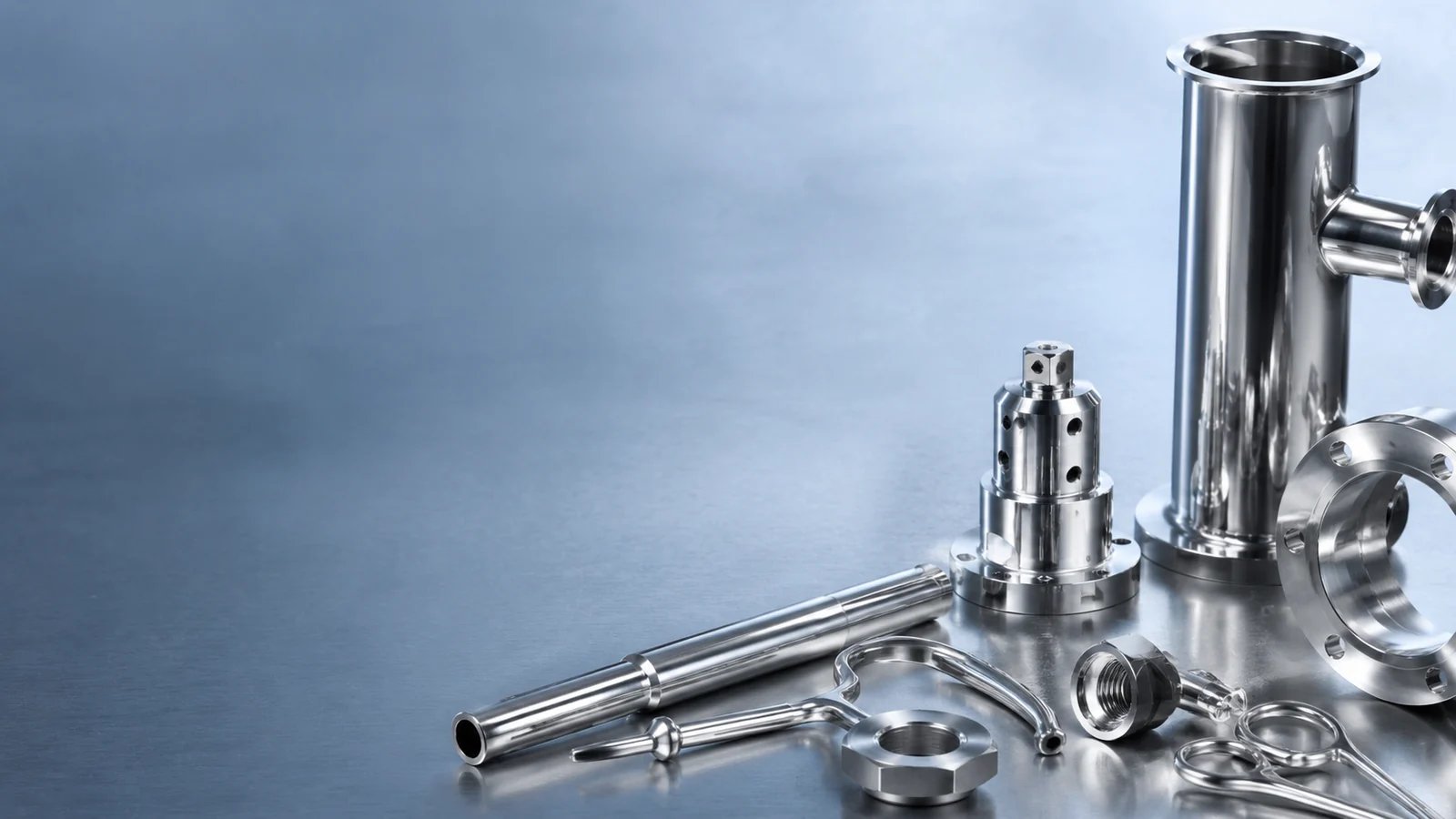
Electropolishing is often described as the reverse of electroplating, but that comparison only explains part of the process. In electroplating, metal is deposited onto a component. In electropolishing, a controlled amount of metal is removed from the component’s surface through an electrochemical reaction.
For stainless steel CNC parts, this controlled removal can smooth microscopic peaks, reduce embedded contamination, improve cleanability, brighten the surface, and support a more corrosion-resistant passive condition. These benefits make electropolishing valuable for medical devices, pharmaceutical equipment, food-processing parts, fluid-control components, semiconductor equipment, laboratory instruments, and other products where surface quality matters.
However, electropolishing is not automatically the best finishing method for every stainless steel component. It removes material rather than adding a protective coating. It can round sharp edges, enlarge holes, reduce external dimensions, expose inclusions, and produce uneven results on poorly designed geometry. It also cannot erase deep scratches, repair pits, correct machining chatter, or make an unsuitable stainless steel grade resistant to an aggressive environment.
The practical question is therefore not simply whether electropolishing makes stainless steel shiny. Engineers should ask whether controlled electrochemical material removal solves the specific surface problem without compromising dimensions, geometry, or function.
This guide explains how electropolishing works, when stainless steel CNC parts benefit from it, how it differs from passivation and mechanical polishing, which features need dimensional allowance, how finished parts are inspected, and how to specify the process on a drawing.
What Surface Problems Can Electropolishing Solve?
Electropolishing should be selected according to the problem on the finished surface. Some projects need lower microscopic roughness. Others need improved cleaning, removal of free iron, a more uniform appearance, or a controlled passive surface. These goals overlap, but they are not identical.
Microscopic Peaks and Difficult-to-Clean Surfaces
A CNC-machined stainless steel surface contains microscopic peaks and valleys even when it appears smooth to the eye. Tool feed marks, grinding lines, and polishing marks create directional texture that can retain:
- Machining coolant
- Cleaning chemicals
- Fine particles
- Biological residue
- Product residue
- Corrosive deposits
During electropolishing, current density is normally higher at projecting surface peaks. These peaks dissolve faster than recessed areas, producing microscopic leveling. The result can be a smoother surface that is easier to rinse and inspect.
The process does not make every surface perfectly flat. It reduces fine-scale texture but does not remove large waves, deep feed marks, dents, or major geometric deviations.
Free Iron and Manufacturing Contamination
Stainless steel parts can pick up free iron from shared tooling, carbon-steel fixtures, grinding dust, wire brushes, workbenches, transport racks, and contaminated washing systems.
ASTM B912-26 states that, under proper electropolishing conditions, free iron is removed and surface passivation occurs simultaneously. The standard covers 200-, 300-, and 400-series stainless steels as well as precipitation-hardening alloys.
This makes electropolishing useful when a project requires both surface smoothing and removal of iron contamination. If the only requirement is free-iron removal with minimal material loss and no surface-brightness target, chemical passivation may be the more efficient choice.
Surface Conditions That Electropolishing Cannot Repair
Electropolishing should not be treated as a rescue process for poor machining. It cannot reliably correct:
- Deep scratches
- Heavy chatter marks
- Large burrs
- Pits or porosity
- Dents and handling damage
- Incorrect dimensions
- Waviness or distortion
- Cracks
- Severe weld undercut
Because the process removes metal from the complete exposed surface, a deep defect may remain visible even after surrounding material has been dissolved. In some cases, electropolishing makes inclusions, porosity, or subsurface defects more visible.
| Surface condition | Can electropolishing help? | Important limitation |
|---|---|---|
| Fine CNC tool marks | Often | Improvement depends on starting roughness and removal amount |
| Microscopic burrs | Often | Large burrs must be mechanically removed first |
| Embedded free iron | Yes, under a qualified process | Post-process recontamination must still be prevented |
| Deep scratch | Usually not completely | May require grinding or mechanical polishing first |
| Machining chatter | Limited improvement | Electropolishing does not correct the machining process |
| Rust from unsuitable alloy selection | No | Surface finishing cannot replace the correct stainless grade |
| Weld heat tint | Can be removed under a suitable process | Heavy scale may require preparation before electropolishing |
| Internal cleanliness concern | Potentially | Electrolyte access and rinsing must be demonstrated |
What Is Electropolishing?
Electropolishing is an electrochemical metal-removal process. The stainless steel component is connected as the anode in an electrical circuit and immersed in a suitable electrolyte. A cathode is positioned in the solution, and direct current is applied under controlled conditions.
ISO 15730:2023 defines requirements and test methods for electropolishing as a means of smoothing and passivating stainless steel alloys. ASTM B912-26 similarly addresses passivation of stainless steels through electropolishing.
The Stainless Steel Part Becomes the Anode
In an electropolishing cell:
- The stainless steel part is the anode
- A separate conductive component serves as the cathode
- The electrolyte completes the electrical path
- Direct current drives controlled dissolution from the part
The process is therefore fundamentally different from abrasive polishing. No wheel or abrasive belt physically contacts every treated surface. Instead, the surface reacts electrochemically wherever current and electrolyte are available.
Surface Peaks Dissolve Faster Than Valleys
The electric field and transport conditions tend to concentrate removal on projecting micro-peaks. This preferential dissolution can reduce microscopic roughness and soften very small sharp projections.
The leveling action has limits. Electropolishing is most effective on fine-scale surface texture. It cannot economically remove enough metal to correct a deep groove without also changing surrounding dimensions.
Smoothing and Passivation Occur Together
Proper electropolishing removes free iron and leaves a chemically clean stainless steel surface capable of forming a chromium-rich passive oxide. ASTM B912-26 notes that surface smoothing also contributes to improved corrosion resistance because fewer irregularities remain to trap contaminants or initiate localized attack.
This does not mean electropolishing creates a thick protective layer. The passive oxide remains extremely thin. The main physical change is controlled removal and leveling of the stainless steel surface.
When Should You Use Electropolishing for Stainless Steel Parts?
Electropolishing offers the greatest value when several surface requirements must be achieved at the same time. It is often selected not for one isolated benefit but for a combination of cleanability, corrosion performance, appearance, and micro-level deburring.
Use It When Cleanability Is a Functional Requirement
Electropolishing is a strong candidate when the component must be repeatedly cleaned, sterilized, flushed, or exposed to high-purity fluids.
Examples include:
- Medical fluid fittings
- Pharmaceutical manifolds
- Food-filling nozzles
- Laboratory instrument parts
- Semiconductor fluid components
- Bioprocess equipment fittings
- High-purity valve components
A smoother surface can reduce locations where residue remains after cleaning. However, hygienic performance also depends on geometry. A bright surface cannot compensate for dead legs, blind cavities, crevices, poor drainage, or inaccessible joints.
Use It When Fine Burrs and Sharp Micro-Edges Are a Problem
Electropolishing can reduce small burrs and soften microscopic edges that remain after machining. This is useful for parts with:
- Small cross-drilled holes
- Fine slots
- Laser-cut edges
- Thin stainless features
- Wire forms
- Perforated components
- Miniature valve or instrument parts
Large burrs must still be removed mechanically. If a burr can bend, break off, or interfere with assembly before electropolishing, it should not be left for the chemical process to solve.
Use It When Appearance and Corrosion Performance Both Matter
Electropolishing usually produces a bright, clean, reflective appearance while supporting passivation. It may be suitable for exposed instrument components, food equipment, medical hardware, architectural fittings, and premium mechanical assemblies.
Appearance should still be defined through an approved sample or measurable criteria. The final brightness depends on alloy, initial finish, surface direction, prior grinding, removal amount, geometry, and process control.
| Project requirement | Is electropolishing a strong candidate? | Alternative to consider |
|---|---|---|
| Remove free iron only | Possible, but may be more process than needed | Chemical passivation |
| Reduce microscopic roughness | Yes | Mechanical polishing, lapping, or improved machining |
| Create a bright stainless appearance | Often | Mechanical polishing |
| Remove large burrs | No | Mechanical, thermal, or abrasive deburring |
| Improve high-purity cleanability | Often | Depends on required surface specification |
| Add wear-resistant coating | No | PVD, hard coating, nitriding, or material change |
| Improve corrosion resistance without changing dimensions | Possibly, but removal must be considered | Chemical passivation |
| Hide deep defects | No | Repair, refinish, or reject the part |
When Is Electropolishing the Wrong Choice?
Electropolishing adds cost and removes material. It should not be specified automatically whenever a stainless steel part needs a clean surface.
When Tight Dimensions Cannot Tolerate Material Removal
Because electropolishing dissolves exposed metal, it can affect:
- External diameters
- Internal diameters
- Thread form
- Sharp corners
- Thin walls
- Small holes
- Seal lands
- Precision fits
Parts with extremely tight finished tolerances may require machining allowance, masking, selective processing, post-process sizing, or a different finish.
If dimensional change cannot be accepted and only free-iron removal is required, passivation is usually less disruptive.
When the Main Requirement Is Wear Resistance
Electropolishing does not add a hard or low-friction layer. It can smooth the surface, but it does not make stainless steel substantially harder.
For sliding, abrasive, or heavily loaded parts, the project may need:
- A harder stainless grade
- Heat treatment
- PVD coating
- Nitriding
- Hard chrome or another engineered coating
- Lubrication
- A different mating material
A smoother electropolished surface may influence friction or cleanability, but it should not be described as a wear-resistant coating.
When Geometry Prevents Uniform Current and Rinsing
Electropolishing may be difficult to control in:
- Deep narrow bores
- Long internal channels
- Blind holes
- Closely spaced assemblies
- Overlapping joints
- Crevices
- Parts with poor drainage
Special cathodes, agitation, flow, fixturing, disassembly, or masking may be required. If the processor cannot demonstrate uniform treatment and complete rinsing, electropolishing may introduce more risk than benefit.
How Does Electropolishing Affect Dimensions and Tolerances?
Dimensional planning is one of the most important differences between electropolishing and chemical passivation. Passivation is not intended to remove significant base metal. Electropolishing intentionally removes metal.
External Features Become Smaller and Internal Features Become Larger
When all surfaces are exposed uniformly:
- An external diameter becomes smaller
- An internal bore becomes larger
- A slot becomes wider
- A thin wall becomes thinner
- A sharp edge becomes more rounded
The actual change depends on current density, time, electrolyte, alloy, temperature, geometry, cathode placement, and starting surface condition. The removal should therefore be based on the finishing supplier’s validated capability rather than a generic internet value.
Edges and Projections Can Lose Material Faster
Current density can concentrate at sharp edges, corners, and projecting features. These areas may round faster than broad flat surfaces.
Features requiring special attention include:
- Knife edges
- Thread crests
- Thin ribs
- Small pins
- Fine serrations
- Sharp sealing edges
- Precision locating corners
If an edge must remain sharp for cutting, sealing, alignment, or optical function, electropolishing may be unsuitable or the feature may need masking and qualification.
Final Dimensions Must Be Defined After Electropolishing
A drawing should identify whether critical dimensions apply before or after electropolishing. For precision parts, the normal engineering objective is to machine the component so that it meets the required dimension after the validated removal amount.
The tolerance stack should include:
- Machining variation
- Expected average electropolishing removal
- Variation in removal across the part
- Final inspection uncertainty
| Feature | Electropolishing effect | Common engineering response |
|---|---|---|
| External shaft | Diameter decreases | Machine oversize based on validated removal |
| Precision bore | Diameter increases | Machine undersize, mask, or finish afterward |
| Internal thread | Thread form and pitch diameter can change | Mask, compensate, or inspect with functional gauge |
| External thread | Thread crests and pitch diameter reduce | Use allowance or protect the thread |
| Thin wall | Wall thickness decreases | Confirm minimum finished thickness |
| Knife edge | Edge rounds rapidly | Mask or avoid electropolishing |
| O-ring groove | Width, depth, and edge radius may change | Evaluate finished seal geometry |
| Cross-drilled hole | Edge may deburr and opening may enlarge | Validate with sample parts |
| Datum surface | Surface position changes slightly | State that inspection applies after finishing |
| Cosmetic face | Brightness can vary with current distribution | Define acceptable sample and rack location |
How Does Electropolishing Affect Surface Roughness?
Electropolishing can reduce microscopic surface roughness, but the result cannot be predicted from process time alone. Starting texture, machining direction, alloy structure, removal amount, and measurement method all matter.
Ra Can Improve Without Removing Deep Tool Marks
Average roughness, or Ra, may decrease as microscopic peaks dissolve. However, two surfaces with the same Ra can look and perform differently if their lay, peak shape, waviness, or defect pattern differs.
A surface with deep, widely spaced feed marks may still show visible lines after electropolishing even when its measured Ra improves. Large texture should be reduced during machining, grinding, or mechanical polishing before electropolishing.
Starting Surface Quality Controls the Final Result
Electropolishing magnifies the importance of the incoming finish. A uniform pre-polished surface generally produces a more uniform electropolished appearance than a surface containing mixed machining, grinding, and hand-blended regions.
Before treatment, the supplier should review:
- Specified initial Ra
- Direction of machining lay
- Grinding and polishing sequence
- Weld blending
- Tool marks and chatter
- Heat tint or oxide
- Part-to-part consistency
Roughness Must Be Measured Correctly
Surface-roughness results depend on cutoff length, evaluation length, filter, probe direction, measurement location, and instrument condition.
A drawing that states only “Ra 0.4 μm after electropolishing” may still be incomplete when the part has several functionally different surfaces. The specification should identify the critical surface and, when necessary, the measurement direction and sampling plan.
What Happens During the Electropolishing Process?
A controlled result depends on the complete finishing sequence. Placing an oily part directly into an electropolishing bath does not produce reliable smoothing or passivation.
Step 1: Review and Prepare the Incoming Part
The processor should confirm:
- Stainless steel grade
- Heat-treatment condition
- Starting dimensions
- Starting surface finish
- Areas to mask
- Required material removal
- Rack-contact location
- Required tests and documentation
Large burrs, severe scratches, heavy weld scale, adhesive, paint, or other defects may require correction before electropolishing.
Step 2: Clean and Rack the Component
Oil, grease, coolant, polishing compound, marking residue, and particles must be removed. Cleaning may involve alkaline solutions, detergents, solvents, ultrasonic equipment, or controlled aqueous washing.
The part is then attached to a conductive rack. The contact point must carry electrical current and may leave a visible or differently finished area. Rack locations should therefore be chosen on noncritical surfaces whenever possible.
Step 3: Electropolish Under Controlled Conditions
The component and cathode are immersed in an electrolyte, and direct current is applied. Important variables include:
- Voltage and current density
- Bath temperature
- Electrolyte composition
- Processing time
- Part-to-cathode spacing
- Part orientation
- Agitation and circulation
- Bath contamination and age
Complex geometry may require custom cathodes to improve current distribution inside bores, tubes, or recessed features.
Step 4: Rinse, Post-Treat, Dry, and Inspect
After electropolishing, parts must be thoroughly rinsed to remove electrolyte. Depending on the qualified process, a post-dip or neutralization step may be used before final rinsing.
Drying equipment, baskets, gloves, and packaging must be clean. Recontact with carbon steel, dirty racks, or contaminated air can reintroduce free iron after a successful process.
Finished parts are then inspected for dimensions, appearance, roughness, cleanliness, and the acceptance tests required by the drawing or standard.
Which Stainless Steel Grades Can Be Electropolished?
Many stainless steels can be electropolished, but they do not all produce the same brightness, leveling, corrosion response, or cosmetic consistency.
304 and 316 Stainless Steel
304, 304L, 316, and 316L are common electropolishing materials. They are widely used for medical, food, pharmaceutical, laboratory, and high-purity fluid components.
These grades often produce a bright, clean finish when the incoming surface and process are controlled. Molybdenum-containing 316 and 316L may be selected for improved resistance in many chloride-containing environments, but electropolishing does not eliminate all chloride-corrosion risk.
303 and Other Free-Machining Grades
303 contains sulfur-bearing inclusions that improve machinability. These inclusions can affect corrosion performance and may respond differently during electropolishing.
Possible results include:
- Less uniform brightness
- Visible inclusion sites
- Higher pitting sensitivity
- Greater appearance variation
When cosmetic consistency or high-purity corrosion performance is important, 303 should not automatically be substituted for 304 or 316 simply because it machines more easily.
Martensitic, PH, Ferritic, and Duplex Grades
400-series, precipitation-hardening, ferritic, and duplex stainless steels may be electropolished under suitable conditions. The alloy, heat treatment, microstructure, scale condition, and desired finish must be considered.
ASTM B912-26 includes 200-, 300-, and 400-series stainless steels and precipitation-hardening alloys within its scope. ISO 15730:2023 similarly covers S2XXXX, S3XXXX, S4XXXX, and precipitation-hardened stainless alloys.
A generic cycle should not be transferred from 316L to 440C, 17-4 PH, or duplex stainless steel without qualification.
| Stainless grade or family | General electropolishing suitability | Main considerations |
|---|---|---|
| 304 / 304L | Common | Good general response with controlled starting finish |
| 316 / 316L | Very common | Widely used for clean and corrosion-sensitive applications |
| 303 | Possible with caution | Sulfur inclusions can affect appearance and corrosion behavior |
| 410 / 420 / 440C | Process-dependent | Heat treatment and carbon content influence response |
| 17-4 PH / 15-5 PH | Common in qualified applications | Condition and scale must be reviewed |
| 430 and ferritic grades | Possible | Brightness and corrosion response may differ from austenitic grades |
| Duplex stainless | Possible under a qualified process | Process must preserve the intended surface performance |
| Unknown stainless grade | Not recommended | Material identity must be confirmed before treatment |
Electropolishing vs. Passivation, Mechanical Polishing, and Pickling
These processes can all improve a stainless steel surface, but they solve different problems. Selecting the wrong term on a drawing can create unnecessary cost or an unacceptable part.
Electropolishing vs. Chemical Passivation
Chemical passivation primarily removes free iron and supports formation of a passive surface. It is not intended to smooth the part or remove a meaningful amount of metal.
Electropolishing:
- Removes a controlled amount of stainless steel
- Can reduce microscopic roughness
- Can soften very small burrs and edges
- Usually brightens the surface
- Passivates the surface under proper conditions
Use passivation when contamination removal is the main goal and dimensions must remain essentially unchanged. Use electropolishing when smoothing, cleanability, brightness, or micro-deburring is also required.
Electropolishing vs. Mechanical Polishing
Mechanical polishing uses abrasives to cut and smooth the surface. It can remove deeper scratches and produce directional satin or mirror finishes, but it may smear material, embed abrasive, or create inconsistent results around complex geometry.
Electropolishing reaches exposed surfaces without direct abrasive contact, but current distribution may still be uneven in recessed areas. Many high-quality parts use mechanical preparation followed by electropolishing.
Electropolishing vs. Pickling
Pickling is an acid treatment intended to remove oxide scale, heat tint, and an affected layer of metal. It is generally more aggressive and does not aim to create the bright, leveled finish associated with electropolishing.
Heavy weld scale may need pickling or mechanical removal before electropolishing. The correct sequence depends on the initial condition and final surface requirement.
Electropolishing vs. Plating and PVD
Electropolishing removes metal. Plating and PVD add a different surface material.
Plating or PVD may be more suitable when the component needs:
- Higher surface hardness
- Defined color
- Wear resistance
- Lower friction
- Electrical properties different from stainless steel
- A barrier coating for a specific environment
Electropolishing is not a substitute for an engineered functional coating.
What Design Features Need Special Attention?
Good electropolishing begins during part design. Geometry controls current distribution, material removal, drainage, and the ability to rinse the finished part.
Deep Bores and Internal Channels
Internal surfaces may receive less uniform current than accessible outer surfaces. Long tubes, deep bores, and internal channels may require auxiliary cathodes or controlled electrolyte flow.
The drawing should identify whether internal surfaces have the same roughness and passivation requirements as the exterior. A processor cannot assume that an exterior brightness inspection proves the condition inside a passage.
Threads, Press Fits, and Sealing Features
Threads can lose material from flanks and crests. Press-fit diameters can loosen. O-ring grooves can widen or develop larger corner radii.
Possible responses include:
- Masking critical features
- Machining with process allowance
- Installing inserts after electropolishing
- Using functional gauges after treatment
- Electropolishing before final precision finishing
Drainage, Trapped Chemistry, and Assemblies
Blind cavities, capillary gaps, rolled joints, press-fitted assemblies, and overlapping sheets can trap electrolyte or rinse water.
Where possible, parts should be processed before assembly. If an assembly must be electropolished, the supplier should review:
- Mixed metals
- Seals and polymers
- Crevice access
- Drain holes
- Rinsing method
- Drying validation
A clean exterior does not prove that all internal chemistry has been removed.
How Should Electropolished Parts Be Inspected?
Inspection should verify the requirements that led to electropolishing. A bright appearance alone does not prove dimensional conformity, surface roughness, free-iron removal, or corrosion performance.
Dimensional and Functional Inspection
Critical features should be measured after electropolishing when the drawing defines final dimensions. Inspection can include:
- Bore and shaft diameters
- Thread gauges
- Wall thickness
- Slot width
- Seal geometry
- Flatness and position
- Assembly fit
- Flow or leak testing
Sampling should reflect process risk. A complex part with several current-density zones may require measurements at multiple locations.
Surface-Roughness and Appearance Inspection
Roughness should be measured at the specified surface using the defined instrument settings and direction. Cosmetic requirements may be evaluated using:
- Approved reference samples
- Defined lighting and viewing distance
- Gloss or reflectance measurement
- Limits for stains, rack marks, pits, and color variation
Terms such as “mirror finish” are subjective unless connected to an approved sample or measurable requirement.
Passivation and Corrosion-Response Tests
ASTM B912-26 identifies possible evaluation methods including water immersion, humidity, salt spray, copper sulfate, and modified ferroxyl testing for free iron. The correct method depends on the alloy and specification.
The test plan should state:
- Applicable standard and revision
- Test method
- Sampling quantity
- Acceptance criteria
- Lot definition
- Documentation required
Not every test is suitable for every stainless steel grade. The finishing supplier should follow the specified method rather than substituting a convenient shop test.
How Should Electropolishing Be Specified on a Drawing?
A complete drawing note reduces disputes among the designer, CNC supplier, electropolishing supplier, and inspection team.
Identify the Standard and Stainless Grade
Common references include:
- ASTM B912-26, Standard Specification for Passivation of Stainless Steels Using Electropolishing
- ISO 15730:2023, Electropolishing as a Means of Smoothing and Passivating Stainless Steel
- A customer-controlled medical, aerospace, pharmaceutical, semiconductor, or food-equipment specification
The material grade and heat-treatment condition should be clear. A process suitable for 316L should not automatically be applied to 303 or 440C.
Define Finished Roughness, Dimensions, and Protected Areas
The drawing should identify:
- Surfaces to be electropolished
- Surfaces to be masked
- Final dimensions after electropolishing
- Finished surface-roughness requirement
- Allowed edge rounding
- Acceptable rack-contact location
- Cosmetic acceptance sample or standard
Do not rely only on a note such as “electropolish to mirror finish.” It does not define material removal, roughness, dimensional tolerance, or acceptance criteria.
Specify Testing and Certification
When required, include:
- Free-iron or corrosion-response test
- Surface-roughness report
- Dimensional inspection report
- Certificate of conformance
- Material and process lot traceability
- Cleaning and packaging requirements
Example drawing note: Electropolish after final machining in accordance with ASTM B912-26 using a process qualified for 316L stainless steel. Final dimensions apply after electropolishing. Achieve Ra ≤ [specified value] on identified product-contact surfaces. Mask identified thread and seal features. Verify passivation using the specified acceptance test and provide a certificate of conformance.
The bracketed requirement must be replaced with the project’s actual value. The note should be reviewed with the finishing supplier before production.
Which Stainless Steel Parts Commonly Use Electropolishing?
Electropolishing is most useful when the finished surface affects cleaning, contamination, fluid flow, appearance, or corrosion reliability.
Medical and Pharmaceutical Parts
Common applications include:
- Surgical instrument components
- Implant-manufacturing fixtures
- Fluid connectors
- Valve parts
- Pump components
- Bioprocess fittings
- Pharmaceutical manifolds
These projects may also require controlled cleaning, traceability, low bioburden packaging, surface-roughness documentation, and validation beyond electropolishing itself.
Food, Beverage, and High-Purity Fluid Parts
Typical parts include:
- Filling nozzles
- Mixing components
- Flow fittings
- Valve bodies
- Sampling components
- Stainless tubes and manifolds
- Packaging-machine product-contact parts
Electropolishing can improve cleanability, but hygienic design still requires drainage, accessible surfaces, suitable welds, and elimination of crevices.
Semiconductor, Laboratory, Optical, and Automation Components
High-purity gas and liquid systems may use electropolished stainless steel to reduce particle retention and support controlled internal surfaces.
Other applications include laboratory instrument hardware, optical equipment parts, sensor housings, robot components, precision fixtures, and visible stainless assemblies where a clean, consistent appearance is required.
For moving automation parts, engineers should remember that electropolishing improves surface condition but does not add a wear-resistant layer.
How Does RapidMFGPro Support Electropolished Stainless Steel CNC Projects?
Electropolishing cannot be separated from machining and inspection. The final result depends on starting roughness, burr condition, alloy, geometry, machining allowance, rack design, current distribution, rinsing, and post-process handling.
RapidMFGPro operates as a manufacturing resource and supplier-matching platform. It helps connect stainless steel CNC projects with machining and finishing resources suited to the complete engineering requirement.
Reviewing the Part Before Supplier Matching
A project review can identify:
- Whether electropolishing is necessary
- Whether passivation alone would be sufficient
- Starting and finished roughness requirements
- Features affected by material removal
- Areas requiring masking
- Internal passages needing special cathodes or flushing
- Applicable ASTM, ISO, or customer standards
- Required tests and documentation
This review helps prevent electropolishing from being added as a vague cosmetic operation after all dimensions have already been finalized.
Matching CNC and Electropolishing Capabilities
The selected manufacturing route may need:
- Controlled stainless steel machining
- Consistent pre-polish or grinding
- Micro-deburring capability
- Custom masking or cathode design
- Validated material-removal control
- Surface-roughness measurement
- Passivation or corrosion-response testing
- Clean rinsing, drying, and packaging
The objective is not simply to find a supplier that lists “electropolishing,” but to match the project with a route that can maintain final dimensions and verify critical surfaces.
Using Samples to Validate the Process Window
For tight-tolerance or high-purity parts, initial samples can be used to confirm:
- Average material removal
- Removal variation by feature
- Final Ra
- Edge rounding
- Thread and assembly fit
- Internal-surface treatment
- Appearance
- Required passivation test
Once validated, the machining allowance, electropolishing settings, inspection locations, and acceptance criteria can be documented for production.
Frequently Asked Questions About Electropolishing
Does Electropolishing Add a Coating?
No. Electropolishing removes a controlled amount of stainless steel. It smooths and passivates the existing surface rather than depositing a separate coating.
Is Electropolishing the Same as Passivation?
No. Both can remove free iron and support a passive surface, but electropolishing also removes base metal and can reduce microscopic roughness. Chemical passivation is primarily a contamination-removal treatment with minimal intended dimensional effect.
Can Electropolishing Remove All Burrs?
No. It can reduce fine burrs and microscopic sharp projections. Large, folded, or structurally significant burrs should be removed before electropolishing.
Does Electropolishing Always Create a Mirror Finish?
No. Final brightness depends on alloy, starting surface, removal amount, geometry, and process control. A rough or deeply scratched surface may remain visibly imperfect.
Can Threads Be Electropolished?
Yes, but material is removed from the thread flanks and crests. Critical threads may need allowance, masking, functional gauging, or installation after electropolishing.
Does Electropolishing Improve Corrosion Resistance?
It can improve corrosion performance by removing free iron, smoothing contaminant-retaining irregularities, and producing a passive surface under proper conditions. It cannot make an unsuitable alloy resistant to an environment beyond its capability.
Can 303 Stainless Steel Be Electropolished?
Yes, but sulfur inclusions can cause a less uniform appearance and lower corrosion performance than common 304 or 316 parts. The process and acceptance criteria should be qualified for 303.
Should Electropolishing Be Done Before or After CNC Machining?
It is normally performed after final machining and deburring because subsequent cutting would remove the finished surface. Some precision features may be finished after electropolishing when dimensional or edge requirements demand it.
Conclusion
Electropolishing is a controlled electrochemical removal process used to smooth, clean, brighten, and passivate stainless steel surfaces. It is especially valuable for parts that require improved cleanability, reduced microscopic roughness, fine deburring, or a bright corrosion-resistant finish.
It should not be used as a substitute for correct machining, large-burr removal, wear-resistant coating, or proper alloy selection. Because it removes metal, dimensions, threads, edges, thin walls, and internal features must be evaluated before processing.
RapidMFGPro helps review these requirements and match stainless steel CNC projects with suitable machining, electropolishing, inspection, and documentation resources.
Reference Sources
- ASTM B912-26: Passivation of Stainless Steels Using Electropolishing
- ISO 15730:2023: Electropolishing as a Means of Smoothing and Passivating Stainless Steel
- ASTM A967/A967M-25: Chemical Passivation Treatments for Stainless Steel Parts
- World Stainless: Stainless Steel Surface Treatment
- World Stainless: Corrosion Properties of Stainless Steel
Need Help Reviewing a Custom Part?
Share your CAD file and requirements to request supplier matching. Supplier capability and commercial terms must be verified before order placement.
Request Supplier Match