Time to read: 8 min
What Is Passivation? Why Do Stainless Steel CNC Parts Need It?
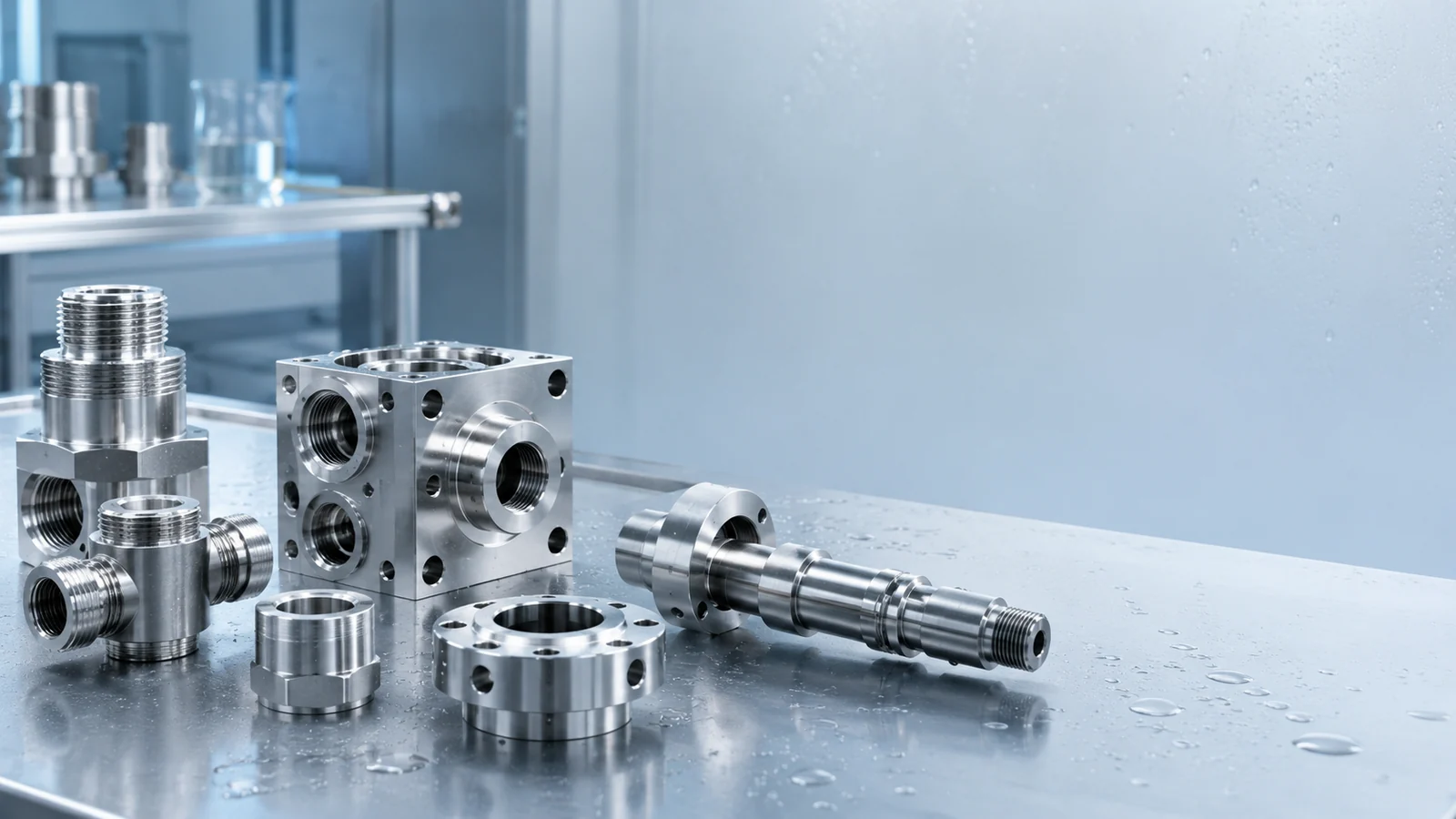
Stainless steel is selected for CNC parts because it offers useful strength, temperature resistance, cleanliness, and corrosion resistance. Yet a newly machined stainless steel component can still develop orange rust spots, staining, or premature corrosion even when the alloy grade is correct.
The problem is often not that the stainless steel itself is defective. CNC machining, grinding, deburring, handling, and washing can leave free iron or other contaminants on the finished surface. These contaminants may corrode before the surrounding stainless steel does, creating visible rust and weakening the surface condition expected from the selected alloy.
Passivation is a controlled chemical treatment used to remove free iron and other less noble contaminants from stainless steel surfaces. It supports the formation of a clean, chromium-rich passive surface without intentionally adding a separate coating.
However, passivation is not automatically required for every stainless steel part. Its value depends on the alloy, manufacturing route, contamination risk, service environment, cleanliness requirement, and customer specification. A decorative indoor bracket and a medical fluid-control component do not need the same finishing plan.
This guide explains what passivation does, why CNC machining can make it necessary, how nitric and citric acid processes differ, which stainless steel grades require special attention, how passivated parts are tested, and what engineers should include on a manufacturing drawing.
Why Can Stainless Steel Rust After CNC Machining?
The word “stainless” can create the impression that stainless steel cannot rust. In reality, stainless steel is corrosion-resistant rather than completely corrosion-proof. Its performance depends on alloy chemistry, surface condition, oxygen availability, contamination, fabrication history, and the surrounding environment.
Stainless Steel Depends on a Passive Surface
Stainless steels contain chromium. When a sufficiently clean stainless steel surface is exposed to oxygen, a very thin chromium-rich oxide layer forms naturally. This passive layer reduces the rate at which the underlying metal reacts with the environment.
The passive layer is extremely thin and is not normally visible. It is different from paint, powder coating, zinc plating, or a thick anodized layer. It can also reform after minor mechanical damage when the surface is clean and oxygen is available.
Passivation does not create stainless steel’s corrosion resistance from nothing. The alloy already contains the chromium needed to form a passive surface. The treatment improves the surface condition by removing contaminants that interfere with normal passivity.
CNC Operations Can Introduce Free Iron
Free iron contamination can be transferred to stainless steel during several ordinary manufacturing operations. Common sources include:
- Cutting tools previously used on carbon steel
- Steel wire brushes or abrasive media
- Carbon steel workholding fixtures
- Grinding dust in a shared workshop
- Steel shot used for blasting
- Rust particles in coolant or washing systems
- Handling on contaminated benches or racks
- Contact with steel chips during storage or transport
These particles may be microscopic. The machined component can therefore look clean at final inspection while still carrying iron that later rusts during storage, washing, humidity exposure, or service.
Visible Rust May Come from Contamination, Not the Base Alloy
When isolated orange spots appear shortly after machining, the corrosion may originate from embedded or smeared iron particles rather than from general corrosion of the stainless steel substrate.
This distinction matters. Replacing 304 with 316 will not necessarily solve a contamination problem if the same tooling, abrasive, handling, and cleaning practices remain unchanged. A higher-alloy stainless steel can still be contaminated by carbon steel.
Passivation is therefore one part of a broader contamination-control system. It works best when machining, deburring, washing, handling, and packaging practices are also controlled.
What Is Stainless Steel Passivation?
Passivation is a chemical surface treatment for stainless steel and other corrosion-resistant steels. Its primary purpose is to remove free iron and other less noble metallic contaminants from the surface so that the alloy can maintain or reform a stable passive condition.
The current ASTM A967/A967M-25 specification covers nitric-acid immersion, citric-acid immersion, and electrochemical passivation treatments for stainless steel parts. SAE AMS2700G, revised in May 2025, similarly defines a process intended to assure removal of free iron or other less noble contaminants from corrosion-resistant steel surfaces.
Passivation Removes Reactive Surface Contamination
During passivation, properly cleaned stainless steel parts are exposed to a controlled chemical solution. The solution preferentially removes free iron and certain surface contaminants without being intended to remove significant amounts of the stainless steel substrate.
The objective is not to make the component shiny or to change its dimensions. The objective is to leave a chemically clean surface that can resist localized staining and corrosion more reliably.
Passivation Supports the Natural Oxide Layer
After contaminants have been removed and the part has been thoroughly rinsed, the exposed stainless steel surface reacts with oxygen. A chromium-rich passive oxide forms naturally.
For this reason, passivation should be understood as a combination of contamination removal and restoration of a suitable surface condition. It is not simply “acid dipping,” and it is not successful unless cleaning, solution control, rinsing, and verification are all handled correctly.
Passivation Is Not a Deposited Coating
A passivated part usually looks very similar to the same part before treatment. Passivation does not intentionally add a measurable metal or polymer layer.
In normal controlled processing, it should not meaningfully alter:
- Critical diameters
- Thread pitch diameters
- Bore sizes
- Surface texture
- Part geometry
- Electrical dimensions
This is one reason passivation is attractive for precision CNC parts. Nevertheless, incorrect chemistry, excessive exposure, inadequate rinsing, or an unsuitable process for the alloy can cause staining, etching, or surface attack.
| Process | Primary purpose | Does it remove metal? | Typical effect on appearance |
|---|---|---|---|
| Cleaning or degreasing | Remove oil, coolant, dirt, and organic residue | Normally negligible | Usually little change |
| Passivation | Remove free iron and support a clean passive surface | Not intended to remove significant base metal | Usually little change |
| Pickling | Remove oxide scale, heat tint, and affected surface material | Yes | May become matte or visibly altered |
| Electropolishing | Electrochemically smooth and clean the surface | Yes, in a controlled amount | Usually smoother and brighter |
| Plating | Add another metal layer for functional or decorative reasons | Adds material rather than only cleaning | Clearly changes the surface |
| Powder coating or painting | Add a protective polymer barrier | Adds coating thickness | Changes color and texture |
Do All Stainless Steel CNC Parts Need Passivation?
No. Stainless steel can naturally passivate in air when the surface is clean, and some CNC parts may perform adequately after controlled machining and cleaning. The need for a formal passivation process should be based on risk rather than habit.
Parts That Commonly Benefit from Passivation
Passivation is strongly worth considering when a stainless steel CNC part:
- Will be exposed to moisture, condensation, washdown, or chemicals
- Must remain visibly free of rust staining
- Is used in medical, pharmaceutical, food, aerospace, or laboratory equipment
- Has been machined in a facility that also processes carbon steel
- Contains internal passages that are difficult to inspect visually
- Will be cleaned repeatedly during service
- Requires compliance with ASTM A967, ASTM A380, or SAE AMS2700
- Has customer-defined corrosion or cleanliness acceptance tests
For these applications, the cost of passivation may be small compared with the risk of field rust, rejected assemblies, contamination, warranty claims, or equipment downtime.
Parts That May Not Require a Separate Passivation Step
Formal chemical passivation may be unnecessary when the part is used in a mild indoor environment, has low contamination risk, receives another qualified surface treatment, or has no corrosion-related performance requirement.
Examples can include:
- Internal machine spacers used in a dry enclosure
- Temporary prototype fixtures
- Components that will be electropolished
- Parts that will undergo another validated chemical finishing process
- Noncritical hardware with no appearance or corrosion requirement
Even in these cases, proper cleaning and segregation from carbon steel remain important. Skipping passivation does not justify contaminated tooling or poor handling.
The Decision Should Be Based on Failure Consequences
A practical decision can be made by asking:
- How likely is iron contamination during manufacturing?
- How severe is the service environment?
- Would minor rust staining be acceptable?
- Could corrosion contaminate a product or fluid?
- Does the customer specification require passivation?
- Can the finished surface be verified by an appropriate test?
| Part situation | Passivation need | Main reason |
|---|---|---|
| Medical fluid-control component | Usually required or strongly recommended | Cleanliness, corrosion, and contamination risk |
| Food-processing nozzle | Usually recommended | Frequent washing and hygienic service |
| Aerospace stainless fastener or fitting | Often specification-driven | Controlled process and traceability |
| Outdoor 316 equipment bracket | Recommended when contamination is possible | Moisture and visible rust risk |
| Dry indoor machine spacer | May be optional | Low environmental and functional risk |
| Electropolished stainless part | Separate passivation may not be needed | Depends on the qualified finishing sequence |
| Welded part with heat tint | Passivation alone may be insufficient | Pickling or mechanical oxide removal may be needed first |
| Unknown stainless grade | Do not select treatment blindly | Process compatibility cannot be confirmed |
How Does CNC Machining Increase the Need for Passivation?
CNC machining does not automatically destroy the corrosion resistance of stainless steel. The issue is that manufacturing creates many opportunities for surface contamination and local damage.
Cutting Tools and Workholding Can Transfer Iron
A cutting tool may contain iron without causing a problem simply because it is made from tool steel. The greater concern is contamination from tools, jaws, fixtures, brushes, or abrasives that carry loose carbon-steel particles or rust.
Risk increases when:
- The same vise jaws are used for stainless and carbon steel
- Abrasive belts process multiple material families
- Steel brushes are used for deburring
- Magnetic tables contain rust or grinding residue
- Machined parts are placed directly on unprotected steel surfaces
Dedicated tools and clean contact surfaces reduce risk, but they do not replace final cleaning and verification when passivation is required.
Coolant and Chips Can Leave Contaminants in Small Features
Blind holes, cross-drilled passages, threads, narrow slots, and deep pockets can retain machining fluid, chips, abrasive particles, and wash chemistry. These residues can interfere with passivation or cause later staining.
Before passivation, the part must be cleaned well enough for the chemical solution to contact the stainless steel surface. Acid treatment cannot reliably remove oil films, heavy grease, adhesive, marking ink, or compacted chips.
For complex parts, ultrasonic cleaning, pressure flushing, repeated rinsing, or dedicated internal-passage cleaning may be necessary before chemical treatment.
Grinding, Welding, and Heat Tint Create Different Problems
Passivation removes free iron, but it is not a substitute for removing heavy scale, weld heat tint, burned lubricant, or mechanically damaged surface layers.
Heat tint around a weld indicates a heat-affected oxide condition and chromium depletion near the surface. Depending on severity and specification, the area may require pickling, controlled mechanical finishing, or electropolishing before the final passive condition is restored.
Similarly, heavy grinding smear or embedded abrasive may need to be removed before passivation. The finishing sequence should address the actual surface condition rather than treating every discoloration as a simple passivation problem.
What Does the Stainless Steel Passivation Process Include?
A reliable passivation process is more than immersion in an acid bath. The complete sequence usually includes inspection, precleaning, chemical treatment, rinsing, drying, and verification.
Step 1: Confirm the Alloy and Surface Condition
The processor should know the stainless steel grade or material family before choosing a treatment. Austenitic, martensitic, ferritic, duplex, and precipitation-hardening stainless steels do not always respond identically.
The initial review should also identify:
- Oil, grease, coolant, or polishing compound
- Free iron contamination
- Weld scale or heat tint
- Laser marking or oxide discoloration
- Brazing or soldering residue
- Mixed-metal assemblies
- Trapped cavities and blind passages
- Customer restrictions on chemistry
If the material grade is unknown, treatment should not be selected by appearance alone.
Step 2: Clean the Part Thoroughly
ASTM A380/A380M-25 covers cleaning, descaling, pickling, and passivation of stainless steel parts, equipment, and systems. It identifies cleaning approaches that may include alkaline, emulsion, chelate, acid, solvent, detergent, ultrasonic, steam, and high-pressure water methods.
The cleaning method must remove substances that prevent uniform contact between the stainless steel and the passivation solution. Water-break testing or other cleanliness checks may be used to detect residual oil films.
A part that is chemically passivated while still oily may show inconsistent results even when the bath chemistry is correct.
Step 3: Apply the Qualified Chemical Treatment
The clean parts are exposed to a specified nitric-acid, citric-acid, or electrochemical treatment. Process variables can include:
- Solution composition
- Concentration
- Temperature
- Immersion time
- Bath contamination level
- Part loading
- Agitation or circulation
These variables should follow the selected standard, approved process specification, and alloy compatibility requirements. A stronger acid or longer immersion time is not automatically better.
Step 4: Rinse, Neutralize When Required, and Dry
After treatment, the part must be rinsed thoroughly so that residual chemistry is not trapped in threads, holes, crevices, or internal passages. Poor rinsing can create stains, deposits, corrosion, or product contamination.
Depending on the qualified process, neutralization may be used before final rinsing. The parts should then be dried using a method that does not recontaminate the surface.
Compressed air, drying racks, baskets, and handling gloves must be clean. A passivated component can be contaminated again after treatment if it contacts rusty steel or dirty packaging.
Nitric Acid vs. Citric Acid Passivation
Nitric acid and citric acid are both recognized passivation routes when used under a qualified specification. The correct choice depends on the stainless steel grade, customer requirement, processor capability, environmental controls, and validation plan.
How Nitric Acid Passivation Works
Nitric acid has a long history in stainless steel passivation. It acts as an oxidizing acid and can effectively remove free iron when concentration, temperature, time, and bath condition are controlled.
Potential advantages include:
- Long industrial history
- Broad familiarity among aerospace and defense suppliers
- Established use in legacy drawings and specifications
- Compatibility with many stainless steel grades under defined conditions
Potential limitations include worker-safety requirements, hazardous fumes, waste-treatment demands, and risk of attack on some alloy conditions when the wrong method is selected.
How Citric Acid Passivation Works
Citric acid acts primarily as a chelating agent that helps remove free iron from the surface. It has become a widely accepted alternative to nitric acid in modern passivation specifications.
Potential advantages include:
- Lower fume and oxidizer hazards than nitric acid
- Effective removal of free iron
- Potentially simpler environmental handling
- Use in current ASTM A967 treatment options
- Suitability for automated and controlled production systems
Citric acid is not automatically the correct treatment for every part. Bath control, cleaning, concentration, temperature, time, rinsing, and validation remain essential.
How Should the Process Be Selected?
The choice should not be based only on statements such as “citric is safer” or “nitric is stronger.” The project should consider:
- The exact stainless steel grade
- The applicable drawing or customer specification
- Required acceptance testing
- Surface condition before treatment
- Presence of sulfur-bearing or free-machining grades
- Part geometry and trapped-solution risk
- Processor qualification and bath control
- Industry-specific documentation requirements
| Selection factor | Nitric acid passivation | Citric acid passivation |
|---|---|---|
| Industrial history | Long-established and common in legacy specifications | Modern, widely recognized alternative |
| Main chemical behavior | Oxidizing acid treatment | Chelation and removal of free iron |
| Fume and handling concerns | Generally higher | Generally lower, but still requires process controls |
| Alloy selection | Method must match grade and condition | Method must match grade and condition |
| Drawing acceptance | Often required by older aerospace or defense documentation | Accepted when permitted by current specification and customer |
| Process verification | Required | Required |
| Automatic preference | Not automatically superior | Not automatically superior |
How Do Different Stainless Steel Grades Respond to Passivation?
Passivation should be selected according to the actual alloy. Stainless steel is a large material family, and a process that works well for 304 may not be appropriate without review for 416, 440C, 17-4 PH, or duplex stainless steel.
Austenitic Stainless Steels
Austenitic grades such as 304, 304L, 316, and 316L are widely machined and commonly passivated. They generally offer good inherent corrosion resistance because of their chromium and nickel content, while molybdenum in 316 and 316L improves resistance in many chloride-containing environments.
Even these grades can develop rust spots if contaminated with carbon steel. Passivation is therefore often specified for medical parts, food-contact components, valve parts, laboratory equipment, and outdoor assemblies.
Martensitic and Free-Machining Stainless Steels
Martensitic grades such as 410, 420, and 440C contain more carbon and are selected when hardness, strength, or wear resistance is important. Their corrosion resistance is generally more dependent on heat treatment, surface condition, and environment than that of common austenitic grades.
Free-machining grades such as 303 and 416 contain sulfur or other inclusions that improve machinability but can reduce corrosion performance and complicate surface treatment. Aggressive or unsuitable passivation can expose inclusions, cause darkening, or create localized attack.
These materials should be processed using a method qualified for the specific grade and condition.
Precipitation-Hardening and Duplex Stainless Steels
17-4 PH and other precipitation-hardening grades combine high strength with useful corrosion resistance. The heat-treatment condition, scale condition, and final machining route should be considered before passivation.
Duplex stainless steels contain both austenitic and ferritic phases. They can provide high strength and improved resistance to certain forms of corrosion, but improper heat exposure or surface treatment can affect performance.
For safety-critical, pressure, marine, or chemical-service parts, the finishing supplier should follow the drawing specification and avoid selecting a generic stainless passivation cycle.
| Stainless steel family | Example grades | Passivation considerations |
|---|---|---|
| Austenitic | 304, 304L, 316, 316L | Commonly passivated; contamination control remains important |
| Free-machining austenitic | 303 | Sulfur inclusions can affect corrosion and surface appearance |
| Ferritic | 430 | Process should reflect lower nickel content and service conditions |
| Martensitic | 410, 420, 440C | Heat treatment and alloy condition strongly affect response |
| Free-machining martensitic | 416 | Requires careful treatment selection and corrosion expectations |
| Precipitation-hardening | 17-4 PH, 15-5 PH | Review heat-treatment condition and applicable specification |
| Duplex | 2205 and related grades | Use a qualified process for the alloy and service requirement |
| Unknown grade | Unverified stainless | Do not passivate until material identity is confirmed |
Does Passivation Change CNC Dimensions or Surface Finish?
Unlike plating, painting, powder coating, or hard anodizing, passivation is not intended to add meaningful coating thickness. It is therefore generally compatible with precision dimensions and close-fitting CNC features.
Normal Passivation Should Not Require a Coating Allowance
Designers normally do not add a dimensional allowance for passivation because the treatment does not intentionally deposit a layer. Precision bores, threads, sealing surfaces, and fits can usually be passivated without recalculating dimensions for coating growth.
However, this assumes a correctly selected and controlled process. Excessive chemical attack is a defect, not an expected dimensional result.
Surface Appearance Usually Remains Similar
A properly passivated machined finish often looks nearly unchanged. Passivation does not normally remove CNC feed marks, polishing lines, scratches, burrs, dents, or tool chatter.
If the customer requires a smoother or brighter finish, the correct operation may be:
- Mechanical polishing
- Electropolishing
- Controlled abrasive finishing
- Improved machining parameters
- Surface grinding or lapping
Passivation should not be sold as a cosmetic repair process.
Complex Geometry Can Still Affect Processing
Although dimensional build-up is not expected, geometry can influence cleaning and rinsing. High-risk features include:
- Blind threaded holes
- Capillary gaps
- Press-fitted assemblies
- Overlapping joints
- Long cooling channels
- Internal cavities without drainage
- Porous sintered features
Trapped acid or rinse water can cause staining and later corrosion. Drainage, disassembly, flushing, and drying methods should therefore be considered during design and process planning.
How Should Passivation Be Specified on a CNC Drawing?
A note that says only “passivate” leaves several important questions unanswered. The machining and finishing suppliers need to know the applicable standard, alloy, method restrictions, testing requirement, and documentation expectations.
Reference the Correct Standard
Common references include:
- ASTM A967/A967M-25 for chemical passivation treatments of stainless steel parts
- ASTM A380/A380M-25 for cleaning, descaling, pickling, and passivation practices
- SAE AMS2700G for passivation of corrosion-resistant steels
- A customer-controlled medical, aerospace, semiconductor, or food-equipment specification
ASTM A967 defines alternative treatments and verification tests but does not make one treatment universally suitable for every alloy and application. The drawing or purchase order should therefore state the required treatment or allow the qualified processor to select it under clearly defined limits.
Define the Required Test and Acceptance Criteria
A passivation note should identify how successful treatment will be confirmed. Possible acceptance methods under applicable standards can include water immersion, high humidity, salt spray, copper sulfate, or potassium ferricyanide-nitric acid testing.
Not every test is appropriate for every stainless grade or every project. For example, a test may react differently with martensitic or free-machining grades than with 304 or 316. The specified test must be compatible with the material and the governing standard.
Clarify Areas, Assemblies, and Documentation
The drawing or purchase order should also identify:
- Whether the entire part must be treated
- Whether the part is passivated before or after assembly
- Whether mixed-metal inserts are installed before treatment
- Whether laser marking is applied before or after passivation
- Whether a certificate of conformance is required
- Whether bath lot, process lot, or test-lot traceability is required
- Whether sample coupons or destructive tests are permitted
Example drawing note: Passivate after final machining and cleaning in accordance with ASTM A967/A967M-25 using a treatment compatible with 316L stainless steel. Verify the lot using the specified acceptance test. Parts shall be free from visible rust, staining, scale, and processing residue. Provide certificate of conformance.
The final note should be reviewed against the customer’s actual engineering and regulatory requirements rather than copied blindly.
How Are Passivated Stainless Steel Parts Tested?
A clean-looking surface is not sufficient proof that passivation was successful. Verification should match the specification, alloy, part risk, and intended service.
Visual and Cleanliness Inspection
Visual inspection can identify:
- Rust spots
- Acid staining
- Discoloration
- Residual scale
- Water spots
- Dry chemical residue
- Incomplete cleaning
- Damage caused by handling
ASTM A380 also identifies cleanliness evaluations such as wipe tests, residual-pattern inspection, water-break testing, and free-iron-related checks.
Visual inspection is useful but cannot independently detect all microscopic contamination.
Free-Iron and Corrosion-Response Tests
ASTM A967/A967M includes several alternative tests with acceptance criteria. Depending on the selected method and alloy, a project may use:
- Water immersion testing
- High-humidity testing
- Salt-spray exposure
- Copper sulfate testing
- Potassium ferricyanide-nitric acid testing
These tests do not all measure exactly the same behavior. Some are intended to reveal free iron, while others expose the part to conditions that may reveal inadequate surface treatment.
The test must be selected from the governing specification rather than chosen only because it is fast or inexpensive.
Lot Control and Documentation
For production parts, inspection should be connected to a defined lot. Important records may include:
- Material grade and heat or batch identification
- Passivation process specification
- Solution identification
- Process date and lot number
- Test method and result
- Quantity accepted or rejected
- Certificate of conformance
- Nonconformance and reprocessing records
Traceability becomes especially important when identical-looking stainless parts are produced from multiple grades or heat-treatment conditions.
What Are Common Passivation Problems?
Passivation failures are often caused by the complete manufacturing sequence rather than the acid bath alone.
Rust Appears After Passivation
Possible causes include:
- Incomplete removal of machining oil
- Free iron trapped in threads or passages
- Recontamination after treatment
- Dirty rinsing water
- Carbon steel contact during drying or packaging
- An unsuitable treatment for the alloy
- Incorrect bath concentration, temperature, or time
- Service conditions beyond the alloy’s corrosion capability
Repassivating the part without correcting the contamination source may only repeat the problem.
The Surface Becomes Dark, Etched, or Stained
Darkening or etching can result from excessive chemical attack, alloy inclusions, incorrect solution selection, high temperature, long exposure, poor rinsing, or retained chemistry.
Free-machining grades and high-carbon martensitic grades may be more sensitive than common 304 or 316. The processor should not assume that all stainless steels can share the same cycle.
The Part Passes a Test but Fails in Service
A passivation test confirms only the property and acceptance condition covered by that method. It does not prove that the stainless alloy is suitable for every corrosive environment.
Service failure may still occur because of:
- Chloride exposure
- Crevices and stagnant liquid
- Galvanic contact
- Incorrect alloy selection
- Loss of oxygen inside a trapped joint
- High temperature
- Cleaning chemicals used during service
- Mechanical damage or wear
Passivation improves surface cleanliness; it does not replace correct material and product design.
| Observed problem | Likely cause | Corrective direction |
|---|---|---|
| Orange spots after storage | Residual or reintroduced free iron | Trace contamination source and repeat full cleaning process |
| Rust inside blind holes | Trapped chips, iron, or rinse residue | Improve flushing, rinsing, and drying |
| Dark surface on 303 or 416 | Alloy inclusions reacting with unsuitable treatment | Use a grade-qualified process |
| Etched dimensions or roughness | Excessive chemical attack | Review solution, temperature, exposure, and alloy identity |
| Water spots | Poor final rinse or drying | Improve water quality and drying control |
| Clean part later rusts after assembly | Contaminated fasteners, tools, or mating parts | Control the complete assembly environment |
| Weld area corrodes | Heat tint or scale not removed before passivation | Use appropriate oxide-removal process first |
| Passed shop test but failed in chloride service | Alloy or design unsuitable for environment | Reassess material, crevices, drainage, and exposure |
Passivation vs. Pickling, Electropolishing, and Coatings
Several stainless steel finishing processes are frequently confused because they can all improve some aspect of corrosion performance. They are not interchangeable.
Passivation vs. Pickling
Passivation mainly targets free iron and surface contamination. Pickling is more aggressive and is used to remove heat tint, scale, and a thin affected layer of base metal.
A welded stainless assembly with heavy oxide scale may need pickling before passivation. Applying passivation directly over intact scale does not solve the underlying surface condition.
Passivation vs. Electropolishing
Electropolishing removes a controlled amount of surface metal electrochemically. It can smooth microscopic peaks, reduce burr-like irregularities, improve cleanability, and produce a brighter appearance.
Electropolishing may be selected for:
- Medical components
- Pharmaceutical equipment
- High-purity fluid parts
- Food-processing surfaces
- Components with demanding cleanability requirements
It is generally more expensive and dimensionally significant than passivation. It should not be specified when the only objective is removal of free iron.
Passivation vs. Paint, Plating, or PVD
Passivation does not provide a thick barrier and does not add color. Paint, powder coating, plating, and physical vapor deposition create separate surface layers with different functions.
A coating may be preferable when the part needs:
- A defined color
- Electrical insulation
- Wear resistance beyond the bare stainless surface
- A low-friction surface
- Decorative appearance
- Protection in an environment unsuitable for the selected stainless grade
Coating selection should be based on service requirements, not on the assumption that passivation is a general-purpose protective film.
Which Industries Commonly Require Passivated CNC Parts?
The importance of passivation increases when surface contamination can affect safety, cleanliness, product purity, appearance, or long-term reliability.
Medical, Pharmaceutical, and Laboratory Equipment
Typical passivated CNC parts include:
- Surgical instrument components
- Fluid-control fittings
- Pump and valve parts
- Sensor housings
- Laboratory fixtures
- Diagnostic equipment components
- Stainless manifolds
These applications may require not only passivation but also material traceability, controlled cleaning, special packaging, surface-roughness limits, and documented inspection.
Food, Beverage, and Packaging Equipment
Stainless steel parts used around food or beverage products are frequently washed and exposed to moisture, detergents, and sanitizing chemistry.
Relevant parts include:
- Filling nozzles
- Valve bodies
- Guide components
- Conveyor hardware
- Mixing equipment parts
- Packaging-machine fittings
Passivation can reduce the risk of rust contamination, but hygienic design, drainage, smooth surfaces, and correct alloy selection are equally important.
Aerospace, Automation, Marine, and Chemical Equipment
Aerospace and precision automation projects may specify passivation to control free iron, standardize finishing, and maintain documentation across production lots.
Marine and chemical-service components often use 316, duplex, or higher-alloy stainless steels. Passivation can improve the finished surface condition, but it cannot make an inadequate alloy resistant to severe chloride or chemical exposure.
Examples include actuator fittings, shafts, fasteners, robotic hardware, optical equipment components, marine instrument parts, pump components, and chemical-handling assemblies.
How Does RapidMFGPro Support Passivated Stainless Steel CNC Projects?
Passivation quality depends on more than finding a supplier with an acid tank. The machining method, stainless grade, cleaning process, surface condition, passivation specification, testing, and packaging must work together.
RapidMFGPro operates as a manufacturing resource and supplier-matching platform. Its role is to help connect stainless steel CNC projects with resources suited to the part’s machining, finishing, inspection, and documentation requirements.
Reviewing Material and Drawing Requirements
Before supplier matching, a project review can identify:
- The exact stainless steel grade and condition
- Whether the part is 303, 304, 316, 416, 440C, 17-4 PH, duplex, or another alloy
- Whether passivation is required by the drawing
- Which standard and revision apply
- Whether pickling or electropolishing is needed instead
- Whether internal passages require special cleaning
- Which acceptance test is required
- What certification and traceability must be supplied
This reduces the risk of using a generic process that is unsuitable for the alloy or customer requirement.
Matching Machining and Finishing Capabilities
A suitable manufacturing route may need:
- Dedicated stainless-steel machining controls
- Clean deburring and abrasive practices
- Ultrasonic or high-pressure cleaning
- Qualified nitric or citric passivation
- Passivation testing under ASTM or SAE requirements
- Inspection reports and certificates
- Clean packaging after treatment
The objective is not only to complete the chemical treatment but also to prevent contamination from being introduced again during inspection, assembly, or shipping.
Validating Prototypes Before Production
For high-risk components, prototype or initial production samples can be reviewed for:
- Surface staining
- Internal-passage cleanliness
- Compatibility with the selected alloy
- Dimensional stability
- Specified free-iron or corrosion-response tests
- Packaging and handling condition
Once the machining, cleaning, passivation, and inspection sequence is validated, the same documented route can be used for subsequent production batches.
Frequently Asked Questions About Stainless Steel Passivation
Does Passivation Prevent Stainless Steel from Ever Rusting?
No. Passivation removes free iron and supports the stainless steel’s natural passive surface, but it does not make the part immune to all corrosion. Incorrect alloy selection, chlorides, crevices, high temperatures, galvanic contact, chemical exposure, and mechanical damage can still cause corrosion.
Can Stainless Steel Passivate Naturally Without Chemical Treatment?
Yes. Clean stainless steel can naturally form a passive oxide in the presence of oxygen. Chemical passivation is used to remove contaminants and provide a more controlled, verifiable surface condition after manufacturing.
Is Passivation the Same as Rust Removal?
No. Light free-iron contamination may be removed during a qualified process, but heavy rust, weld scale, heat tint, or severe corrosion may require cleaning, pickling, mechanical refinishing, or rejection before passivation.
Does Passivation Change the Color of Stainless Steel?
Normally, a properly controlled process causes little visible change. Darkening, etching, or staining may indicate alloy sensitivity, contamination, excessive treatment, or inadequate rinsing.
Should 316 Stainless Steel Be Passivated?
316 already offers better corrosion resistance than 304 in many environments, but it can still carry free iron introduced during machining. Passivation may therefore be recommended or required depending on contamination risk, service environment, and specification.
Can Passivation Remove CNC Tool Marks?
No. Passivation does not remove normal feed marks, scratches, chatter, burrs, or roughness. Those conditions must be controlled during machining, deburring, grinding, polishing, or electropolishing.
Can an Assembled Part Be Passivated?
Sometimes, but assemblies create risks involving trapped solution, mixed metals, capillary gaps, inserts, seals, and difficult rinsing. The finishing supplier should review the complete assembly before processing.
Is Citric Acid Passivation Better Than Nitric Acid?
Neither method is universally better. Citric acid can offer effective free-iron removal with lower oxidizer and fume concerns, while nitric acid remains established in many legacy specifications. The correct process must match the alloy, standard, acceptance test, and qualified supplier capability.
Conclusion
Passivation helps stainless steel CNC parts maintain their intended corrosion resistance by removing free iron and other reactive contaminants introduced during machining, deburring, handling, and cleaning. It does not add a thick coating, repair scratches, remove heavy scale, or make an unsuitable stainless grade corrosion-proof.
The treatment is most valuable when rust staining, contamination, repeated washing, harsh service, or specification compliance matters. Reliable results require the correct alloy identification, complete precleaning, a qualified nitric or citric process, thorough rinsing, suitable testing, and clean post-process handling.
RapidMFGPro helps review these requirements and match stainless steel CNC projects with suitable machining, passivation, and inspection resources.
Reference Sources
- ASTM A967/A967M-25: Chemical Passivation Treatments for Stainless Steel Parts
- ASTM A380/A380M-25: Cleaning, Descaling, Pickling, and Passivation of Stainless Steel
- SAE AMS2700G: Passivation of Corrosion Resistant Steels
- NASA PRC-5002: Passivation and Pickling of Corrosion-Resistant Steel
- World Stainless: Introduction to Stainless Steels
Need Help Reviewing a Custom Part?
Share your CAD file and requirements to request supplier matching. Supplier capability and commercial terms must be verified before order placement.
Request Supplier Match