Time to read: 20 min
What Is Soft Metal? Properties, Machining, and Selection for Custom Parts
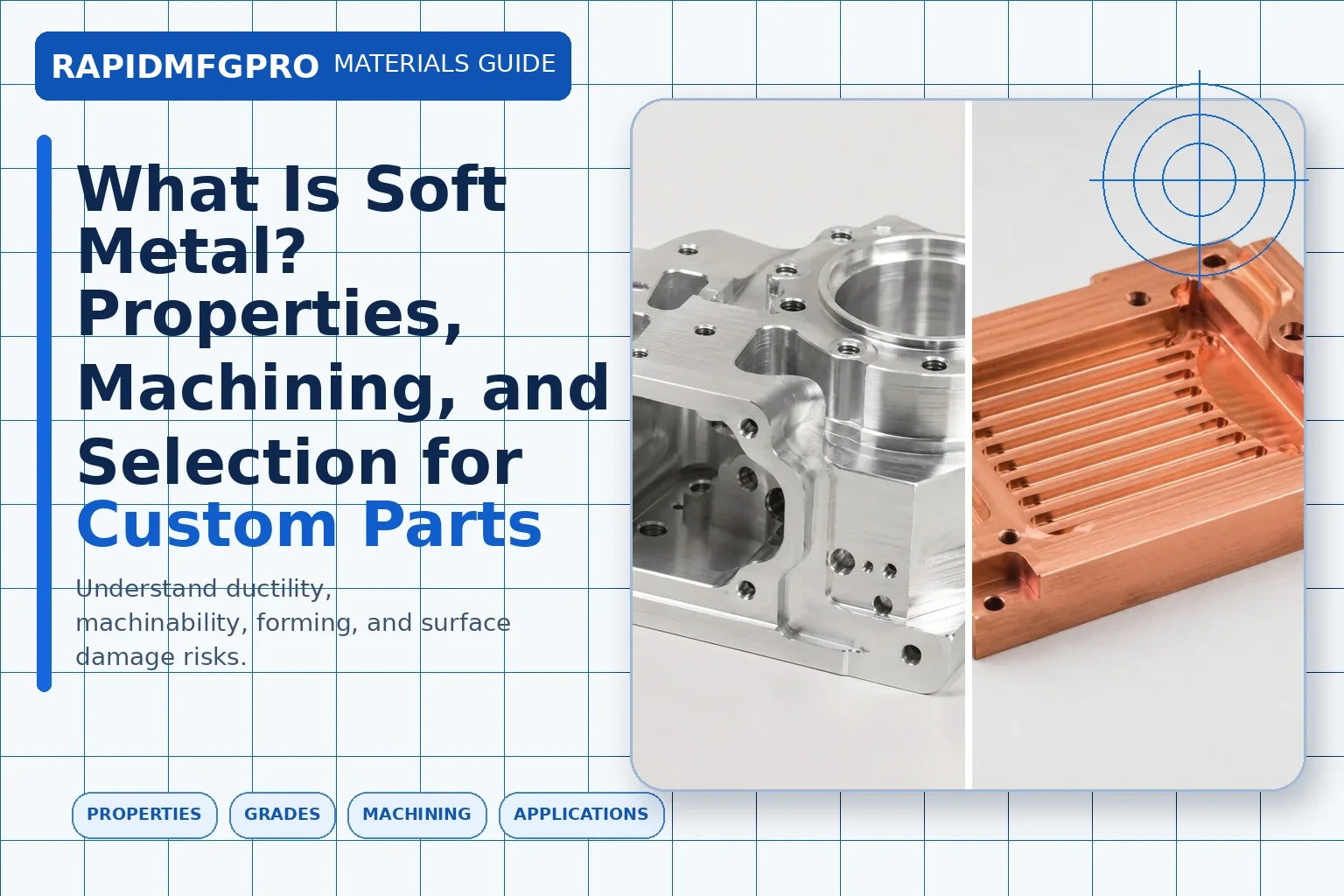
“Soft metal” is a practical engineering description rather than one strict material class. It usually refers to a metal that has relatively low hardness, low resistance to indentation, easy plastic deformation, or a low force requirement during cutting and forming. The exact meaning depends on the material condition, temperature, comparison material, and intended application.
Lead, tin, indium, commercially pure aluminum, annealed copper, and selected soft tempers of brass are common examples of metals or metal conditions described as soft. These materials are not interchangeable. Some are selected for conductivity, some for sealing, some for soldering, some for forming, and some for bearing or damping behavior.
A soft metal is not automatically weak, unsuitable, or low quality. In many products, softness is the property that allows a gasket to seal, a terminal to crimp, a foil to form, a bearing layer to conform, or a plated coating to protect the base part. Problems occur when a soft material is used in a thread, wear surface, press fit, or high-load feature that needs greater hardness.
RapidMFGPro evaluates soft-metal projects from a manufacturing supplier-matching perspective. The platform reviews the required material, temper, hardness, product form, geometry, quantity, forming method, joining process, finish, inspection scope, and service condition before identifying suppliers with suitable machining, stamping, casting, plating, assembly, and quality-control capabilities.
This guide explains what soft metal means, how softness is measured, when a soft material is useful, when it creates risk, and how to select and manufacture soft-metal parts.
What Is Soft Metal?
Soft metal describes a metal that deforms, scratches, cuts, or indents relatively easily compared with a harder reference material. The term is always comparative.
Relative Material Description
Aluminum may be described as soft compared with hardened steel, while the same aluminum may be considered hard compared with lead or indium.
A useful definition should identify the comparison material and the property being discussed.
Condition-Dependent Behavior
The same alloy can be soft in the annealed condition and much harder after cold work, aging, or heat treatment.
Material grade without temper or condition may not define actual softness.
Temperature-Dependent Behavior
Many metals become softer as temperature rises.
A material that performs adequately at room temperature may creep or deform under sustained load at elevated temperature.
| Meaning | What It Describes | Typical Example |
|---|---|---|
| Low indentation hardness | Surface deforms under a local load | Lead or indium |
| Easy forming | Material bends or draws with low force | Annealed copper |
| Easy cutting | Material removes at low cutting force | Selected aluminum alloys |
| Conforming contact | Surface adapts to a mating shape | Soft bearing layer |
| Low-temperature melting | Metal melts or solders at low heat | Tin-based solder alloy |
Is Soft Metal a Formal Material Category?
Soft metal is not usually a formal family like stainless steel, titanium alloy, or tool steel. It is a descriptive term used across machining, forming, electronics, sealing, plating, and product design.
Material Standards
Material standards normally identify alloy composition, temper, mechanical properties, dimensions, and test requirements.
They rarely classify a material simply as soft metal.
Drawing Requirements
A drawing should state the exact alloy, temper, hardness range, product form, and applicable standard.
The note “soft metal” is too vague for purchasing and inspection.
Supplier Interpretation
One supplier may interpret soft metal as pure aluminum, while another may think of lead, tin, or annealed copper.
Precise terminology prevents quotation and performance differences.
How Is Metal Softness Measured?
Softness is normally evaluated indirectly through hardness testing, tensile behavior, forming force, or indentation response.
Brinell Hardness
Brinell testing uses a relatively large ball indentation and is useful for many soft and medium-hard metals.
The test averages a larger material area and can be suitable for castings and nonuniform structures.
Vickers Hardness
Vickers testing can measure soft metals, thin sections, coatings, and local features using controlled loads.
Microhardness testing is useful where the material or coating is too thin for a large indentation.
Rockwell Hardness
Rockwell scales for softer metals use different indenters and loads from the Rockwell C scale used for hardened steel.
The selected scale should match the thickness and hardness range.
Shore Testing
Selected soft metals may be checked with rebound or indentation methods suited to the application.
The reported scale must be stated clearly.
Why Are Some Metals Soft?
Metal softness comes from atomic bonding, crystal structure, alloy purity, grain structure, temperature, and the ability of dislocations to move through the material.
Low Resistance to Slip
Plastic deformation occurs when crystal planes slip under stress.
Materials with fewer obstacles to dislocation motion deform more easily.
High Purity
Pure metals are often softer than their alloyed versions because alloying atoms obstruct dislocation movement.
Pure aluminum and pure copper are softer than many strengthened aluminum and copper alloys.
Annealed Structure
Annealing reduces work hardening and restores ductility.
Annealed sheet and wire are easier to bend, draw, crimp, and form.
Fine or Coarse Microstructure
Grain size influences strength and hardness.
The effect depends on alloy, processing history, and temperature.
What Is the Difference Between Softness and Ductility?
Softness and ductility are related but not identical. A soft material resists indentation poorly, while a ductile material can undergo substantial plastic deformation before fracture.
Soft but Limited Ductility
Some low-melting metals are soft but may tear, creep, or fracture under particular loading conditions.
Low hardness alone does not prove deep-drawing capability.
Ductile but Work Hardened
Copper and brass can remain ductile while becoming harder through cold work.
The forming sequence may require intermediate annealing.
Design Meaning
Bending, stamping, crimping, and drawing depend on ductility, strain distribution, and work hardening.
Wear and indentation depend more directly on hardness.
What Is the Difference Between Softness and Strength?
A soft material may have low yield strength, but hardness and strength should not be treated as identical values.
Yield Strength
Yield strength identifies when permanent bulk deformation begins.
It is important for loaded brackets, threads, tabs, and formed components.
Tensile Strength
Tensile strength identifies the maximum tensile stress reached before fracture.
A material may be soft at the surface while still providing useful tensile performance.
Compressive Behavior
Soft metals can spread or conform under compression.
This may be beneficial for gaskets but harmful for bolted joints that must retain clamping force.
What Is the Difference Between Softness and Malleability?
Malleability describes how well a metal can be compressed, rolled, hammered, or formed into sheet without cracking.
Sheet Formation
Malleable metals can be rolled into thin sheet or foil.
Aluminum, copper, tin, and gold are well-known examples.
Compressive Deformation
Malleability is most closely associated with deformation under compression.
Ductility is more often associated with tensile deformation.
Manufacturing Relevance
Coining, rolling, embossing, and foil production benefit from malleability.
Machining performance cannot be predicted from malleability alone.
When Is a Soft Metal Useful?
Soft metals are useful when the part must conform, seal, crimp, absorb local deformation, transfer heat, conduct electricity, or form into a complex shape.
Conforming Seals
Soft metal gaskets adapt to mating surfaces and fill small surface irregularities.
Sealing force, temperature, pressure, and chemical compatibility control material choice.
Electrical Crimping
Soft copper and selected copper alloys deform around conductors during crimping.
Correct compression creates mechanical retention and low electrical resistance.
Thermal Interfaces
Soft metallic interface materials can conform to surface variation and improve contact.
Thermal conductivity, thickness, oxidation, and clamping pressure should be considered.
Decorative Forming
Soft aluminum, copper, tin, and precious metals can be embossed, spun, rolled, or hammered into visible products.
Surface scratches and handling marks require control.
When Does Softness Create a Problem?
Softness becomes a disadvantage when the part must retain precise geometry, resist wear, support threads, maintain preload, or survive repeated contact.
Thread Stripping
Internal threads in soft metal can shear or deform under excessive torque.
Inserts, larger diameters, longer engagement, or lower torque may be required.
Surface Denting
Soft surfaces can dent during clamping, transport, assembly, or accidental contact.
Protective fixtures and packaging may be needed.
Wear
Sliding, abrasive, or repeated contact can remove material quickly.
A hard coating, bearing alloy, insert, or different material may improve life.
Loss of Preload
Soft metals may creep or embed under fastener pressure.
The joint can lose clamping force over time.
Which Pure Soft Metals Are Common?
Several pure or near-pure metals are known for low hardness. Their engineering roles differ greatly.
Lead
Lead is dense, soft, formable, and capable of absorbing vibration and radiation.
It is used in shielding, ballast, batteries, seals, and specialized industrial components.
Tin
Tin is soft, corrosion resistant in selected environments, and widely used in coatings and solder systems.
Pure tin is rarely chosen for heavily loaded structural parts.
Indium
Indium is very soft and can conform to mating surfaces.
It is used in vacuum seals, thermal interfaces, low-temperature soldering, and specialized electronics.
Gold
Pure gold is soft, ductile, corrosion resistant, and highly conductive.
Engineering use is usually limited to thin plating, bonding wire, contacts, and specialized components because of cost.
| Metal | Main Useful Property | Main Limitation | Typical Use |
|---|---|---|---|
| Lead | Density and conformability | Toxicity and low strength | Shielding and ballast |
| Tin | Coating and solderability | Low structural strength | Plating and solder |
| Indium | Extreme conformability | High cost and creep | Vacuum seal |
| Gold | Corrosion resistance and conductivity | Very high cost | Electrical plating |
Which Soft Engineering Metals Are Common?
Common engineering metals may be supplied in soft tempers even when stronger versions of the same material exist.
Commercially Pure Aluminum
1000-series aluminum grades provide high corrosion resistance, conductivity, and formability.
They are softer and lower in strength than many heat-treatable aluminum alloys.
Annealed Copper
Annealed copper provides high conductivity and excellent forming behavior.
It is used for busbars, flexible conductors, tubes, terminals, and heat-transfer components.
Soft Brass Temper
Alpha brass can be supplied in annealed or soft conditions for stamping, drawing, and bending.
Cold work raises strength and hardness during forming.
Low-Carbon Steel
Low-carbon steel is relatively soft compared with hardened alloy and tool steels.
It is useful for forming, welding, general machining, and carburized components.
Which Aluminum Grades Are Relatively Soft?
Aluminum softness depends on alloy series and temper. Pure grades and annealed tempers are generally softer.
Aluminum 1050
1050 provides high purity, corrosion resistance, electrical conductivity, and forming performance.
It is used for electrical, chemical, reflector, and sheet-forming applications.
Aluminum 1100
1100 is commercially pure aluminum with good ductility and conductivity.
It is used for sheet-metal products, heat exchangers, decorative parts, and chemical equipment.
Aluminum 3003-O
3003 in the annealed condition is soft and formable.
It is used for drawn and bent sheet components, enclosures, tanks, and heat-transfer parts.
Aluminum 5052-O
5052 in the annealed condition provides corrosion resistance and good forming behavior.
It is used for marine sheet, enclosures, tanks, and formed components.
Which Copper Materials Are Relatively Soft?
Copper and copper alloys can be supplied in soft, annealed, half-hard, hard, or spring tempers.
C11000 Annealed Copper
Annealed C11000 provides high conductivity and easy forming.
It is used for busbars, terminals, heat spreaders, and fabricated electrical components.
C12200 Copper
C12200 provides useful forming, brazing, soldering, and tube-manufacturing performance.
It is widely used for plumbing and heat-exchanger applications.
C26000 Soft Brass
C26000 in a soft temper supports deep drawing and stamping.
It is used for shells, terminals, decorative parts, and formed components.
How Does Temper Change Soft Metal?
Temper describes the processing condition that controls hardness, strength, ductility, and forming behavior.
Annealed Temper
Annealing reduces work hardening and restores ductility.
It is used before severe forming or after intermediate forming stages.
Half-Hard Temper
Half-hard material provides more strength than annealed material while retaining some formability.
It is common in clips, terminals, sheet components, and moderate bends.
Hard Temper
Hard temper is produced through greater cold work.
It provides higher strength but less forming capability.
Spring Temper
Spring temper provides high elastic strength in selected copper and steel strip.
It should not be treated as a soft condition.
How Does Cold Work Change Soft Metal?
Cold work increases strength and hardness by creating obstacles to dislocation movement.
Rolling
Cold rolling reduces thickness and increases hardness.
Sheet flatness, surface finish, grain direction, and anisotropy may change.
Drawing
Wire and tube drawing increase strength while reducing cross-section.
Intermediate annealing may be required for severe reduction.
Stamping
Stamped areas can work harden during forming.
Bends and drawn walls may have different hardness from the original flat sheet.
Local Hardening
Crimping, coining, burnishing, and forming can create local property changes.
Inspection should consider the final formed condition.
How Are Soft Metals CNC Machined?
Soft metals often cut with low force, but they can adhere to tools, smear, form long chips, create burrs, and deform under clamping.
Sharp Tooling
Sharp edges and positive rake help produce a clean shearing action.
Dull tools push and smear soft material.
Polished Flutes
Polished flutes reduce adhesion in aluminum and copper machining.
Chip evacuation becomes more reliable.
Controlled Clamping
Excessive clamping force can dent or distort the part.
Soft jaws, broad contact areas, and low-distortion fixtures may be needed.
Burr Control
Soft metals can produce large burrs around holes, slots, and edges.
Toolpath, backup support, edge geometry, and deburring should be planned together.
How Are Soft Metals CNC Milled?
Milling soft metals is common for housings, busbars, heat spreaders, plates, terminals, and prototype parts.
Pocket Milling
Deep pockets can trap long chips and create recutting.
Coolant, air blast, and open toolpaths improve evacuation.
Thin-Wall Milling
Thin walls can flex under cutting and clamping force.
Balanced roughing and staged finishing improve accuracy.
Face Milling
Face milling can produce flat contact surfaces on aluminum and copper.
Tool balance, insert geometry, and stock support affect waviness and burrs.
Micro Milling
Very small features are vulnerable to smearing and burr formation.
Tool runout and edge sharpness become critical.
How Are Soft Metals CNC Turned?
Turning soft metals produces fittings, contacts, bushings, terminals, shafts, and cylindrical thermal parts.
Chip Breaking
Soft ductile materials may form long continuous chips.
Feed, insert geometry, coolant, and chip-breaker selection must be controlled.
Surface Smearing
A worn insert can smear the surface and hide true roughness.
This may affect plating, sealing, and appearance.
Parting
Soft metals can leave a heavy cutoff burr or deformed face.
Tool sharpness, support, and secondary facing may be required.
Small Threads
Fine threads in soft material can tear or deform.
Thread rolling, forming, inserts, or a stronger alloy may be considered.
How Are Soft Metals Drilled?
Drilling soft metal requires control of grabbing, chip evacuation, exit burrs, and hole distortion.
Drill Geometry
Point angle, rake, margin, and edge preparation should match the material.
A standard drill may grab very soft sheet.
Backup Support
Supporting thin sheet reduces exit deformation and burrs.
Sacrificial backing may improve hole quality.
Deep Holes
Long chips can block coolant and scratch the bore.
Peck cycles and through-tool coolant may be required.
How Are Soft Metals Formed?
Forming is one of the main reasons to select a soft material. The process must still account for thinning, wrinkling, tearing, springback, and surface damage.
Bending
Soft annealed sheet can accept tight bends.
Grain direction, thickness, radius, and surface condition remain important.
Deep Drawing
Aluminum, copper, brass, and tin-coated sheet can be deep drawn into cups, shells, and housings.
Blank shape, lubrication, draw ratio, and annealing control the result.
Spinning
Metal spinning forms rotationally symmetric shells over a mandrel.
Soft aluminum and copper are common choices.
Embossing
Soft sheet accepts decorative or functional raised features.
Tool polish and material support affect surface quality.
How Are Soft Metals Stamped?
Stamping produces terminals, contacts, clips, covers, gaskets, foils, and high-volume sheet parts.
Blanking
Blanking separates the part from strip or sheet.
Clearance controls rollover, burnish, fracture, and burr.
Progressive Stamping
Progressive dies perform multiple forming and cutting operations in sequence.
They are common for electrical terminals and contacts.
Coining
Coining compresses the material to create accurate local features.
It can increase local hardness and improve contact geometry.
Burr Direction
Stamped parts have a burr side.
The drawing should control burr direction when it affects assembly or safety.
How Are Soft Metals Joined?
Soft metals can be soldered, brazed, welded, crimped, riveted, bonded, or mechanically fastened.
Soldering
Tin-based solder alloys join electrical and thermal components at relatively low temperature.
Flux, surface finish, joint gap, temperature, and residue removal affect quality.
Brazing
Copper and selected aluminum alloys can be brazed into heat exchangers and fluid assemblies.
Filler compatibility and joint clearance are important.
Crimping
Crimping plastically deforms a terminal around a conductor or tube.
Tooling, compression, pull-out force, and cross-section may be inspected.
Riveting
Soft rivets deform to clamp sheet components.
Hole size, rivet length, upset shape, and material compatibility control the joint.
How Are Soft Metals Cast?
Low-melting and soft metals can be cast into detailed shapes, inserts, weights, seals, and components.
Die Casting
Aluminum, zinc, tin, and lead-based alloys can be die cast depending on application and regulation.
Tooling supports high production volume.
Gravity Casting
Soft non-ferrous alloys may be poured into permanent or sand molds.
Shrinkage, porosity, oxide, and surface finish require control.
Insert Casting
A soft metal may be cast around a harder insert.
Thermal expansion, bonding, contamination, and insert position should be controlled.
Casting Inspection
Dimensional checks, radiography, leak testing, density, and composition testing may be required.
The inspection method should match the risk.
How Are Soft Metals Used in Bearings?
Soft bearing metals conform to shafts, embed small particles, and reduce damage to the harder mating surface.
Babbitt Metal
Babbitt alloys are tin-based or lead-based bearing materials.
They are used as a soft lining supported by a stronger shell.
Conformability
The bearing layer adapts to small alignment and geometry variations.
Excessive softness can reduce load capacity.
Embeddability
Small particles can embed in the soft lining rather than scoring the shaft.
Lubrication and cleanliness remain essential.
Layered Bearings
Modern bearings often combine a strong backing with a softer functional layer.
Bond quality and layer thickness affect life.
How Are Soft Metals Used in Seals?
Soft metal seals create contact by plastic deformation and are used where elastomers cannot tolerate temperature, vacuum, pressure, radiation, or chemicals.
Metal Gaskets
Copper, aluminum, silver, indium, and coated steel may be used in metal gaskets.
Surface finish and bolt load determine sealing.
Vacuum Seals
Indium and copper gaskets are used in selected vacuum systems.
Cleanliness and controlled compression are critical.
High-Temperature Seals
Soft metal layers can maintain contact where polymer seals degrade.
Creep, oxidation, and thermal cycling should be evaluated.
How Are Soft Metals Used in Electronics?
Electronics use soft metals for conductivity, soldering, contact interfaces, shielding, and thermal transfer.
Copper Conductors
Soft copper wire and strip form conductors, windings, terminals, and flexible connections.
Conductivity and fatigue are important.
Tin Coatings
Tin plating protects copper contacts and improves solderability.
Coating thickness, whisker risk, and storage should be considered.
Indium Interfaces
Indium foil and solder can provide compliant thermal and vacuum interfaces.
Creep and cost limit general use.
Gold Contacts
Thin gold coatings provide corrosion-resistant electrical contact.
A harder underlayer is often needed to support the soft gold surface.
How Are Soft Metals Used in Packaging?
Soft metals support barrier protection, easy forming, sealing, and decorative appearance in packaging.
Aluminum Foil
Aluminum foil provides a moisture, light, and gas barrier.
It is used in food, pharmaceutical, and industrial packaging.
Tinplate
Tin-coated steel combines a strong steel base with a corrosion-resistant, solderable surface.
Coating integrity and forming control are important.
Soft Seals
Foil seals deform around container surfaces.
Thickness, liner, adhesive, and sealing temperature determine performance.
How Should Soft-Metal Parts Be Designed?
Soft-metal design should prevent local crushing, thread damage, wear, excessive creep, and handling deformation.
Increase Bearing Area
Broad contact surfaces reduce local pressure.
Washers, flanges, and larger bosses protect soft material.
Use Supported Walls
Thin walls need ribs, flanges, or local support.
Unsupported sections can buckle or dent.
Control Sharp Edges
Soft edges can roll over or form burrs.
Chamfers and radii improve handling.
Protect Functional Surfaces
Electrical, thermal, and sealing surfaces should be protected from scratches and clamps.
Packaging should reflect the surface sensitivity.
Allow for Creep
Sustained pressure can deform soft metals over time.
Spring elements or retightening strategies may be required.
How Should Threads Be Designed in Soft Metal?
Threads in soft materials require sufficient engagement, low stress concentration, and controlled assembly torque.
Thread Engagement
Soft material may require longer engagement than steel.
The required length depends on load, thread size, and alloy strength.
Thread Inserts
Helical, solid, or molded-in inserts improve repeated assembly and pull-out resistance.
Insert installation should not crack or expand thin walls.
Coarse Threads
Coarse threads can provide greater material between thread roots.
They may be more tolerant of soft alloys in selected applications.
Torque Control
Excessive torque can strip threads or crush the joint.
Torque and lubrication should be specified together.
How Should Press Fits Be Designed?
Press fits can deform soft metal, enlarge holes, create cracks, or relax over time.
Interference Amount
Interference should reflect the yield strength and wall thickness of the soft material.
Steel-based press-fit values may be excessive.
Wall Support
Thin bosses may expand during insertion.
Local reinforcement or an insert may be required.
Insertion Geometry
Chamfers and lead-ins reduce shaving and galling.
Surface roughness affects insertion force.
Relaxation
Soft material may creep and reduce retention over time.
Knurls, barbs, adhesive, staking, or mechanical locking may improve reliability.
Which Surface Treatments Suit Soft Metals?
Surface treatment can improve wear, corrosion, appearance, solderability, friction, or hardness.
Anodizing
Aluminum anodizing creates a harder oxide layer than the base aluminum.
Coating thickness affects dimensions and electrical contact.
Hard Anodizing
Hard anodizing improves wear resistance on selected aluminum alloys.
It does not make the entire aluminum part hard or eliminate substrate deformation.
Electroless Nickel Plating
Electroless nickel can provide a hard, uniform coating on aluminum, copper, and other substrates after suitable pretreatment.
Adhesion, phosphorus content, thickness, and heat treatment affect performance.
Tin Plating
Tin plating improves solderability and protects copper contacts.
It remains relatively soft and can deform under contact pressure.
Nickel Plating
Nickel plating adds wear resistance and a barrier layer.
The soft substrate can still deform beneath the coating.
| Treatment | Typical Substrate | Main Benefit | Main Limitation |
|---|---|---|---|
| Anodizing | Aluminum | Corrosion and appearance | Electrical insulation |
| Hard anodizing | Aluminum | Surface wear resistance | Soft substrate remains |
| Electroless nickel | Aluminum or copper | Hard uniform surface | Adhesion and buildup |
| Tin plating | Copper or brass | Solderability | Soft coating |
| Nickel plating | Copper or brass | Barrier and wear resistance | Substrate deformation |
Can a Hard Coating Fix a Soft Part?
A hard coating can improve surface wear, but it cannot fully compensate for an undersized or overloaded soft substrate.
Substrate Support
The coating needs a substrate strong enough to support contact pressure.
Excessive deformation can crack or delaminate the coating.
Coating Thickness
Thin coatings improve the surface without changing bulk stiffness.
Thick buildup affects dimensions and may create residual stress.
Edge Behavior
Sharp soft edges can deform beneath a hard coating.
Rounded or supported edges improve durability.
Realistic Use
Hard coatings are effective for light sliding wear, corrosion, and appearance when the substrate load remains controlled.
A stronger base material is better for heavy contact.
Which Process Fits the Quantity?
Production quantity influences whether a soft-metal part should be machined, stamped, drawn, die cast, extruded, rolled, or assembled from standard forms.
Prototype Quantity
CNC machining and simple sheet fabrication are practical for prototypes.
They avoid production tooling.
Pilot Quantity
Pilot production validates forming, burrs, coating, crimping, sealing, and handling.
It can reveal whether a different temper is required.
Production Quantity
High volume may justify progressive stamping, deep-drawing dies, extrusion tooling, or die-casting molds.
Tooling cost should be compared with cycle time and material utilization.
| Process | Typical Quantity | Main Advantage | Main Limitation |
|---|---|---|---|
| CNC machining | Prototype to medium volume | No production tooling | Burrs and material waste |
| Sheet forming | Low to high volume | Efficient thin parts | Springback and surface marks |
| Progressive stamping | High volume | Fast repeated production | Die investment |
| Extrusion | Medium to high volume | Efficient constant profile | Cross-section limits |
| Die casting | High volume | Complex near-net shape | Tooling and porosity |
Where Are Soft Metals Used?
Soft metals are used where conformity, conductivity, forming, sealing, low melting point, damping, or surface compatibility matters.
Electrical Parts
Copper terminals, busbars, contacts, wires, and tin coatings use soft metals.
Conductivity, crimping, and contact resistance are key.
Thermal Parts
Aluminum and copper are used for heat spreaders, cold plates, heat exchangers, and thermal interfaces.
Flatness and contact pressure affect performance.
Sealing Parts
Copper, aluminum, silver, indium, and lead-based materials may be used in gaskets and seals.
Temperature, pressure, and chemistry determine selection.
Bearing Parts
Babbitt and layered bearing metals provide conformability and embeddability.
A stronger backing supports the soft layer.
Decorative Parts
Soft aluminum, copper, brass, tin, silver, and gold can be formed and polished.
Scratch control and protective coating are important.
Radiation Shielding
Lead is used where high density and radiation attenuation are required.
Worker safety, encapsulation, and regulation must be considered.
How Do You Select a Soft Metal?
Selection should begin with the reason softness is needed and then consider strength, temperature, corrosion, conductivity, toxicity, regulation, process, and cost.
Define the Functional Benefit
Determine whether the part needs sealing, crimping, forming, conductivity, damping, or low-temperature melting.
The material should support that function.
Define the Load
Identify compression, tension, torque, wear, impact, and long-term preload.
Softness may cause permanent deformation under high load.
Define the Temperature
Soft metals may creep or melt at relatively low temperature.
Service and assembly temperatures should be stated.
Define the Environment
Confirm humidity, chemicals, galvanic contact, vacuum, radiation, and cleaning fluids.
Corrosion and contamination can control selection.
Define the Regulation
Lead, cadmium, beryllium, tin, and other materials may be restricted in specific products.
Compliance should be confirmed before quotation.
Define the Process
Match the material and temper to machining, stamping, drawing, casting, soldering, crimping, or sealing.
A material suitable for forming may be unsuitable for threads.
What Should Be Specified on the Drawing?
A soft-metal drawing should identify the exact grade, temper, hardness, product form, surface finish, and acceptance criteria.
Material Grade
State the exact alloy designation and applicable standard.
Soft aluminum or soft copper is not sufficiently precise.
Temper
Specify annealed, O temper, half-hard, hard, or another controlled condition.
Temper affects forming and strength.
Hardness
State the hardness scale and range when softness controls function.
Thin sheet and coatings may require microhardness.
Surface Finish
Define roughness, polish, plating, anodizing, coating, and protected areas.
Soft cosmetic surfaces need clear acceptance criteria.
Edge Condition
Define burr direction, chamfer, radius, or deburring.
Soft sheet can produce large burrs.
Inspection Scope
Identify dimensions, hardness, conductivity, coating thickness, pull-out tests, leak tests, or functional checks.
What Should Be Included in the RFQ?
A complete RFQ allows suppliers to quote the same material, temper, process, finish, inspection, and packaging.
Technical Files
Provide a 3D model and controlled 2D drawing.
The drawing defines acceptance.
Quantity
State prototype quantity, initial order, and annual demand.
Quantity affects tooling and process choice.
Material Documentation
Specify certificates, composition, temper, hardness, conductivity, and regulatory compliance.
Functional Requirement
State sealing pressure, crimp force, contact resistance, thermal load, or expected deformation.
These details help suppliers evaluate suitability.
Packaging Requirement
Soft parts dent, scratch, bend, and tarnish easily.
Packaging should protect surfaces, edges, flatness, and shape.
How Does RapidMFGPro Evaluate Soft-Metal Projects?
RapidMFGPro evaluates soft-metal projects by identifying why softness is needed and which supplier capabilities are required.
Function Review
The review begins with forming, sealing, conductivity, thermal transfer, bearing behavior, damping, or low-temperature joining.
This prevents softness from being specified without a functional reason.
Material Review
The material review confirms grade, temper, product form, hardness, regulatory limits, and availability.
Substitutions are checked against the required softness and strength.
Process Review
The process review compares CNC machining, stamping, drawing, extrusion, casting, soldering, crimping, plating, and assembly.
The route is matched to geometry and quantity.
Supplier Matching
Suppliers are compared according to soft-metal machining experience, forming equipment, die control, casting resources, joining, finishing, metrology, and production capacity.
A supplier suitable for aluminum housings may not be suitable for indium vacuum seals or lead shielding.
Quality Review
The quality review confirms material identity, temper, hardness, dimensions, burrs, coating, deformation, function, and packaging.
The final scope should be agreed before production.
How Should Soft-Metal Parts Be Inspected?
Soft-metal inspection requires methods that do not dent, bend, scratch, or otherwise alter the part.
Material Verification
Certificates, composition, temper, and product form may be reviewed.
Positive material identification may be required for critical alloys.
Hardness Inspection
Brinell, Vickers, Rockwell, or microhardness may be used.
Test load must match thickness and material.
Dimensional Inspection
Low-force gauges, optical systems, CMMs, and noncontact methods may be preferred.
Excessive probe or caliper force can distort the measurement.
Surface Inspection
Inspect dents, scratches, burrs, smearing, stains, oxidation, coating damage, and handling marks.
Cosmetic criteria should define viewing conditions.
Functional Inspection
Functional checks may include crimp pull-out, leak testing, contact resistance, compression, seal verification, insertion force, or trial assembly.
Dimensions alone may not prove performance.
What Problems Commonly Occur?
Soft-metal problems commonly involve material deformation, burrs, smearing, thread damage, creep, surface scratches, plating failure, or unsuitable substitution.
Clamping Dents
Hard jaws or excessive pressure can mark the part.
Soft jaws and broader support reduce risk.
Machining Smear
Dull tools push material across the surface.
Sharp tooling and suitable lubrication improve cutting.
Heavy Burrs
Soft ductile metals produce persistent burrs.
Deburring should not damage dimensions or conductivity surfaces.
Thread Failure
Threads can strip under high torque.
Inserts or geometry changes may be required.
Creep
Sustained load can cause gradual deformation.
Temperature and preload should be included in design.
Packaging Damage
Soft parts can arrive bent or scratched even after passing inspection.
Individual protection and rigid packaging are important.
Frequently Asked Questions
These questions address common material decisions when considering a soft metal for a part.
What Is the Softest Metal?
Some alkali metals are extremely soft, but they are highly reactive and not used as ordinary engineering materials. Among practical engineering metals, indium, lead, and tin are commonly described as very soft.
Is Aluminum a Soft Metal?
Pure and annealed aluminum grades are relatively soft. Heat-treatable and work-hardened aluminum alloys can be much stronger and harder.
Is Copper a Soft Metal?
Annealed pure copper is soft and ductile. Cold-worked copper and copper alloys can be significantly harder.
Is Brass a Soft Metal?
Brass softness depends on grade and temper. Annealed cartridge brass is formable, while hard and spring tempers are much stronger.
Are Soft Metals Easy to Machine?
They may require low cutting force, but they can create long chips, built-up edge, smearing, burrs, and clamping distortion.
Can Soft Metal Be Hardened?
Some soft metals can be work hardened, alloyed, aged, or surface treated. Pure lead, tin, and indium have limited structural hardening options.
Can a Soft Metal Hold Threads?
Yes, but engagement, torque, wall thickness, and repeated assembly must be controlled. Inserts are common for higher loads.
Does Soft Metal Wear Faster?
Often yes under sliding or abrasive contact, but soft bearing metals can perform well because they conform, embed debris, and operate with a harder mating surface.
Conclusion
Soft metal is a relative engineering description rather than one formal material family. Lead, tin, indium, pure aluminum, annealed copper, and soft brass tempers are selected for different reasons, including sealing, forming, conductivity, thermal transfer, bearing behavior, soldering, and decorative work. Softness becomes a risk when a part must resist wear, retain threads, hold preload, or maintain precise geometry. Correct selection requires the exact grade, temper, hardness, process, load, temperature, environment, finish, inspection, and packaging to be defined. RapidMFGPro supports this decision by matching projects with suppliers whose soft-metal machining, forming, casting, joining, finishing, and quality capabilities fit the actual part.
Need Help Reviewing a Custom Part?
Share your CAD file and requirements to request supplier matching. Supplier capability and commercial terms must be verified before order placement.
Request Supplier Match