Time to read: 20 min
What Is the Strongest Metal? A Practical Guide for Your Part Project
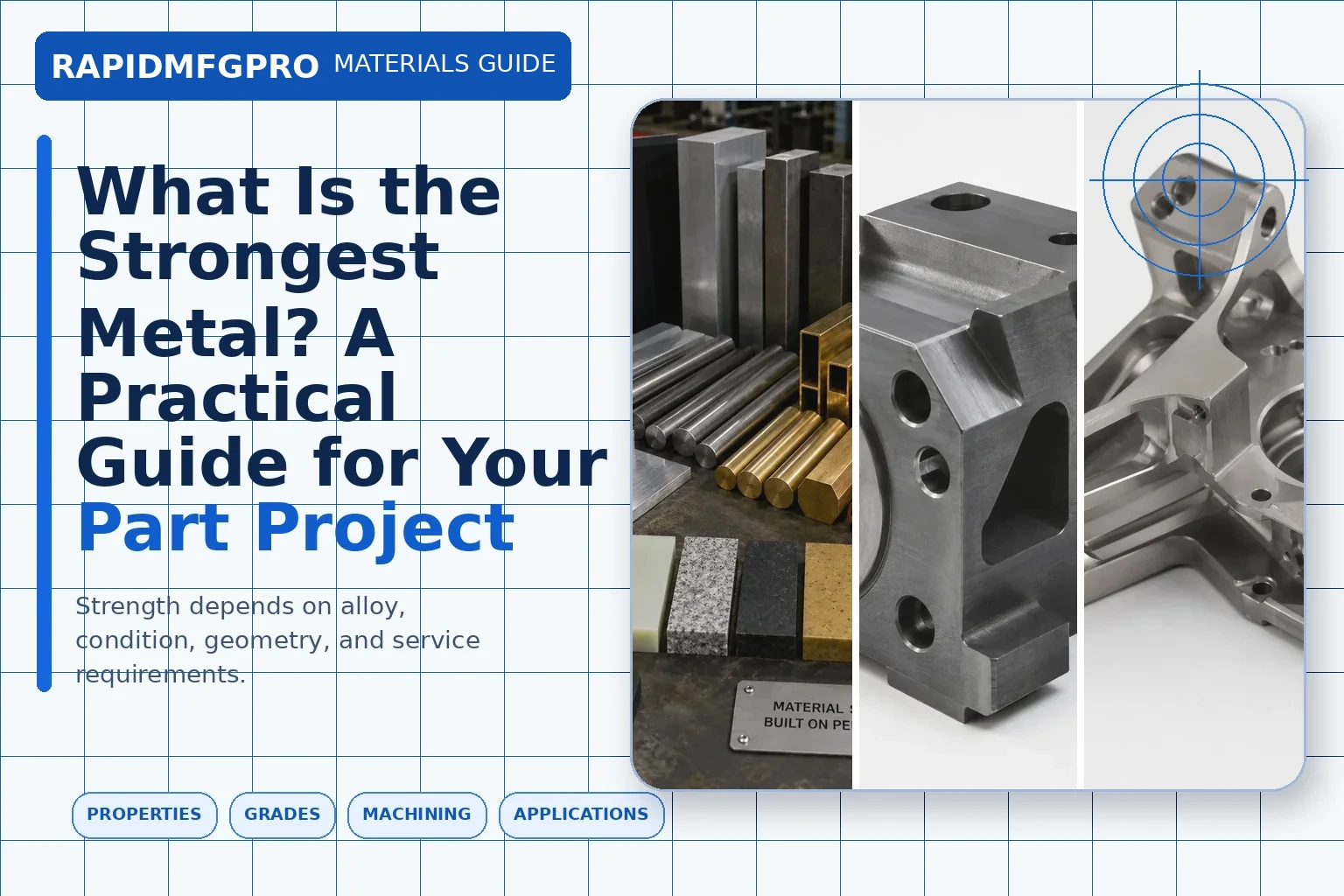
“What is the strongest metal?” sounds like a simple question, but there is no single correct answer until strength is defined. One material may have the highest tensile strength, another may resist permanent deformation better, another may be harder, and another may offer the best strength-to-weight ratio.
For part design, the strongest material is not necessarily the best material. A metal can be extremely strong but too brittle, too heavy, too expensive, too difficult to machine, or unsuitable for the operating temperature and environment.
Steel, titanium alloys, tungsten, nickel alloys, cobalt alloys, maraging steels, and selected tool steels all appear in discussions about the strongest metals. Their actual suitability depends on grade, heat treatment, product form, geometry, loading, temperature, fatigue, corrosion, and production process.
RapidMFGPro evaluates high-strength metal projects from a manufacturing supplier-matching perspective. The platform reviews the required property, alloy, condition, quantity, geometry, heat treatment, finishing, inspection scope, and certification before identifying suppliers with suitable machining, forging, casting, heat-treatment, grinding, and quality-control capabilities.
This guide explains what “strongest metal” really means and shows how to select a realistic material for a precision part project.
Is There One Strongest Metal?
There is no universal strongest metal because engineering strength has several different meanings. A material that performs best in one test may perform poorly in another.
Strength Depends on the Test
Tensile testing, compression testing, hardness testing, fatigue testing, and impact testing measure different aspects of performance.
A metal with extremely high hardness may crack under impact, while a tougher metal may deform before fracture.
Strength Depends on Material Condition
The same alloy can show very different strength after annealing, cold work, quenching, tempering, aging, carburizing, or nitriding.
A grade name without its condition is often incomplete for engineering comparison.
Strength Depends on Temperature
Materials lose strength at different rates as temperature rises.
A room-temperature high-strength steel may be less suitable than a nickel alloy in a hot turbine or exhaust environment.
Strength Depends on Geometry
A strong material cannot compensate for every design weakness.
Sharp corners, thin walls, poor load paths, inadequate section thickness, and stress concentrations can cause failure even when a high-strength alloy is used.
| Strength Measure | What It Describes | Typical Material Candidate |
|---|---|---|
| Tensile strength | Maximum tensile stress before fracture | Maraging steel or hardened alloy steel |
| Yield strength | Resistance to permanent deformation | High-strength steel or titanium alloy |
| Hardness | Resistance to indentation and wear | Tool steel or tungsten carbide |
| Specific strength | Strength relative to weight | Titanium alloy |
| High-temperature strength | Load capacity at elevated temperature | Nickel superalloy |
| Impact toughness | Ability to absorb energy before fracture | Tough alloy steel |
What Does Tensile Strength Mean?
Tensile strength describes how much tensile stress a material can withstand before it fractures. It is one of the most commonly quoted values in material comparisons.
Ultimate Tensile Strength
Ultimate tensile strength is the maximum engineering stress reached during a tensile test.
It is useful for comparing alloys, but it does not show when permanent deformation begins.
Elongation
Elongation measures how much a test specimen stretches before fracture.
A very high tensile strength with very low elongation may indicate limited ductility.
Necking
Necking is the local reduction in cross-section that occurs before tensile fracture in ductile materials.
Some high-strength materials show limited necking and fail more suddenly.
Design Limitation
Most structural parts should not operate near ultimate tensile strength.
Yield, fatigue, impact, stress concentration, temperature, and safety factor normally control the design.
What Does Yield Strength Mean?
Yield strength indicates the stress at which permanent deformation begins. It is often more useful than tensile strength for brackets, shafts, frames, pressure parts, and precision assemblies.
Permanent Deformation
Below the elastic limit, the part returns toward its original shape after the load is removed.
Once yielding begins, some deformation remains.
Proof Strength
Some materials do not show a clear yield point. A defined proof strength is then used.
The drawing or specification should identify the required test basis when it matters.
Thin-Wall Parts
Yield strength is important for thin walls, clips, housings, tabs, and brackets that can deform during assembly or service.
Clamping and machining forces may also permanently distort a high-strength but thin part.
Precision Fits
Bearing bores, alignment features, seals, and press fits can fail functionally after small permanent deformation.
The material should be selected with sufficient margin below yield.
What Does Hardness Mean?
Hardness describes resistance to local indentation, scratching, or plastic deformation. It often correlates with wear resistance and tensile strength, but the relationship is not identical for every alloy.
Rockwell Hardness
Rockwell testing is widely used for hardened steels and production inspection.
Different Rockwell scales are used for different material ranges.
Vickers Hardness
Vickers testing can measure a wide hardness range and is useful for thin sections, coatings, and case depth.
Microhardness testing can map hardness through a surface-treated layer.
Brinell Hardness
Brinell testing uses a larger indentation and is common for castings, forgings, and softer structural metals.
Surface preparation and part thickness affect the result.
Hardness Limitation
The hardest metal is not automatically the strongest part material.
Excessive hardness can reduce toughness and increase cracking risk.
What Does Specific Strength Mean?
Specific strength compares material strength with density. It is important when a part must remain light while carrying significant load.
Weight Efficiency
A lower-density material may produce a lighter structure even if its absolute strength is lower than steel.
Aerospace, motorsport, drones, robotics, and portable equipment often use this comparison.
Titanium Advantage
Titanium alloys are well known for high strength-to-weight performance.
They are stronger than many aluminum alloys and much lighter than steel.
Aluminum Advantage
High-strength aluminum alloys can provide excellent specific strength at lower cost and easier machining than titanium.
Their temperature capability and corrosion behavior differ from titanium.
Geometry Requirement
Specific strength does not include stiffness.
A titanium or aluminum part may need a larger section than steel to control deflection.
What Does Toughness Mean?
Toughness describes the ability to absorb energy before fracture. It combines strength and ductility.
Impact Loading
Construction equipment, landing systems, tools, safety components, and heavy machinery may experience sudden impact.
A very hard brittle material may crack where a tougher steel survives.
Notch Sensitivity
Holes, grooves, sharp corners, threads, and surface defects increase local stress.
Tough materials tolerate these stress concentrations better than brittle materials.
Low-Temperature Toughness
Some steels become more brittle as temperature falls.
Cryogenic or winter-service parts may require impact-tested grades.
Heat-Treatment Balance
Increasing hardness can reduce toughness.
Tempering is used to balance strength and fracture resistance.
What Does Fatigue Strength Mean?
Fatigue strength describes resistance to failure under repeated cyclic loading. Many machine parts fail through fatigue rather than a single overload.
Stress Cycles
Shafts, gears, springs, aircraft fittings, robot joints, and vehicle components experience repeated loads.
Fatigue cracks can grow from small defects over many cycles.
Surface Condition
Scratches, machining marks, grinding burns, corrosion pits, and sharp edges can reduce fatigue life.
Polishing, shot peening, rolling, and controlled radii may improve performance.
Mean Stress
Fatigue performance depends on both cyclic stress and the average load.
Bolted joints, press fits, and residual stress can change the effective loading condition.
Material Cleanliness
Inclusions and internal defects can initiate fatigue failure.
Critical bearings, gears, and aerospace parts may require controlled steel cleanliness and nondestructive testing.
Is Tungsten the Strongest Metal?
Tungsten is often called the strongest metal because it has a very high melting point, high density, high stiffness, and useful high-temperature properties. This description is incomplete.
High Melting Point
Tungsten has the highest melting point among commonly recognized pure metals.
This makes it valuable in high-temperature electrodes, furnace components, and specialized aerospace applications.
High Density
Tungsten is extremely dense.
Its weight can be useful for counterweights, radiation shielding, and compact mass, but it is unsuitable for lightweight structures.
Brittleness
Tungsten can be brittle at room temperature depending on purity, processing, and grain structure.
It may not tolerate impact, bending, or stress concentration as well as tough steel.
Manufacturing Difficulty
Tungsten is difficult and expensive to process.
Many commercial tungsten parts are produced by powder metallurgy rather than conventional melting and machining.
Is Maraging Steel the Strongest Metal?
Maraging steels are among the strongest commercially available structural metal alloys. They achieve very high strength through precipitation hardening rather than high carbon content.
Low-Carbon Composition
Maraging steel contains very low carbon and uses nickel, cobalt, molybdenum, titanium, and other additions.
This composition supports high toughness before aging.
Aging Treatment
After solution treatment and machining, aging forms strengthening precipitates.
Final properties depend on grade, aging temperature, time, and section size.
Dimensional Stability
Maraging steel can provide useful dimensional stability during aging compared with some quench-hardened steels.
Precision tooling, aerospace parts, dies, and high-strength shafts benefit from this behavior.
Cost Limitation
Maraging steel is expensive and may have limited availability.
It should be selected only when its strength, toughness, and heat-treatment behavior justify the cost.
Is Titanium the Strongest Metal?
Titanium is not the strongest metal by absolute tensile strength, but it is one of the most important high-specific-strength metals.
Low Density
Titanium is much lighter than steel and nickel alloys.
This allows high load capacity at reduced mass.
High Strength
Ti-6Al-4V and other titanium alloys provide high strength after controlled processing.
Advanced beta titanium alloys can achieve even higher strength.
Corrosion Resistance
Titanium also provides excellent corrosion resistance in many marine, chemical, and biological environments.
This combination can reduce coating and maintenance requirements.
Stiffness Limitation
Titanium is less stiff than steel.
A titanium part may need a larger section to meet deflection limits.
Are Nickel Alloys the Strongest at High Temperature?
Nickel-based superalloys are among the most important high-strength metals for elevated-temperature service. They are used where ordinary steels and titanium alloys lose strength or oxidize too rapidly.
Creep Resistance
Creep is gradual deformation under sustained load at high temperature.
Nickel superalloys are designed to resist creep in turbines, engines, and hot process equipment.
Oxidation Resistance
Chromium and aluminum additions can form protective oxides.
This helps maintain surface integrity in hot gas.
Precipitation Strengthening
Alloys such as Inconel 718 use precipitation hardening to achieve high strength.
Heat-treatment control strongly affects final properties.
Machining Difficulty
Nickel alloys work harden, retain strength at cutting temperature, and create high tool wear.
They require experienced suppliers and realistic geometry.
Are Tool Steels the Hardest Metals?
Tool steels can achieve very high hardness and wear resistance, but hardness is not the same as overall structural strength.
Cold-Work Tool Steel
D2 and similar grades provide high wear resistance for dies, punches, and cutting tools.
Their toughness is lower than that of some other tool steels.
Hot-Work Tool Steel
H13 provides resistance to heat checking, thermal fatigue, and softening.
It is used for die casting, forging, and extrusion tooling.
High-Speed Steel
M2 and related grades retain hardness at cutting temperature.
They are used for drills, taps, cutters, and broaches.
Brittleness Risk
Tool steels must balance hardness with toughness.
Improper heat treatment can produce cracking, distortion, or premature failure.
Is Tungsten Carbide a Metal?
Tungsten carbide is often included in lists of the strongest or hardest metals, but it is not a pure metal. Commercial cemented carbide is a composite material.
Carbide Particles
Hard tungsten carbide particles provide wear resistance and compressive strength.
They are bonded together with cobalt, nickel, or another metallic binder.
Extreme Hardness
Cemented carbide is much harder than most steels.
It is used for cutting tools, wear inserts, dies, nozzles, and mining components.
Brittle Behavior
Carbide has lower fracture toughness than tough steel.
Impact, bending, and edge chipping must be controlled.
Manufacturing Route
Carbide parts are typically produced through powder pressing, sintering, grinding, and electrical discharge machining.
Conventional CNC machining is limited after sintering.
Which High-Strength Metals Are Common?
Practical high-strength material selection usually involves commercially available alloys rather than theoretical record holders.
300M Steel
300M is an ultra-high-strength alloy steel used in aerospace landing gear, shafts, and highly loaded parts.
Heat treatment, surface condition, shot peening, and inspection are critical.
4340 Steel
4340 provides high strength, toughness, and fatigue performance.
It is used for aircraft parts, shafts, gears, axles, and heavy machinery.
Maraging 300
Maraging 300 provides very high strength with useful toughness after aging.
It is used for aerospace tooling, shafts, dies, pressure components, and high-performance structures.
Ti-6Al-4V
Ti-6Al-4V provides high specific strength, corrosion resistance, and broad aerospace availability.
It is used for brackets, fittings, fasteners, and medical or motorsport parts.
Inconel 718
Inconel 718 provides high strength and corrosion resistance at elevated temperature.
It is used in turbines, engines, energy equipment, and high-temperature fasteners.
MP35N
MP35N is a nickel-cobalt alloy with high strength and corrosion resistance.
It is used in medical, marine, aerospace, and high-performance spring applications.
| Material | Main Strength Advantage | Main Limitation | Typical Application |
|---|---|---|---|
| 300M steel | Ultra-high strength with toughness | Corrosion protection and process control | Landing gear |
| 4340 steel | Balanced strength and toughness | Heat treatment and coating | Heavy shafts |
| Maraging 300 | Very high aged strength | High cost | Aerospace tooling |
| Ti-6Al-4V | High strength-to-weight ratio | Machining cost and lower stiffness | Aerospace bracket |
| Inconel 718 | High-temperature strength | Difficult machining | Turbine part |
| MP35N | Strength with corrosion resistance | Very high material cost | Medical spring |
How Do Strong Metals Compare by Density?
Density changes how useful strength becomes in a moving or weight-limited system.
Steel Density
Steel is dense but provides high stiffness and economical strength.
It is often best for compact, stationary, or highly loaded structures.
Titanium Density
Titanium is substantially lighter than steel.
It provides strong weight savings in aerospace, motorsport, and robotics.
Nickel-Alloy Density
Nickel alloys are generally dense.
They are selected because of temperature and corrosion performance rather than weight.
Tungsten Density
Tungsten is extremely dense.
It is useful for compact mass, shielding, and counterweights, but not lightweight structures.
How Do Strong Metals Compare by Stiffness?
Stiffness determines elastic deflection and should not be confused with yield or tensile strength.
Steel Stiffness
Steel provides high stiffness and is widely used for machine frames, shafts, rails, and precision structures.
Titanium Stiffness
Titanium is less stiff than steel.
A titanium part may need thicker walls or deeper sections.
Aluminum Stiffness
Aluminum is much less stiff than steel.
Geometry must compensate when alignment and deflection matter.
Tungsten Stiffness
Tungsten has very high elastic modulus.
Its brittleness, density, and manufacturing difficulty limit structural use.
How Do Strong Metals Compare by Corrosion?
Strength alone does not ensure service life. Corrosion can reduce section thickness, create pits, and initiate fatigue cracks.
High-Strength Steel
Ultra-high-strength steels are sensitive to corrosion and may also be vulnerable to hydrogen embrittlement.
Coating, sealing, maintenance, and process control are essential.
Titanium Alloy
Titanium provides excellent corrosion resistance in many chloride and biological environments.
Crevice chemistry and high-temperature conditions still require review.
Nickel Alloy
Nickel alloys provide strong corrosion resistance in many hot and chemically aggressive systems.
The exact alloy must match the chemical environment.
Tool Steel
Many tool steels have limited corrosion resistance.
Oil, coating, storage control, and maintenance may be required.
How Do Strong Metals Compare by Temperature?
The strongest room-temperature metal may not remain strong in a hot environment.
Aluminum Temperature Limit
High-strength aluminum alloys lose strength as temperature rises.
They are generally not used for sustained extreme-temperature service.
Titanium Temperature Range
Titanium performs above the practical range of many aluminum alloys.
Oxidation and creep still limit long-term high-temperature use.
Nickel-Alloy Temperature Range
Nickel superalloys are designed for sustained elevated-temperature loading.
They are common in turbines, combustion systems, and hot process equipment.
Tungsten Temperature Range
Tungsten retains value at extreme temperature but oxidizes rapidly in air when hot unless protected.
Vacuum or controlled atmosphere may be required.
Which Metal Is Best for a Lightweight Part?
Lightweight selection should compare strength, stiffness, fatigue, corrosion, cost, and geometry.
High-Strength Aluminum
7075 and other high-strength aluminum alloys offer low density and good machinability.
They are suitable for aerospace, robotics, motorsport, and performance structures.
Titanium Alloy
Titanium provides higher strength and temperature capability than aluminum at greater cost.
It is suitable for highly loaded, corrosion-sensitive lightweight parts.
Thin-Wall Steel
Advanced steel can still be competitive when high stiffness allows thin sections.
Formed sheet and high-strength structural steel may outperform a bulky low-stiffness design.
Which Metal Is Best for a Wear Part?
Wear performance depends on hardness, toughness, lubrication, contact pressure, temperature, and the mating material.
Tool Steel
Tool steel is a common choice for dies, punches, guides, blades, and forming surfaces.
Grade selection should match impact and abrasion.
Bearing Steel
52100 and similar grades provide high hardness and rolling-contact fatigue performance.
Cleanliness and heat treatment are critical.
Tungsten Carbide
Carbide provides extreme wear resistance for inserts, dies, nozzles, and cutting tools.
It is vulnerable to shock and edge chipping.
Cobalt Alloy
Cobalt-based alloys can resist wear, corrosion, and high temperature.
They are expensive and difficult to machine.
Which Metal Is Best for a High-Temperature Part?
High-temperature selection should consider creep, oxidation, thermal fatigue, corrosion, and load duration.
Inconel 718
Inconel 718 provides high strength and oxidation resistance at elevated temperature.
It is widely used in aerospace and energy equipment.
Rene Alloys
Rene nickel superalloys are used in severe turbine and aerospace conditions.
They require specialized casting, forging, heat treatment, and machining.
Hastelloy
Hastelloy grades are selected for hot corrosive process environments.
Chemical compatibility must be evaluated for the exact grade.
Refractory Metals
Tungsten, molybdenum, tantalum, and niobium serve extreme-temperature and vacuum applications.
Oxidation, brittleness, cost, and manufacturing difficulty limit general use.
Which Metal Is Best for a Corrosive Part?
Corrosion resistance should be matched to the exact fluid, concentration, temperature, flow, crevice, and galvanic contact.
Titanium
Titanium performs well in many chloride and seawater environments.
It is used in marine, chemical, and medical systems.
Nickel Alloy
Nickel alloys resist many acids, hot gases, and chemical process conditions.
No single nickel alloy is suitable for every chemical.
Stainless Steel
Stainless steel provides economical corrosion resistance in many food, medical, marine, and industrial applications.
Chloride pitting and stress-corrosion cracking require grade review.
Copper Alloy
Copper-nickel and aluminum bronze provide useful marine performance.
They may also provide bearing or anti-fouling benefits.
Which Metal Is Best for a Spring?
Spring materials need high elastic strength, fatigue resistance, stable heat treatment, and suitable corrosion performance.
Spring Steel
High-carbon and alloy spring steels provide strong elastic performance at economical cost.
Coating may be needed for corrosion protection.
Stainless Spring Steel
Stainless spring grades provide corrosion resistance with useful fatigue behavior.
Cold work and heat treatment influence final strength.
Elgiloy
Elgiloy is a cobalt-based spring alloy used in corrosion-sensitive and demanding applications.
It is common in medical and aerospace components.
Beryllium Copper
Beryllium copper provides high spring strength with electrical conductivity.
Manufacturing safety and regulatory control are important.
Which Metal Is Best for an Impact Part?
Impact parts need toughness rather than maximum hardness alone.
4340 Steel
4340 provides high toughness and strength after suitable heat treatment.
It is used for shafts, aircraft parts, and heavy machinery.
S7 Tool Steel
S7 is a shock-resistant tool steel used for punches, chisels, tools, and impact components.
It offers greater impact resistance than highly wear-focused tool steels.
Hadfield Manganese Steel
Austenitic manganese steel work hardens under impact and abrasion.
It is used for crusher components, rail crossings, and heavy wear parts.
How Does Heat Treatment Create Strength?
Heat treatment changes microstructure and is central to many high-strength metals.
Quench Hardening
Steel is heated and rapidly cooled to create a hard structure.
Quench severity affects hardness, distortion, and cracking.
Tempering
Tempering reduces brittleness after hardening.
It sets the final balance of hardness, strength, and toughness.
Precipitation Hardening
Titanium, nickel alloys, maraging steels, stainless steels, and copper alloys may be strengthened by controlled precipitation.
Time and temperature determine precipitate size and distribution.
Cold Working
Rolling, drawing, forming, and shot peening can increase strength through work hardening.
Ductility normally decreases as cold work increases.
Why Do Strong Metals Distort?
High-strength metals can move during machining, heat treatment, welding, grinding, and coating. Strength does not prevent residual-stress release.
Residual Stress
Forging, rolling, welding, machining, and heat treatment can leave internal stress.
Material removal may release the stress and change shape.
Quench Distortion
Uneven cooling causes differential contraction and phase transformation.
Thin sections and thickness changes are especially sensitive.
Grinding Stress
Excessive grinding heat can create tensile stress, burns, cracks, or softening.
Coolant, wheel selection, dressing, and feed require control.
Corrective Machining
Critical parts may be rough machined, heat treated, straightened, and finish ground.
Sufficient stock allowance should be provided.
Why Are Strong Metals Difficult to Machine?
High-strength alloys create greater cutting force, heat, tool wear, work hardening, and vibration than easy-machining materials.
Cutting Force
High strength increases the force needed to form chips.
Rigid machines, fixtures, tools, and toolholders are important.
Tool Wear
Hard particles, high temperature, adhesion, and abrasive phases shorten tool life.
Tool material and coating should match the alloy.
Work Hardening
Nickel alloys and austenitic materials can harden locally during rubbing.
The tool should remain engaged in a controlled cutting action.
Springback
High-strength sheet and titanium can spring back after forming.
Tool compensation and forming trials may be required.
How Are High-Strength Parts CNC Milled?
CNC milling high-strength metals requires stable engagement, rigid workholding, suitable tooling, and controlled heat.
Rough Milling
Roughing removes bulk material while leaving allowance for heat treatment or finish machining.
Toolpaths should maintain consistent load.
Finish Milling
Finish passes establish dimensional and surface requirements.
Tool wear must be controlled to prevent drift.
Five-Axis Milling
Five-axis machining reduces setups for aerospace, turbine, medical, and structural parts.
Programming and inspection become more demanding.
Hard Milling
Hardened tool steel can be milled with suitable carbide or ceramic tooling in selected applications.
Machine rigidity and thermal stability are critical.
How Are High-Strength Parts CNC Turned?
Turning high-strength alloys requires controlled cutting force, chip management, support, and tool-life monitoring.
Soft Turning
Steel parts are often turned before final hardening.
Allowance is retained for grinding or hard turning.
Hard Turning
Hardened steel can be finish turned with CBN or ceramic inserts.
Surface integrity should be validated against grinding requirements.
Nickel-Alloy Turning
Nickel alloys create heat and work hardening.
Strong edges, controlled speed, feed, and coolant are required.
Titanium Turning
Titanium retains heat near the cutting edge and can gall.
Sharp tools and high-pressure coolant improve chip evacuation.
When Is Forging Better Than Billet Machining?
Forging can improve grain flow, material utilization, and structural reliability in high-load parts.
High-Load Geometry
Forgings are common for landing gear, connecting rods, shafts, gears, and structural fittings.
Grain flow can follow the part shape.
Material Savings
A near-net forging reduces expensive machining waste.
Savings increase with part size and volume.
Tooling Cost
Closed-die forging requires tooling.
Annual quantity should justify the investment.
Forging Inspection
Forgings may require ultrasonic testing, magnetic-particle inspection, penetrant testing, and dimensional verification.
The inspection scope depends on risk and standard.
When Is Casting Used for Strong Metals?
Casting is used when complex geometry, integrated features, or large size makes wrought stock inefficient.
Steel Casting
Steel castings are used for valves, heavy machinery, structural components, and energy equipment.
Heat treatment and nondestructive testing may be required.
Nickel-Alloy Casting
Nickel superalloys are investment cast for turbine blades and hot-section components.
Directional solidification or single-crystal processes may be used in advanced applications.
Titanium Casting
Titanium investment casting can reduce machining waste for complex parts.
Reactive molten metal requires specialized equipment.
Casting Defects
Porosity, shrinkage, inclusions, hot tears, and grain variation can reduce strength.
Radiography, ultrasonic testing, and process qualification may be required.
When Is Additive Manufacturing Used?
Metal additive manufacturing is used for complex, lightweight, low-volume, or internally optimized high-strength parts.
Titanium Printing
Ti-6Al-4V is widely printed for aerospace and medical components.
Support removal, heat treatment, and finish machining are normally required.
Maraging-Steel Printing
Maraging steel is printed for conformal-cooled tooling, molds, and complex high-strength components.
Aging produces final strength.
Inconel Printing
Inconel alloys are printed for aerospace, energy, and thermal components.
Residual stress and porosity require control.
Qualification Requirement
Build orientation, powder traceability, heat treatment, hot isostatic pressing, and nondestructive testing may be required.
Printing capability alone does not prove finished-part capability.
Which Process Fits the Quantity?
High-strength part quantity influences whether production should use billet machining, forging, casting, additive manufacturing, or dedicated tooling.
Prototype Quantity
CNC machining from available stock is often the fastest route.
It avoids production tooling and supports design changes.
Pilot Quantity
Pilot production validates heat treatment, distortion, tool life, coating, and inspection.
It can reveal whether a forging or casting is needed.
Production Quantity
Repeated production may justify near-net forgings, castings, additive preforms, or dedicated fixtures.
Material utilization becomes increasingly important for expensive alloys.
| Process | Typical Quantity | Main Advantage | Main Limitation |
|---|---|---|---|
| Billet CNC machining | Prototype to medium volume | Fast design change | High material waste |
| Closed-die forging | Medium to high volume | Grain flow and strength | Tooling investment |
| Investment casting | Low to medium volume | Complex geometry | Defect qualification |
| Additive manufacturing | Prototype to low volume | Internal and lightweight geometry | Post-processing and qualification |
| Powder metallurgy | Medium to high volume | Hard-to-process materials | Tooling and sintering control |
How Should a High-Strength Part Be Designed?
High-strength materials should be used in a geometry that supports load flow, avoids stress concentration, allows manufacturing access, and controls distortion.
Remove Sharp Corners
Sharp internal corners increase local stress.
Fillets improve fatigue and fracture performance.
Use Smooth Section Changes
Abrupt thickness changes create stress concentration and heat-treatment distortion.
Tapers and radii produce more gradual load transfer.
Control Thin Walls
Thin high-strength walls can still deflect during machining and heat treatment.
Local ribs and staged machining may be required.
Plan Heat-Treatment Allowance
Critical hardened parts may require finish grinding.
Stock allowance should be included.
Protect Surface Integrity
Grinding burns, decarburization, machining tears, and coating damage can reduce performance.
Surface requirements should be defined on the drawing.
Design for Inspection
Critical surfaces should be accessible to gauges, probes, and nondestructive tests.
Hidden features may need dedicated test coupons or process qualification.
How Should Threads Be Designed?
Threads in high-strength materials can create fatigue, galling, embrittlement, and inspection risks.
Thread Root Radius
Thread roots create stress concentration.
Rolled threads often provide better fatigue performance than cut threads.
Thread Engagement
Engagement should match load and material strength.
Excessive depth adds machining cost.
Galling Control
Titanium, stainless steel, and nickel alloys can gall.
Coatings, lubricants, inserts, and material pairing may be required.
Hydrogen Embrittlement
High-strength steel fasteners can be vulnerable to hydrogen introduced during plating or cleaning.
Process control and baking may be required.
Which Surface Treatment Supports Strength?
Surface treatment can improve wear, fatigue, corrosion, and friction, but it can also introduce hydrogen, heat, dimensional buildup, or surface damage.
Shot Peening
Shot peening introduces compressive residual stress at the surface.
It can improve fatigue performance in gears, springs, shafts, and aerospace parts.
Nitriding
Nitriding creates a hard wear-resistant surface with relatively low distortion.
It is used on gears, molds, shafts, and tools.
Carburizing
Carburizing creates a hard case with a tough core in low-carbon alloy steel.
Distortion and case depth require control.
PVD Coating
PVD coatings can reduce wear and friction on tools and components.
Substrate hardness and surface preparation affect adhesion.
Protective Plating
Zinc, nickel, cadmium, and other coatings may protect high-strength steel.
Hydrogen embrittlement risk and dimensional change must be managed.
| Treatment | Main Benefit | Common Substrate | Main Risk |
|---|---|---|---|
| Shot peening | Fatigue improvement | Steel or titanium | Coverage and intensity control |
| Nitriding | Surface hardness | Alloy steel or tool steel | Brittle compound layer |
| Carburizing | Hard case with tough core | Low-carbon alloy steel | Distortion |
| PVD coating | Wear and friction control | Tool steel or titanium | Adhesion |
| Electroplating | Corrosion protection | High-strength steel | Hydrogen embrittlement |
What Should Be Specified on the Drawing?
A high-strength metal drawing should identify the exact alloy, condition, heat treatment, hardness, surface treatment, datums, tolerances, and inspection.
Alloy Designation
State the exact grade and applicable standard.
General notes such as high-strength steel are insufficient.
Material Condition
Specify annealed, solution-treated, aged, quenched and tempered, forged, or prehardened condition.
This affects machining and properties.
Hardness Requirement
State hardness range, scale, and test location.
Surface-treated parts may require case depth.
Grain Direction
Plate and forgings may have directional properties.
Critical aerospace parts may control grain flow and orientation.
Surface Integrity
Define roughness, shot peening, grinding, coating, decarburization, and edge requirements.
Surface defects can reduce fatigue life.
Inspection Scope
Identify dimensional reporting, hardness, tensile testing, fatigue validation, nondestructive testing, and certification.
What Should Be Included in the RFQ?
A complete RFQ allows suppliers to evaluate material, heat treatment, machining, inspection, documentation, and delivery from the same assumptions.
Technical Files
Provide the 3D model and controlled 2D drawing.
The drawing defines acceptance.
Quantity
State prototype quantity, first order, and annual demand.
Quantity influences process and tooling.
Material Documentation
Specify mill certificate, heat number, origin, aerospace traceability, or medical documentation.
Heat-Treatment Documentation
Define required furnace records, hardness reports, tensile tests, case-depth reports, or aging certificates.
Nondestructive Testing
Identify ultrasonic, magnetic-particle, penetrant, radiographic, or eddy-current inspection.
Delivery Condition
State final hardness, coating, packaging, rust prevention, and protected surfaces.
How Does RapidMFGPro Evaluate the Project?
RapidMFGPro evaluates high-strength metal projects by identifying the actual property requirement and matching it with the correct material, process, treatment, inspection, and supplier capability.
Strength Review
The review confirms whether the project needs tensile strength, yield strength, hardness, fatigue, toughness, specific strength, or high-temperature performance.
This prevents selecting an alloy based only on a headline strength value.
Material Review
The material review confirms grade, condition, product form, certification, stock availability, and substitution limits.
Proposed alternatives are checked against the controlling property.
Process Review
The process review compares machining, forging, casting, additive manufacturing, heat treatment, grinding, and coating.
The goal is to reduce material waste and control distortion.
Supplier Matching
Suppliers are compared according to alloy experience, machine capability, heat-treatment control, forging or casting access, grinding, coating, nondestructive testing, and production capacity.
A supplier suitable for 4140 shafts may not be suitable for maraging steel tooling or Inconel turbine parts.
Quality Review
The quality review confirms material traceability, hardness, dimensions, surface integrity, nondestructive tests, packaging, and required reports.
The final quality scope should be agreed before production.
How Should High-Strength Parts Be Inspected?
High-strength part inspection should confirm material identity, heat-treatment condition, dimensions, hardness, surface integrity, internal soundness, and function.
Material Verification
Material certificates, heat numbers, chemistry, and positive material identification may be required.
Traceability is critical for aerospace, medical, energy, and safety-related parts.
Hardness Testing
Rockwell, Brinell, Vickers, or microhardness testing may be used.
Test location should match the functional section.
Dimensional Inspection
Coordinate measuring machines, micrometers, bore gauges, optical systems, and specialized gauges may be used.
Final inspection should occur after heat treatment and finishing when required.
Nondestructive Testing
Ultrasonic, magnetic-particle, penetrant, radiographic, or eddy-current inspection may detect defects.
The method should match material and defect type.
Surface Integrity Inspection
Inspect grinding burn, decarburization, cracks, laps, seams, pits, coating damage, and shot-peening coverage.
Surface defects can reduce fatigue strength.
Functional Testing
Load testing, proof testing, fatigue testing, torque testing, fit verification, or trial assembly may be required.
Dimensional conformity alone may not prove structural performance.
What Problems Commonly Occur?
High-strength metal projects commonly fail because the wrong strength metric was used, heat treatment was uncontrolled, machining damaged the surface, or inspection did not match the risk.
Wrong Strength Metric
A material may have high tensile strength but insufficient toughness, fatigue resistance, or stiffness.
The controlling failure mode should be defined first.
Heat-Treatment Distortion
Quenching, aging, and stress relief can change dimensions.
Finish allowance and straightening may be required.
Heat-Treatment Cracks
Sharp corners, high carbon, uneven sections, and severe quenching can cause cracks.
Geometry and process should be reviewed together.
Grinding Burn
Excessive grinding heat can soften, reharden, or crack the surface.
Specialized inspection may be required.
Hydrogen Embrittlement
High-strength steel can absorb hydrogen during plating, cleaning, or corrosion.
Process control and baking may be required.
Material Substitution
Similar-looking alloys can have different heat treatment, toughness, or corrosion behavior.
Substitution should require engineering approval.
Frequently Asked Questions
These questions address common decisions when comparing the strongest metals for real parts.
What Is the Strongest Pure Metal?
Tungsten is often cited because of its high tensile capability at suitable conditions, high stiffness, and extreme melting point. Its brittleness and density limit general structural use.
What Is the Strongest Metal Alloy?
Some maraging steels and ultra-high-strength steels are among the strongest commercially available structural alloys. The exact answer depends on condition and test method.
Is Titanium Stronger Than Steel?
Some steels have higher absolute strength and stiffness. Titanium often provides better strength-to-weight performance.
Is Tungsten Stronger Than Titanium?
Tungsten is stiffer, denser, and more temperature resistant, but titanium is lighter, tougher, and more practical for many structures.
Is Tungsten Carbide Stronger Than Steel?
Tungsten carbide is much harder and more wear resistant, but it is more brittle and is not a metal alloy in the same sense as steel.
Which Metal Has the Best Strength-to-Weight Ratio?
Titanium alloys are among the most important commercial choices for high specific strength. Advanced aluminum and composite systems may also be competitive.
Which Metal Is Best for High Temperature?
Nickel superalloys are common for sustained high-temperature strength. Refractory metals are used for more extreme specialized conditions.
Should I Always Choose the Strongest Metal?
No. The correct material must also meet stiffness, fatigue, toughness, corrosion, temperature, machining, cost, quantity, and inspection requirements.
Conclusion
There is no single strongest metal for every part. Tungsten leads in melting point and stiffness, maraging and ultra-high-strength steels lead in absolute structural strength, titanium alloys provide excellent strength-to-weight performance, tool steels provide hardness, and nickel superalloys retain strength at high temperature. The correct choice depends on the actual failure mode, geometry, environment, production route, heat treatment, finish, and inspection requirement. RapidMFGPro supports this decision by reviewing the project and matching it with suppliers whose material, machining, forging, casting, heat-treatment, finishing, and quality capabilities fit the actual part.
Need Help Reviewing a Custom Part?
Share your CAD file and requirements to request supplier matching. Supplier capability and commercial terms must be verified before order placement.
Request Supplier Match