Time to read: 20 min
What Is Titanium and Is It Suitable for Your Parts?
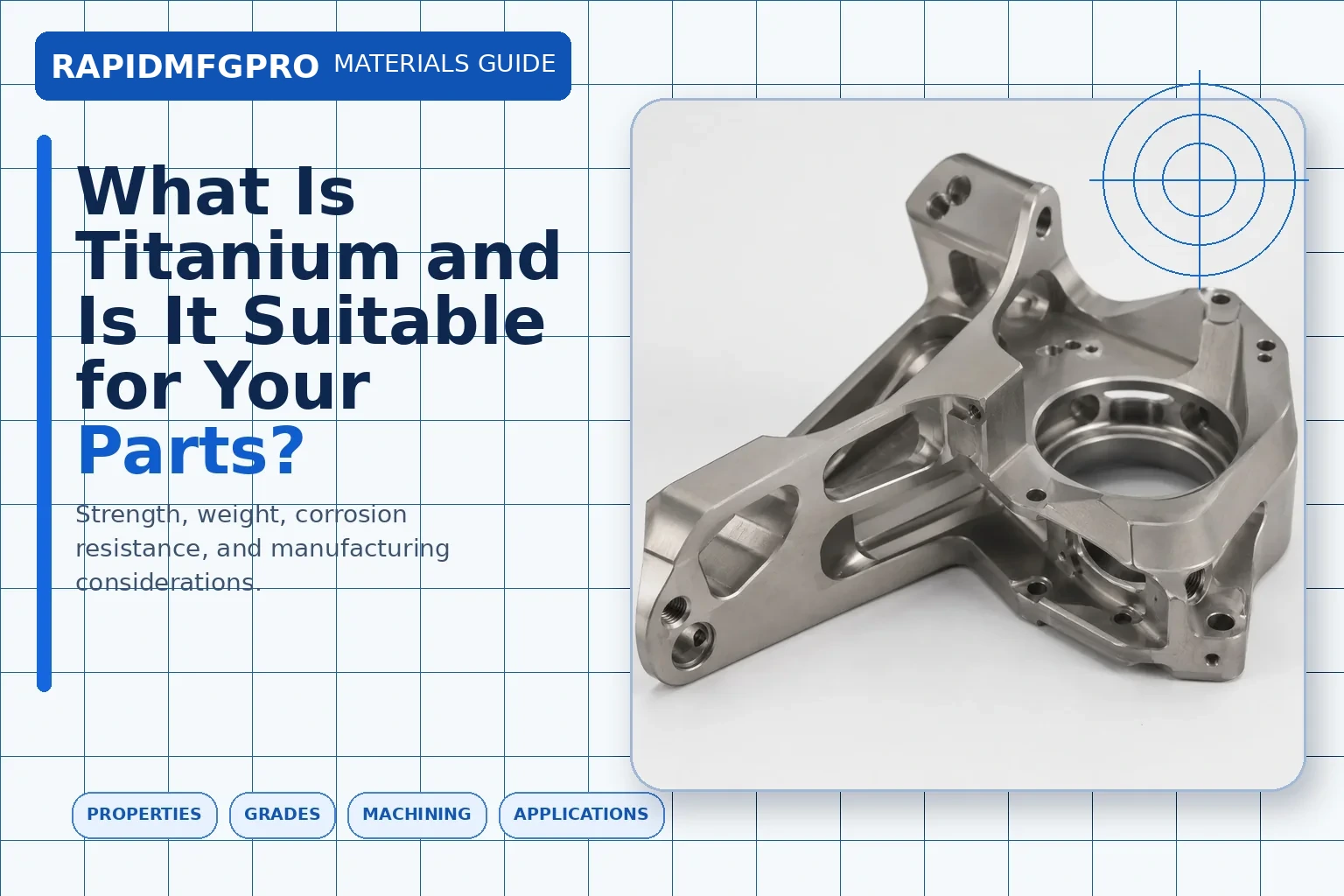
Titanium is often selected when a part must combine low weight, high strength, corrosion resistance, and reliable performance in demanding environments. It is widely used in aircraft, medical equipment, chemical-processing systems, marine assemblies, motorsport components, robotics, and high-performance industrial products.
However, titanium is not automatically the best material for every precision part. It is more expensive than common aluminum and steel grades, it removes heat poorly during cutting, and it can increase tool wear, cycle time, inspection effort, and material lead time. A titanium part is usually successful when the design takes advantage of titanium’s specific strengths rather than using it as a general upgrade.
RapidMFGPro evaluates titanium projects from a manufacturing supplier-matching perspective. The platform reviews the drawing, alloy, product form, quantity, geometry, surface condition, inspection scope, and application risk before identifying suppliers with suitable titanium experience. This is especially important because a supplier that routinely machines aluminum may not have the tooling, process control, material traceability, or finishing resources required for titanium.
This guide explains what titanium is, how its grades differ, when it is suitable for a part, how it is manufactured, and what engineers and buyers should confirm before production.
Is Titanium Suitable for Your Part?
The most useful way to evaluate titanium is to begin with the functional problem. Titanium is suitable when its performance advantages solve a real design constraint, but it may be unnecessary when a lower-cost material can meet the same requirements.
When Titanium Is a Strong Candidate
Titanium becomes a strong candidate when a component must carry meaningful load while remaining lighter than a comparable steel part. It is also useful when corrosion exposure makes ordinary steel difficult to protect or when a part must perform reliably around saltwater, body fluids, oxidizing chemicals, or repeated thermal cycles.
Typical reasons to specify titanium include:
- High strength-to-weight requirements
- Severe corrosion exposure
- Medical or laboratory compatibility requirements
- Elevated service temperature
- Fatigue-sensitive loading
- Limited installation space
- Long service life in difficult environments
Titanium is most valuable when several of these requirements occur at the same time. A lightweight, corrosion-resistant, high-strength bracket in an aircraft or marine system is a more convincing titanium application than a low-load indoor mounting plate.
When Titanium May Be Excessive
Titanium may be excessive when the part is lightly loaded, used indoors, protected from corrosion, and not exposed to high temperature. In these situations, aluminum, stainless steel, alloy steel, or an engineering plastic may provide sufficient performance at lower cost.
Titanium can also be a poor choice when the design contains large amounts of removable stock, very deep small-diameter holes, broad thin walls, or extensive low-value surfaces that do not benefit from its properties. These features increase machining time without increasing part performance.
How to Make the Initial Decision
The initial decision should compare the full component requirement rather than material price alone. A titanium blank is expensive, but it may reduce coating, maintenance, replacement, or assembly costs over the service life of the product.
| Project Requirement | Titanium Suitability | Reason |
|---|---|---|
| High load with strict weight limit | Strong | High specific strength can reduce mass |
| Saltwater or chloride exposure | Strong | Many titanium grades provide excellent corrosion resistance |
| Low-load indoor bracket | Weak | Aluminum or steel may meet the requirement at lower cost |
| Repeated contact with body fluids | Strong | Selected grades are widely used in medical applications |
| Very high production volume | Conditional | Material utilization and process selection become critical |
| Part requires extensive welding | Conditional | Clean shielding and titanium welding expertise are required |
| Part requires maximum electrical conductivity | Weak | Copper or aluminum is generally more suitable |
What Is Titanium?
Titanium is a metallic chemical element used as pure titanium and as the base of many engineering alloys. Its industrial value comes from the relationship between low density, useful mechanical strength, and a stable surface oxide film.
Titanium as an Element
Titanium has the chemical symbol Ti and atomic number 22. It is a silver-gray transition metal with a density between that of aluminum and steel.
Titanium is not usually found in nature as free metal. It occurs in mineral compounds and must be processed through energy-intensive extraction and refining steps before it becomes usable metallic material. This production route contributes to the higher cost of titanium compared with common structural metals.
Titanium as an Engineering Material
Commercial titanium is supplied as commercially pure grades or alloyed grades. Alloying additions such as aluminum, vanadium, molybdenum, niobium, zirconium, tin, and iron change strength, formability, temperature resistance, corrosion behavior, and heat-treatment response.
A drawing should identify the exact titanium grade rather than using the general term titanium. Grade 2, Grade 5, and Grade 23 differ significantly in strength, machining behavior, cost, and typical application.
Titanium Product Forms
Titanium is available in multiple product forms. The selected form influences material cost, grain flow, dimensional stability, stock allowance, certification, and manufacturing method.
Common forms include:
- Sheet
- Plate
- Round bar
- Forged billet
- Tube
- Wire
- Cast blank
- Additively manufactured preform
RapidMFGPro considers product form during supplier matching because machining a part from rectangular plate may require a different supplier and cost structure than producing it from a forging or near-net-shape preform.
What Makes Titanium Different?
Titanium is not the lightest metal, the strongest metal, or the most corrosion-resistant material in every environment. Its value comes from combining several useful properties in one material system.
Specific Strength
Specific strength compares strength with density. Titanium alloys can provide high strength without the mass of many steels and nickel alloys.
This property is important in aerospace structures, racing components, mobile robotics, and rotating systems where reduced mass can improve efficiency or dynamic response.
Corrosion Resistance
Titanium forms a thin, adherent oxide film that protects the underlying metal in many environments. This passive film can reform when the surface is damaged and oxygen is available.
Titanium performs particularly well in many chloride-containing and oxidizing environments. The exact corrosion behavior still depends on grade, temperature, concentration, crevices, surface condition, and contact with other materials.
Temperature Capability
Titanium generally retains useful mechanical properties at temperatures above those suitable for many common aluminum alloys. This makes selected grades useful near engines, exhaust systems, aerospace equipment, and industrial heat sources.
Titanium is not a universal high-temperature material. At sufficiently high temperature, oxidation, embrittlement, creep, or loss of mechanical performance can become limiting factors.
Biological Compatibility
Selected titanium grades are widely used in medical and dental devices because of their corrosion resistance, low magnetic response, and compatibility with biological environments.
Medical use depends on more than alloy choice. Manufacturing cleanliness, surface condition, traceability, validation, regulatory control, and packaging may be as important as the base material.
How Does Titanium Compare With Other Metals?
Titanium is often compared with aluminum and stainless steel during material selection. The best choice depends on whether the project prioritizes weight, stiffness, corrosion resistance, machining cost, heat transfer, or absolute strength.
Titanium Compared With Aluminum
Titanium is denser and more difficult to machine than aluminum, but many titanium alloys provide much higher strength and better temperature performance.
Aluminum is usually more suitable for heat sinks, general housings, low-cost structures, and high-volume machined parts. Titanium is more suitable when high load, corrosion, fatigue, or temperature makes aluminum inadequate.
Titanium Compared With Stainless Steel
Titanium is lighter than stainless steel and can offer excellent corrosion performance in selected environments. Stainless steel is usually less expensive and often easier to source.
Stainless steel may be preferred where stiffness, wear resistance, high-volume manufacturing, or material price dominates the decision. Titanium may be preferred when weight reduction and corrosion resistance justify the premium.
Titanium Compared With Nickel Alloys
Nickel alloys can provide superior performance in some high-temperature or highly aggressive chemical environments. They are also dense and can be difficult to machine.
Titanium may be more attractive when lower mass is important and the service temperature remains within the suitable range for the selected titanium grade.
| Material Family | Relative Density | Relative Stiffness | Machining Difficulty | Typical Strength | Typical Cost |
|---|---|---|---|---|---|
| Aluminum alloys | Low | Low | Low | Low to high | Low to moderate |
| Titanium alloys | Moderate | Moderate | High | Moderate to very high | High |
| Stainless steels | High | High | Moderate to high | Moderate to high | Moderate |
| Nickel alloys | High | High | Very high | High | High to very high |
The table provides a general engineering comparison. Final selection should use the actual grade, product form, heat treatment, service temperature, environment, and required standard.
Which Titanium Grades Are Common?
Titanium grades are selected according to the balance of strength, corrosion resistance, formability, fatigue performance, temperature capability, and medical or aerospace requirements.
Grade 1 Titanium
Grade 1 is one of the softest commercially pure titanium grades. It provides excellent formability and high corrosion resistance, but its strength is relatively low.
It is used for formed sheet, heat exchangers, chemical equipment, cladding, and applications that require substantial deformation.
Grade 2 Titanium
Grade 2 is the most widely used commercially pure titanium grade. It offers a useful balance of strength, ductility, weldability, and corrosion resistance.
Typical applications include chemical-processing equipment, marine parts, heat exchangers, pressure components, laboratory equipment, and selected medical devices.
Grade 4 Titanium
Grade 4 is the strongest commonly used commercially pure titanium grade. It retains good corrosion resistance while providing higher strength than Grades 1 and 2.
It may be selected for medical, dental, marine, and industrial components that need commercially pure titanium with higher load capacity.
Grade 5 Titanium
Grade 5, commonly known as Ti-6Al-4V, is the most widely used titanium alloy. It provides high strength, useful fatigue performance, and broad availability in aerospace and industrial supply chains.
It is used for aircraft structures, fasteners, high-load brackets, rotating components, motorsport parts, robotics, tooling, and performance-critical machined parts.
Grade 9 Titanium
Grade 9, commonly known as Ti-3Al-2.5V, provides higher strength than commercially pure titanium while retaining useful formability and weldability.
It is often supplied as tubing and is used in aerospace hydraulic systems, bicycle frames, sports products, and lightweight structural assemblies.
Grade 23 Titanium
Grade 23 is an extra-low-interstitial version of Ti-6Al-4V. It is often selected when improved fracture toughness, ductility, or medical-device compatibility is required.
It is widely associated with surgical instruments, orthopedic components, dental products, and other controlled medical applications.
Beta Titanium Alloys
Beta and near-beta titanium alloys use additions such as molybdenum, vanadium, chromium, niobium, or iron to stabilize the beta phase.
These alloys may provide very high strength, deep hardenability, lower elastic modulus, or specialized forming performance. They are used in aerospace, medical, spring, fastener, and advanced structural applications.
| Grade | Material Type | Relative Strength | Key Characteristic | Typical Application |
|---|---|---|---|---|
| Grade 1 | Commercially pure | Low | High formability | Formed chemical equipment |
| Grade 2 | Commercially pure | Moderate | Balanced corrosion performance | Marine and process equipment |
| Grade 4 | Commercially pure | Moderate to high | Highest strength among common CP grades | Medical and industrial parts |
| Grade 5 | Alpha-beta alloy | High | Broad structural use | Aerospace and high-load parts |
| Grade 9 | Alpha-beta alloy | Moderate to high | Useful tubing performance | Aerospace tubing and sports products |
| Grade 23 | Alpha-beta ELI alloy | High | Improved ductility and toughness | Medical devices |
Why Is Titanium Difficult to Manufacture?
Titanium is often described as difficult to machine, but the challenge comes from several specific material behaviors. Understanding these behaviors helps engineers avoid designs that create unnecessary cycle time or quality risk.
Low Thermal Conductivity
Titanium conducts cutting heat away from the tool poorly. A large share of the heat remains near the cutting edge, which can accelerate tool wear.
Tool selection, cutting speed, feed, coolant delivery, and engagement must be controlled to prevent excessive heat concentration.
Elastic Recovery
Titanium can deflect away from the cutting tool and then spring back. This behavior can cause rubbing, dimensional variation, chatter, or an unstable finish.
Sharp tools, rigid workholding, controlled tool engagement, and stable machine construction help reduce these effects.
Chemical Reactivity
Titanium becomes reactive at elevated temperature. During cutting or welding, this can promote tool adhesion, contamination, or surface damage.
Clean processing conditions and correct shielding are especially important for welding and high-temperature treatment.
Galling Tendency
Titanium can gall when titanium surfaces slide against each other or against certain metals under load. Galling can damage threads, sliding fits, and assembly surfaces.
Suitable coatings, lubricants, surface treatments, inserts, material pairing, or design clearance may be required.
How Is Titanium CNC Machined?
CNC machining is widely used for titanium prototypes, precision components, aerospace parts, medical equipment, and low-to-medium-volume production. Successful machining depends on rigid setups, controlled heat, sharp tooling, and realistic geometry.
Titanium Milling
Milling is used for brackets, housings, structural fittings, medical instruments, mounts, and complex prismatic parts.
Stable engagement is important. Sudden tool loading, excessive radial engagement, and poor chip evacuation can increase heat and shorten tool life. Tool paths should maintain consistent cutting conditions whenever possible.
Titanium Turning
Turning is used for shafts, fasteners, rings, sleeves, connectors, threaded parts, and cylindrical medical components.
Long slender titanium parts may deflect during cutting. Support, tool geometry, depth of cut, and sequence should be planned to control taper and chatter.
Titanium Drilling
Drilling titanium can be difficult because heat concentrates at the cutting edge and chips may not evacuate easily from deep holes.
Deep holes, small diameters, and high length-to-diameter ratios can add substantial cycle time. Designers should avoid unnecessarily deep holes and should allow practical drill access.
Titanium Threading
Threads can be produced by tapping, thread milling, turning, or forming depending on the grade, diameter, depth, and production requirement.
Thread milling may be preferred for costly parts because it offers better control and reduces the risk of losing the entire component if a tap breaks.
Five-Axis Titanium Machining
Five-axis machining is used for aerospace structures, impellers, medical components, and parts with angled surfaces or complex tool access.
It can reduce setups and improve feature relationships, but it requires experienced programming, stable fixturing, appropriate tooling, and capable inspection.
How Is Titanium Formed?
Titanium sheet and tube can be formed into useful shapes, but springback, temperature, grain direction, and tooling condition must be considered. Formability varies significantly by grade and temper.
Cold Forming
Commercially pure titanium can be formed at room temperature for selected geometries. Grade 1 and Grade 2 are commonly chosen when substantial ductility is required.
Tight radii and severe deformation increase the risk of cracking or excessive springback.
Warm Forming
Warm forming uses controlled heat to reduce forming force and improve shape control. It may be used for stronger titanium alloys or more demanding geometries.
Temperature must be managed carefully because overheating or contamination can affect surface and mechanical properties.
Tube Forming
Titanium tube is used in aerospace, chemical-processing, heat-exchanger, sports, and medical applications. Bending may require internal support, controlled tooling, and allowances for springback.
Wall thinning, ovality, wrinkling, and surface damage should be included in the inspection plan.
How Is Titanium Forged?
Forging is used when a titanium component requires favorable grain flow, high structural integrity, or a near-net-shape blank that reduces machining waste.
Open-Die Forging
Open-die forging is suitable for larger billets, rings, discs, and low-volume structural blanks. The process can improve internal structure compared with a simple cast blank.
Machining allowance is normally required because the forged surface and dimensions are not final.
Closed-Die Forging
Closed-die forging uses shaped tooling to produce a blank closer to the finished geometry. It is suitable for repeated structural parts such as aerospace fittings and high-load components.
Tooling investment is higher, so annual quantity and material savings should justify the process.
Forging Inspection
Forged titanium parts may require ultrasonic inspection, dimensional verification, heat-treatment records, surface inspection, and material traceability.
The inspection scope depends on the industry, loading, drawing, and applicable material standard.
How Is Titanium Cast?
Titanium casting can produce complex shapes with lower material waste than machining the same part from a large billet. The process is technically demanding because molten titanium is highly reactive.
Investment Casting
Investment casting is commonly used for titanium components with complex external geometry, integrated features, or quantities that justify tooling.
Critical holes, datums, sealing surfaces, and threaded features usually require secondary machining.
Casting Defects
Potential concerns include shrinkage, porosity, inclusions, surface reaction, incomplete filling, and dimensional variation.
The supplier should define the inspection method for internal and external defects before production.
When Casting Is Appropriate
Casting may be appropriate when the part has complex shape, expensive machining waste, integrated ribs, or repeated production demand.
It may not be economical for a simple prototype when CNC machining from available stock can deliver the part faster without casting tooling.
Can Titanium Be Additively Manufactured?
Titanium is widely used in metal additive manufacturing because the process can produce complex, weight-optimized, patient-specific, or low-volume parts that are difficult to machine from solid stock.
Powder Bed Fusion
Laser powder bed fusion builds a titanium part layer by layer from metal powder. Ti-6Al-4V and Ti-6Al-4V ELI are common material choices.
The process is useful for lattice structures, internal channels, medical implants, aerospace brackets, and low-volume complex parts.
Post-Processing
Printed titanium parts usually require support removal, heat treatment, surface finishing, and CNC machining on critical interfaces.
Hot isostatic pressing may be specified when internal defect reduction and improved consistency are required.
Additive Manufacturing Limits
Additive manufacturing does not eliminate all tooling or finishing. Surface roughness, support access, residual stress, build orientation, inspection, and powder traceability remain important.
A supplier should be matched according to both printing capability and post-processing capability.
Which Titanium Process Fits the Quantity?
Quantity influences whether a titanium part should be machined from stock, produced from a forging, cast, formed, or additively manufactured. The correct process balances tooling, material utilization, cycle time, precision, and supply risk.
| Process | Typical Quantity | Main Advantage | Main Limitation | Typical Part |
|---|---|---|---|---|
| CNC machining | Prototype to medium volume | No production mold | High material removal cost | Brackets and housings |
| Sheet forming | Low to high volume | Efficient thin structures | Springback and bend limits | Panels and covers |
| Forging | Medium to high volume | Favorable grain flow | Tooling investment | Structural fittings |
| Investment casting | Low to medium volume | Complex near-net shape | Process qualification | Integrated housings |
| Additive manufacturing | Prototype to low volume | Complex internal geometry | Post-processing demand | Lattice and medical parts |
Prototype Quantity
CNC machining is often the fastest route for a prototype when suitable titanium stock is available. It avoids casting or forging tooling and allows rapid design changes.
Pilot Quantity
Pilot production may continue with machining while the design is validated. This stage is useful for identifying material removal, fixture, inspection, and finishing risks.
Production Quantity
Higher quantities may justify a forging, casting, formed blank, or additive preform that reduces machining waste and cycle time.
The final decision should include tooling amortization, scrap rate, material lead time, process validation, and secondary machining.
How Should Titanium Parts Be Designed?
Titanium parts should be designed to use the material where its properties create value. Geometry should reduce unnecessary stock removal, maintain tool access, control distortion, and avoid fragile features.
Use Near-Net Geometry
Large rectangular blanks can create high material cost when most of the stock must be removed. Forgings, shaped plate, tube, formed sheet, castings, or additive preforms may reduce waste.
Near-net geometry becomes more important as part size and annual quantity increase.
Limit Deep Cavities
Deep narrow cavities require long cutting tools. Tool deflection, vibration, heat concentration, and chip removal become more difficult.
Increasing the opening, reducing depth, dividing the assembly, or machining from another side may improve manufacturability.
Use Practical Corner Radii
Large internal radii allow stronger tools and more stable cutting. Very small radii may require smaller cutters, additional operations, and longer cycle time.
The radius should be selected according to function rather than cosmetic preference alone.
Control Thin Walls
Thin titanium walls can deflect during machining and spring back after cutting. Their low stiffness relative to steel can make dimensional control difficult.
Ribs, local thickness, staged machining, balanced stock removal, and stable fixturing can improve results.
Assign Tolerances Selectively
Tight tolerances increase machining time, inspection effort, and scrap risk. They should be applied to sealing, alignment, bearing, and mating features that affect function.
General surfaces can normally use broader tolerances.
How Should Titanium Threads Be Designed?
Titanium threads require attention because galling, high friction, and repeated assembly can damage the mating surfaces. Thread design should consider load, assembly frequency, lubrication, and mating material.
Thread Engagement
The required engagement length depends on thread size, titanium grade, load, mating material, and joint design.
Excessively deep threads may add machining cost without increasing useful joint strength.
Thread Inserts
Helical or solid inserts can improve durability in repeatedly assembled joints. They are common in aerospace, motorsport, robotics, and serviceable equipment.
Insert type, installation depth, locking method, and pull-out requirement should be shown on the drawing.
Galling Prevention
Galling risk can be reduced through compatible mating materials, coatings, lubricants, controlled surface finish, and correct tightening torque.
Dry titanium-to-titanium threaded contact should be reviewed carefully.
Which Surface Treatments Suit Titanium?
Titanium often performs well without a thick protective coating, but surface treatment may be used to improve appearance, wear, friction, identification, fatigue behavior, or biological response.
Titanium Anodizing
Titanium anodizing can create controlled oxide layers and visible colors without using conventional pigments. Color depends mainly on oxide thickness and light interference.
Anodizing is used for identification, decorative parts, medical instruments, fasteners, and selected aerospace components.
Passivation
Titanium passivation processes remove contamination and support a clean oxide surface. The exact cleaning and passivation route depends on the application and governing specification.
Medical, laboratory, and corrosion-sensitive components may require controlled chemistry, rinsing, drying, and cleanliness records.
Polishing
Mechanical polishing can improve appearance, reduce surface roughness, and remove machining marks.
Excessive polishing can change edge condition or dimensions, so critical features should be protected.
Bead Blasting
Bead blasting creates a uniform matte appearance and can reduce visible tool marks.
Media type, pressure, cleanliness, and contamination control are important. Media previously used on steel can contaminate titanium surfaces.
PVD Coating
Physical vapor deposition can provide decorative color, reduced friction, or improved wear performance.
Coating selection should match the substrate condition, service temperature, contact stress, and required adhesion.
DLC Coating
Diamond-like carbon coatings can reduce friction and improve wear performance on selected titanium components.
The coating system must be engineered for the load and interface. A hard coating cannot compensate for poor geometry or excessive contact pressure.
| Treatment | Main Purpose | Typical Appearance | Key Design Concern |
|---|---|---|---|
| Anodizing | Identification or appearance | Colored oxide | Color consistency |
| Passivation | Clean surface condition | Minimal visible change | Chemistry and cleanliness |
| Polishing | Smoothness or appearance | Bright or controlled finish | Edge and dimension control |
| Bead blasting | Uniform matte texture | Matte gray | Media contamination |
| PVD coating | Wear or decorative color | Metallic color | Adhesion and coating thickness |
| DLC coating | Low friction and wear resistance | Dark gray to black | Contact stress |
Where Is Titanium Used?
Titanium is used where its combination of weight, strength, corrosion resistance, fatigue performance, or biological compatibility provides a measurable advantage over more common materials.
Aerospace Parts
Aerospace applications include structural fittings, engine components, fasteners, landing-system parts, hydraulic components, brackets, and satellite hardware.
These parts may require certified material, strict traceability, first-article inspection, nondestructive testing, and controlled finishing.
Medical Parts
Medical applications include surgical instruments, orthopedic components, dental products, equipment housings, and implant-related components.
Medical projects may require controlled material grade, cleanliness, surface condition, validation, documentation, and packaging.
Marine Parts
Marine applications include fasteners, heat exchangers, shafts, pump components, underwater equipment, and corrosion-resistant fittings.
Titanium can reduce maintenance in chloride exposure, but crevice conditions, contact materials, and service temperature should still be reviewed.
Chemical-Processing Parts
Chemical-processing equipment uses titanium for heat exchangers, vessels, piping components, valves, and process hardware.
Grade selection should be based on the actual chemical, concentration, temperature, flow condition, and crevice geometry.
Automotive Parts
Automotive and motorsport applications include connecting rods, valves, exhaust components, fasteners, suspension parts, and lightweight brackets.
Titanium is usually reserved for high-performance or weight-sensitive applications because material and manufacturing costs are high.
Robotic Parts
Robotics applications include arm links, compact joints, end-effector components, high-strength fasteners, and corrosion-resistant parts.
Low moving mass can improve response, while high strength can support compact geometry. Stiffness should still be checked because titanium is less stiff than steel.
What Should Be Specified on a Titanium Drawing?
A clear titanium drawing reduces quotation differences and production risk. The supplier should not need to guess the material condition, finish, datum system, or inspection standard.
Material Grade
Specify the exact grade, applicable standard, product form, and heat-treatment condition. Grade 5 and Grade 23 should not be treated as interchangeable.
Critical Datums
Datums should reflect how the part functions in the assembly. Critical bores, mounting faces, and sealing surfaces should be related to these datums.
Surface Requirement
Define roughness, polishing, blasting, anodizing, coating, passivation, or cleaning requirements where they affect function or appearance.
Edge Requirement
State whether edges require deburring, a controlled radius, a chamfer, or a sharp functional condition.
General notes such as “break all sharp edges” should include a practical range when the edge condition is important.
Inspection Requirement
Identify dimensions requiring full inspection, sampling, first-article reporting, nondestructive testing, leak testing, or functional verification.
What Should Be Included in a Titanium RFQ?
Titanium quotations depend heavily on material, geometry, documentation, and inspection. A complete request allows suppliers to quote from the same assumptions.
Technical Files
Provide a 3D CAD model and a controlled 2D drawing. The model defines geometry, while the drawing defines acceptance requirements.
Quantity
State prototype quantity, initial order quantity, and estimated annual demand. These values affect the choice between stock machining, forging, casting, forming, and additive manufacturing.
Material Documentation
Specify whether the project requires a material certificate, heat number, country-of-origin statement, aerospace traceability, or medical-grade documentation.
Quality Documentation
Identify whether the supplier must provide a dimensional report, first-article inspection, certificate of conformity, coating certificate, heat-treatment record, or nondestructive-test report.
Delivery Requirement
State the delivery destination, required date, packaging expectations, and whether partial delivery is acceptable.
Titanium stock availability can affect lead time, so the material requirement should be reviewed before committing to an aggressive schedule.
How Does RapidMFGPro Evaluate Titanium Projects?
RapidMFGPro evaluates titanium projects by identifying the technical capabilities needed for production and comparing those needs with suitable supplier resources.
Material Review
The material review confirms grade, standard, product form, certification, stock availability, and traceability.
This prevents quotations based on an easier or more available grade that does not meet the drawing.
Manufacturing Review
The manufacturing review considers geometry, material removal, tool access, wall thickness, hole depth, thread type, quantity, and finishing.
The goal is to determine whether the part should be machined from stock or produced from a more efficient blank.
Supplier Capability Review
Potential suppliers are compared according to titanium machining experience, machine rigidity, tooling, coolant delivery, welding control, finishing resources, inspection equipment, and production capacity.
General CNC capability alone is not enough for a demanding titanium project.
Quality Review
The quality review confirms the proposed inspection method, material records, critical-feature checks, surface verification, packaging, and required reports.
The exact quality scope remains part of the purchase requirement and should be agreed before production.
How Should Titanium Parts Be Inspected?
Titanium inspection should confirm material identity, dimensional conformity, surface condition, internal integrity when required, and functional performance.
Material Verification
Material verification may include grade, heat number, certificate review, product form, and positive material identification.
Traceability is especially important for aerospace, medical, pressure, and safety-critical parts.
Dimensional Inspection
Dimensional inspection may use calipers, micrometers, bore gauges, thread gauges, height gauges, optical systems, and coordinate measuring machines.
Thin or flexible features should be measured using a method that does not distort the part.
Surface Inspection
Surface inspection looks for scratches, burrs, chatter, heat discoloration, tool marks, contamination, coating defects, and damaged edges.
Cosmetic criteria should identify controlled surfaces and acceptable defect limits.
Nondestructive Testing
Nondestructive testing may include liquid penetrant inspection, ultrasonic inspection, radiography, or other methods depending on the material form and application.
The test method and acceptance standard should be defined on the drawing or purchase specification.
Functional Testing
Functional checks may include thread assembly, leak testing, pressure testing, fit verification, torque testing, fatigue testing, or trial assembly.
A part can pass dimensional inspection and still fail at a seal, joint, or mating interface.
What Common Problems Occur With Titanium Parts?
Most titanium manufacturing problems are linked to heat, tool wear, contamination, unstable geometry, unclear specifications, or an unsuitable production route.
Premature Tool Wear
Tool wear can cause dimensional drift, poor finish, burrs, and increased cost. Cutting conditions and tool replacement strategy should be controlled.
Part Distortion
Thin walls, asymmetric material removal, residual stress, and clamping can cause distortion.
Roughing strategy, rest periods, intermediate inspection, and final finishing may be required.
Heat Discoloration
Welding or thermal treatment can create discoloration when shielding or cleanliness is inadequate.
Severe discoloration may indicate oxygen contamination and should not be treated as a cosmetic issue alone.
Thread Galling
Galling can damage threads during assembly. Coatings, lubricants, inserts, material pairing, and torque control can reduce risk.
Material Substitution
Substituting Grade 5 for Grade 23 or commercially pure titanium for an alloy can change strength, ductility, fatigue behavior, and application suitability.
Any substitution should require engineering approval.
Frequently Asked Questions About Titanium
These questions address common decisions that engineers and buyers face when considering titanium for precision parts.
Is Titanium Stronger Than Steel?
Some titanium alloys provide high strength, but many steels have equal or greater absolute strength and higher stiffness. Titanium’s main structural advantage is high strength relative to weight.
Is Titanium Lighter Than Aluminum?
No. Titanium is significantly denser than aluminum. Titanium may still produce a lighter part than steel when its strength allows a smaller section.
Is Titanium Difficult to Machine?
Titanium is more difficult to machine than common aluminum and many steels because heat remains near the cutting edge, tool wear can be rapid, and the material may deflect or gall.
Can Titanium Be Welded?
Yes. Titanium can be welded successfully, but the weld and heated area must be protected from atmospheric contamination with effective shielding. Cleanliness and welding experience are critical.
Does Titanium Rust?
Titanium does not rust like carbon steel. It forms a protective oxide film. It can still corrode under unsuitable chemical, crevice, temperature, or galvanic conditions.
Is Titanium Suitable for Medical Parts?
Selected titanium grades are widely used in medical applications. Suitability also depends on cleanliness, surface condition, traceability, manufacturing controls, validation, and regulatory requirements.
Conclusion
Titanium is suitable for parts that genuinely benefit from high specific strength, corrosion resistance, fatigue performance, temperature capability, or biological compatibility. It is less suitable when the project is driven mainly by low cost, high conductivity, simple indoor service, or extensive material removal. Successful titanium production requires the correct grade, realistic geometry, appropriate product form, controlled machining, clear inspection requirements, and a supplier with relevant titanium experience. RapidMFGPro supports this process by reviewing the technical package and matching projects with suppliers whose manufacturing, finishing, traceability, and quality capabilities fit the actual requirement.
Need Help Reviewing a Custom Part?
Share your CAD file and requirements to request supplier matching. Supplier capability and commercial terms must be verified before order placement.
Request Supplier Match