Time to read: 8 min
What Payment, Shipping, and Delivery Terms Should You Confirm Before Ordering CNC Parts?
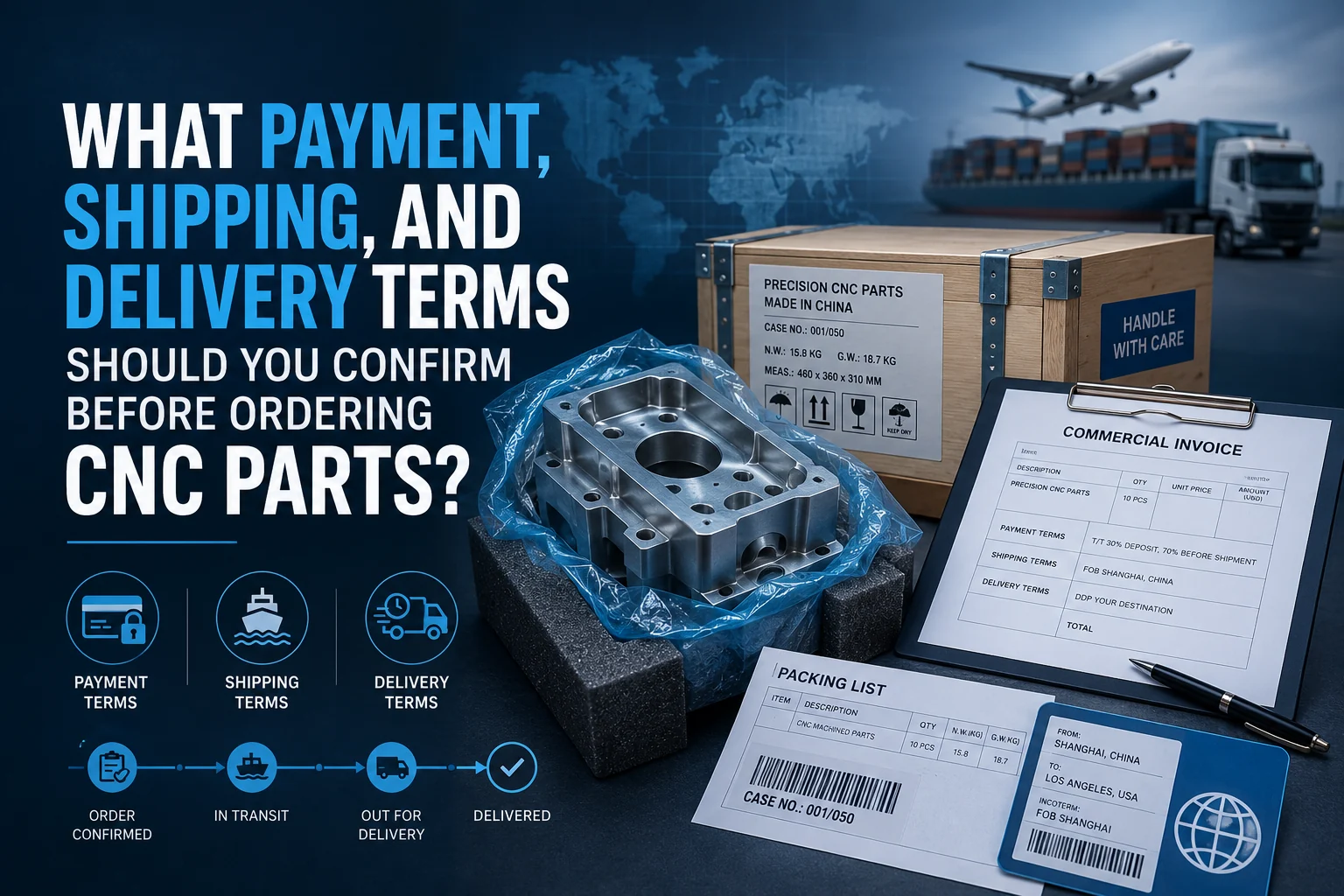
Ordering CNC-machined parts involves more than approving a drawing and accepting a unit price. Payment, shipping, and delivery terms determine when production begins, who carries financial and transportation risk, which documents must be supplied, who clears the shipment through customs, and what happens when parts arrive late, damaged, incomplete, or nonconforming.
Many purchasing disputes begin because both parties use familiar words differently. “Lead time” may begin when the purchase order is received, when the deposit clears, when the drawing is approved, or when material arrives. “FOB price” may be stated without a named port. “Balance before shipment” may not define which inspection records the buyer receives before payment. “Delivery” may mean that the parts left the factory rather than that they reached the buyer.
These details are especially important for custom CNC parts because the goods are made to a specific drawing and may have limited resale value. Suppliers often need a deposit to purchase material and reserve capacity. Buyers, meanwhile, need evidence that the parts meet the specification before releasing the final payment or accepting the shipment.
The safest approach is to map the commercial transaction from purchase order to final acceptance. The agreement should identify payment milestones, currency, bank charges, tooling ownership, the applicable Incoterms rule and named place, customs responsibilities, shipping documents, packaging, production and transit lead times, inspection rights, claims procedures, and remedies for delay or nonconformance.
This guide explains the main terms to confirm before ordering CNC parts from a domestic or international supplier and shows how RapidMFGPro supports clearer supplier matching and transaction preparation.
Build a Transaction Timeline Before Discussing Individual Terms
Payment, production, inspection, and shipping should not be negotiated as unrelated topics. Each milestone should connect to a defined event and a required document.
Identify the Events That Control the Order
A typical CNC order may include:
- Purchase order issued
- Deposit or initial payment received
- Drawing, DFM, and material approved
- Production slot confirmed
- First article completed
- First article approved
- Batch production completed
- Final inspection documents issued
- Balance payment received
- Goods handed to the carrier
- Import clearance completed
- Goods delivered and accepted
Not every order needs every stage. The important point is that both parties understand which event triggers the next obligation.
Separate Production Completion from Shipment and Delivery
These are different dates:
- Production completion date: parts have completed the agreed manufacturing route.
- Ready-to-ship date: inspection, documentation, and packaging are complete.
- Shipment date: goods are handed to the carrier or depart under the agreed transport method.
- Estimated arrival date: transport provider’s expected arrival.
- Delivery date: goods reach the contractually named place.
- Acceptance date: buyer completes the agreed receiving or quality review.
A supplier can meet the production date and still miss the buyer’s required arrival date if transit and customs time were not included.
State Which Documents Prove Each Milestone
Examples include:
- Payment receipt
- Approved drawing or DFM record
- First-article report
- Final dimensional report
- Certificate of conformity
- Commercial invoice
- Packing list
- Air waybill or bill of lading
- Delivery receipt
| Milestone | Evidence | Possible payment connection |
|---|---|---|
| Order release | Accepted purchase order and controlled drawing | Deposit becomes due |
| Material purchase | Material order or certificate when available | Included in deposit or separate material payment |
| First article | Sample, report, and approval record | Second milestone payment where agreed |
| Batch completion | Final inspection and completion notice | Balance becomes due |
| Shipment | Carrier document and packing list | Payment before shipment or against documents |
| Delivery | Signed delivery record | Open-account payment period may begin |
| Acceptance | Receiving inspection or acceptance confirmation | Retention or final portion released if agreed |
Which Payment Method Should You Use?
The payment method should balance the supplier’s risk of producing custom goods with the buyer’s risk of paying before conformity is demonstrated.
Cash in Advance and Bank Transfer
The U.S. International Trade Administration explains that cash-in-advance terms protect the exporter from nonpayment because funds are received before ownership transfers. Wire transfers are a common international cash-in-advance method.
For CNC orders, cash in advance may mean:
- 100% before production
- A deposit before production and balance before shipment
- Payment for tooling and material before machining
Full advance payment creates the greatest buyer exposure and is more appropriate when the supplier relationship is established, the order is small, or an independent platform or other safeguard is used.
Letter of Credit
A letter of credit is a bank commitment to pay when the seller presents documents that comply with the credit terms. The U.S. International Trade Administration describes letters of credit as a tool designed to protect both exporter and importer in international transactions.
Documentary credits are commonly governed by ICC UCP 600 when the credit incorporates those rules. They can be useful for larger transactions or new cross-border relationships, but they add:
- Bank fees
- Document preparation
- Risk of document discrepancies
- Longer administrative time
The credit must describe documents precisely. Banks examine documents, not the physical CNC parts, so a letter of credit does not replace technical inspection.
Documentary Collection, Open Account, and Escrow
Other possible arrangements include:
- Documentary collection: banks handle shipping and payment documents but do not provide the same payment undertaking as a letter of credit.
- Open account: supplier ships before payment, such as net 30 days after invoice or delivery.
- Escrow: a third party holds funds until defined conditions are met.
Open-account terms are attractive to buyers but require supplier confidence in the buyer’s credit and the legal recoverability of payment. Escrow terms must define exactly what evidence releases funds.
| Payment method | Buyer risk | Supplier risk | Best suited to |
|---|---|---|---|
| 100% cash in advance | High before conformity is demonstrated | Low payment risk | Small orders or established supplier relationships |
| Deposit plus balance before shipment | Moderate; buyer should require completion evidence | Moderate and commonly manageable | Custom CNC prototypes and production batches |
| Milestone payment | Lower when milestones are measurable | Lower than long open-account exposure | High-value, tooling-intensive, or long-duration projects |
| Letter of credit | Controlled through documentary conditions | Reduced when compliant documents are presented | Larger international orders or new relationships |
| Documentary collection | Depends on release terms and documents | Higher than a bank payment undertaking | Established international trade relationships |
| Open account | Low before payment | High credit and collection risk | Trusted recurring customers with approved credit |
| Escrow | Depends on release criteria and dispute process | Depends on platform terms and evidence | Selected new or platform-supported transactions |
How Should Deposits and Milestone Payments Be Structured?
Custom CNC work often requires a deposit because the supplier purchases material, prepares programs and fixtures, and reserves machine capacity for goods that may not be saleable to another customer.
Connect the Deposit to Real Upfront Cost
A deposit may cover:
- Raw material
- Custom tooling
- Fixture preparation
- Programming
- Reserved capacity
The percentage should reflect project risk rather than follow one fixed rule for every order.
Use Milestones for High-Value or Long Projects
A milestone structure may include:
- Deposit at order release
- Payment after first-article approval
- Payment after batch inspection
- Final payment before shipment or after delivery
Each milestone should have measurable acceptance evidence and a time limit for buyer review.
Define What Happens After a Buyer-Requested Change
If the buyer changes the drawing after material or tooling has been committed, the agreement should address:
- Noncancelable material
- Completed work
- Fixture modification
- Schedule change
- Additional inspection
The supplier should not reuse the original delivery commitment automatically after a material design change.
Confirm Currency, Bank Fees, and Payment Security
The invoice amount can change through currency conversion, intermediary-bank fees, and incorrect payment instructions.
State the Currency and Exchange-Rate Responsibility
Confirm:
- Quotation currency
- Invoice currency
- Whether price is fixed after order
- Who carries exchange-rate risk
- How long the quotation remains valid
Allocate Bank Charges
International transfers may involve:
- Sending-bank fees
- Intermediary-bank fees
- Receiving-bank fees
- Currency-conversion charges
State whether the supplier must receive the full invoice amount and which party pays each category of charge.
Verify Any Change in Bank Details Independently
Payment-redirection fraud can occur when an email account or invoice is compromised. Before sending funds to new bank details:
- Confirm through a known telephone or communication channel
- Verify the beneficiary company name
- Review whether the bank country is reasonable
- Require dual approval for changes
- Consider a small verification transfer for high-risk cases
Do not rely only on an email announcing revised bank instructions.
What Should Trigger the Final Payment?
“Balance before shipment” is common, but the buyer should define what must be completed before the payment request is valid.
Require Completion Evidence
Depending on the project, this may include:
- Finished-part photographs
- Final inspection report
- Material certificate
- Surface-treatment certificate
- Certificate of conformity
- Approved first-article status
- Packing list
Do Not Use Photographs as the Only Quality Evidence
Photographs can confirm quantity, appearance, and packaging preparation, but they cannot prove bore size, thread class, material chemistry, coating thickness, or hidden internal condition.
Define Retention Carefully
A buyer may request that a small portion remain unpaid until delivery or acceptance. Retention can protect the buyer, but it should state:
- Retention percentage
- Release event
- Acceptance time limit
- Allowed reasons for withholding
- Dispute process
An undefined retention can create an open-ended credit obligation for the supplier.
What Are Incoterms, and What Do They Not Cover?
Incoterms 2020 are eleven standardized trade terms issued by the International Chamber of Commerce. The U.S. International Trade Administration explains that they allocate responsibilities for shipment, insurance, documentation, customs clearance, costs, and risk between seller and buyer.
Incoterms Allocate Delivery Tasks, Costs, and Risk
An Incoterms rule helps identify:
- Where the seller delivers the goods
- Where transport risk transfers
- Who contracts carriage
- Who handles export clearance
- Who handles import clearance
- Whether the seller must arrange insurance
Incoterms Do Not Replace the Sales Contract
They do not fully determine:
- Payment timing
- Transfer of ownership or title
- Product acceptance
- Warranty
- Remedies for nonconformance
- Governing law
- Dispute resolution
These issues must be stated elsewhere in the contract or purchase order.
Always Include the Named Place and Version
A complete term should follow a format such as:
FCA [named place], Incoterms 2020
Writing only EXW, FOB, or DAP leaves the delivery point unclear.
How Do Common Incoterms Apply to CNC Part Orders?
The correct rule depends on transport mode, buyer and seller customs capability, control of freight, and where risk should transfer.
EXW and FCA
Under EXW, the seller’s obligation is comparatively limited at its premises. The buyer takes broad responsibility for collection, export, and transport. EXW can be difficult when the buyer cannot complete export formalities in the seller’s country.
FCA is often a practical alternative because the seller delivers the goods to the carrier at the named place and handles export clearance under the rule.
CPT, CIP, DAP, and DDP
These rules can be used for any mode or combination of modes:
- CPT: seller pays carriage to the named destination, while risk transfers at the rule’s delivery point.
- CIP: similar carriage arrangement with seller-provided insurance under the rule.
- DAP: seller delivers at the named destination ready for unloading; import responsibilities remain allocated according to the rule.
- DDP: seller takes extensive responsibility including import clearance and duties under the rule.
DDP should not be selected automatically. A foreign seller may be unable to act as importer of record or comply with local tax, customs, and regulatory requirements.
FAS, FOB, CFR, and CIF
FAS, FOB, CFR, and CIF are intended for sea or inland-waterway transport. ICC guidance states that FAS and FOB may be used only for maritime transport. ICC also notes that CIF is a maritime rule, while CIP can be used for multimodal transport.
For containerized CNC parts handed to a carrier before vessel loading, buyers should review whether FCA better matches the actual delivery point rather than using FOB as a general synonym for export price.
| Rule | Transport use | Typical CNC-order consideration |
|---|---|---|
| EXW | Any mode | Buyer controls collection but may face export-clearance difficulty |
| FCA | Any mode | Useful when seller delivers to buyer’s carrier and clears export |
| CPT | Any mode | Seller pays main carriage; buyer must understand earlier risk transfer |
| CIP | Any mode | Seller arranges carriage and required insurance under the rule |
| DAP | Any mode | Seller manages transport to named destination; buyer reviews import obligations |
| DDP | Any mode | Convenient to buyer but legally and operationally demanding for seller |
| FOB | Sea or inland waterway | Do not use automatically for courier, air, or container pickup |
| CIF | Sea or inland waterway | Seller arranges cost, insurance, and freight under the rule |
How Should You Select the Shipping Method?
The best method depends on shipment weight, dimensions, value, urgency, and customs complexity.
Courier and Express Parcel
Courier is often suitable for:
- Prototypes
- Small precision parts
- Urgent first articles
- Low-weight shipments
Confirm maximum package size, declared value, insurance, brokerage service, and whether duties are billed to sender or recipient.
Air Freight
Air freight can be economical for larger urgent shipments that exceed parcel limits. It may require separate airport handling, customs brokerage, and final delivery.
Sea, Rail, or Consolidated Freight
These methods may reduce freight cost for heavy production quantities but create longer transit and consolidation schedules.
Review:
- Port or terminal handling
- Container or less-than-container load
- Consolidation delay
- Demurrage and storage risk
- Corrosion protection for long transit
Which Shipping Documents Should Be Required?
Missing or inaccurate documents can delay customs clearance even when the parts arrive on time.
Commercial Invoice
The commercial invoice commonly identifies:
- Seller and buyer
- Part description
- Quantity
- Unit and total value
- Currency
- Country of origin
- Incoterms rule and named place
- Tariff classification where used
U.S. Customs and Border Protection states that commercial entry documentation should provide an adequate merchandise description, quantities, and values. Understating value or using vague descriptions can create penalties or clearance delays.
Packing List and Transport Document
The packing list should show:
- Package count
- Net and gross weight
- Package dimensions
- Part quantity by carton or crate
- Serial or lot identification where required
The carrier issues a document such as an air waybill, bill of lading, or courier tracking record.
Technical and Compliance Documents
Depending on the order, include:
- Certificate of conformity
- Material certificate
- First-article or final inspection report
- Heat-treatment certificate
- Surface-treatment certificate
- Country-of-origin certificate
- Insurance certificate
- Customer-required declarations
The purchase order should state whether documents travel with the goods, are emailed before shipment, or must be uploaded to a supplier portal.
| Document | Primary purpose | Who normally prepares it | When to review it |
|---|---|---|---|
| Commercial invoice | Customs value, transaction details, and payment reference | Seller | Before dispatch and customs filing |
| Packing list | Package, weight, dimension, and quantity details | Seller | Before carrier collection |
| Air waybill or bill of lading | Evidence of transport arrangement and shipment | Carrier or freight forwarder | Immediately after shipment |
| Material certificate | Material grade, heat, chemistry, or mechanical properties | Material producer or authorized supplier | Before final payment when required |
| Inspection report | Evidence of dimensional or functional conformity | Manufacturer or inspection provider | Before shipment or acceptance |
| Certificate of conformity | Supplier declaration that the order meets specified requirements | Manufacturer or responsible seller | With final quality package |
| Special-process certificate | Evidence of heat treatment, anodizing, plating, or other process | Qualified process provider | Before shipment and receiving inspection |
| Insurance certificate | Evidence of agreed cargo insurance | Insurer, broker, or responsible contracting party | Before or at shipment |
Who Is Responsible for Customs and Import Compliance?
The Incoterms rule helps allocate customs tasks, but the buyer must still understand local import law.
Confirm the Importer of Record
The importer of record may be responsible for:
- Entry filing
- Tariff classification
- Declared value
- Duties and taxes
- Regulatory compliance
- Record retention
Do not assume a supplier or courier can legally act as importer of record merely because DDP or door delivery appears on the quote.
Confirm HS Classification and Product Description
CNC parts may be classified according to material, function, or the machine/product for which they are intended. Classification should be reviewed by the responsible importer or customs professional.
Identify Duties, Taxes, and Additional Trade Measures
Total import cost may include:
- Customs duty
- Value-added tax or GST
- Antidumping or countervailing duties
- Brokerage
- Inspection fees
- Storage after clearance delay
These amounts are not determined by the supplier’s machining price.
How Should CNC Parts Be Packaged?
Packaging requirements depend on part weight, finish, cleanliness, sharp edges, and transit time.
Protect Precision and Cosmetic Surfaces
Possible controls include:
- Individual bags or wraps
- Dividers or trays
- Thread protectors
- Foam separation
- Maximum parts per layer
- No metal-to-metal contact
Prevent Corrosion and Contamination
Long-distance shipping may require:
- VCI material
- Desiccant
- Protective oil
- Sealed moisture-barrier bags
- Clean packaging for medical or fluid components
The buyer should confirm whether protective oil is acceptable, especially for oxygen, vacuum, optical, medical, or adhesive-bonding applications.
Define Package Weight and Labeling
State:
- Maximum carton or crate weight
- Lift points
- Part number and revision
- Quantity
- Lot or heat number
- Purchase-order number
- Handling symbols
How Should Production and Delivery Dates Be Defined?
A delivery commitment should identify the starting event, duration, exclusions, and required destination.
Define When the Lead-Time Clock Starts
Possible starting events include:
- Purchase-order acceptance
- Deposit receipt
- Drawing approval
- Material approval
- First-article approval
Use one explicit event rather than assuming “order date” is understood.
Separate Working Days from Calendar Days
Clarify:
- Working or calendar days
- Factory holidays
- Customer approval time
- Transit time
- Customs time
Define On-Time Delivery Measurement
On-time delivery can be measured against:
- Supplier shipment date
- Carrier pickup date
- Arrival at named destination
- Accepted delivery date
The selected measure should match the Incoterms delivery point and the buyer’s operational need.
What Should Happen If Delivery Is Delayed?
Delay terms should encourage early communication and practical recovery rather than only assign blame after the date is missed.
Require Prompt Delay Notice
The supplier should communicate:
- Cause of delay
- Affected quantity
- Recovery actions
- Revised dates
- Partial-shipment options
Define Recovery Responsibilities
Possible remedies include:
- Priority production
- Partial shipment
- Premium freight
- Alternate approved finishing source
- Order cancellation for unstarted quantity
Use Late-Payment or Delay Penalties Carefully
Liquidated damages, penalties, or service credits may be subject to governing law and should be reviewed by qualified legal counsel. They should distinguish supplier-caused delay from:
- Buyer design changes
- Late approvals
- Customs holds
- Carrier disruption
- Force-majeure events
How Should Delivery Inspection and Acceptance Work?
Delivery does not automatically prove that the parts conform to the drawing.
Define the Receiving-Inspection Period
The buyer should have a reasonable period to verify:
- Quantity
- Visible shipping damage
- Packaging condition
- Required documents
- Critical dimensions or functions
Separate Shipping Damage from Manufacturing Nonconformance
Shipping damage may involve the carrier and transport-risk allocation. Manufacturing nonconformance concerns whether the parts met the purchase specification before shipment.
Photograph damaged cartons and parts before repacking or disposal.
Address Latent Defects
Some defects appear only during assembly or service. The agreement should state:
- Warranty period
- Notification requirements
- Evidence needed
- Supplier investigation rights
- Replacement, rework, or credit options
Who Owns Tooling, Fixtures, and Programs?
Custom CNC projects may involve buyer-funded fixtures, gauges, or special tools.
Identify Tooling Ownership
State whether the buyer owns:
- Dedicated fixture
- Soft jaws
- Special cutter
- Inspection gauge
- Packaging tray
Define Storage and Maintenance
Confirm:
- Storage location
- Identification
- Maintenance responsibility
- Expected life
- Replacement cost
- Disposition after inactivity
Do Not Assume CNC Programs Are Included
CAM programs, setup sheets, tool libraries, and process knowledge are often considered supplier manufacturing information unless the contract states otherwise.
A Pre-Order Checklist for Payment, Shipping, and Delivery
The following checklist can be included in an RFQ comparison or purchase-order review.
Payment Checklist
- Currency and total amount
- Deposit and milestone percentages
- Payment method
- Bank-fee allocation
- Final-payment evidence
- Tooling and cancellation charges
- Bank-detail verification procedure
Shipping Checklist
- Incoterms rule, named place, and 2020 version
- Transport mode
- Freight and insurance responsibility
- Importer of record
- Customs documents
- Packaging and labeling
- Tracking and pre-alert
Delivery and Acceptance Checklist
- Lead-time start event
- Production-completion date
- Shipment and arrival estimate
- Partial-shipment rules
- Delay notification and recovery
- Receiving-inspection period
- Nonconformance and warranty process
How Does RapidMFGPro Support CNC Ordering Terms?
RapidMFGPro operates as a manufacturing resource and supplier-matching platform. Clear commercial terms are part of supplier matching because a technically capable supplier may still be unsuitable if payment, shipping, documentation, or delivery responsibilities do not match the buyer’s needs.
Clarifying the Transaction Scope
A project review can identify:
- Required payment milestones
- First-article and final-report needs
- Tooling responsibilities
- Shipment method and destination
- Required customs and quality documents
Matching Logistics and Documentation Capability
Supplier matching may consider experience with:
- International shipment
- Certified materials
- First-article documentation
- Special-process certificates
- Protective packaging
- Scheduled or partial deliveries
Reducing Avoidable Ordering Disputes
The objective is to ensure that the quotation, purchase order, supplier confirmation, and shipping documents use the same assumptions regarding:
- Price
- Payment
- Delivery point
- Risk and customs
- Inspection
- Claims
Clear terms do not eliminate every supply-chain problem, but they make responsibilities and recovery actions easier to manage.
Frequently Asked Questions
Is a 50% Deposit and 50% Before Shipment Standard?
It is a common structure for custom manufacturing, but not a universal standard. The percentage should reflect material cost, tooling, order value, supplier relationship, and buyer protection.
Which Incoterms Rule Is Best for CNC Parts?
No single rule is best. FCA is often practical for international multimodal shipments, while DAP may simplify transport for the buyer. The correct rule depends on customs capability, freight control, and the desired risk-transfer point.
Is FOB Suitable for Air Freight or Courier Shipments?
No. FOB is intended for sea or inland-waterway transport. Use an appropriate multimodal rule such as FCA, CPT, CIP, DAP, or DDP according to the transaction.
Does DDP Mean the Buyer Has No Import Responsibility?
DDP allocates extensive import obligations to the seller under Incoterms, but local law may prevent a foreign seller from acting as importer of record or fulfilling tax and regulatory duties. Verify local feasibility.
Should the Final Balance Be Paid Before Inspecting the Parts?
The contract may require payment before shipment, but buyers can require inspection reports, certificates, photographs, first-article approval, or third-party inspection before releasing the balance.
Who Pays for Duties and Taxes?
The Incoterms rule helps allocate import responsibilities, but actual duty and tax liability depends on local law and the importer-of-record arrangement. State this clearly in the quotation and purchase order.
What Is the Difference Between Shipment Date and Delivery Date?
Shipment date is when the goods are handed to or depart with the carrier. Delivery date is when the seller completes delivery at the contractually defined point, which depends on the agreed term.
What Documents Should Arrive with CNC Parts?
Common documents include the commercial invoice, packing list, transport document, certificate of conformity, and any required material, inspection, heat-treatment, or surface-treatment certificates.
Reference Sources
- ICC — Incoterms 2020
- ICC — Incoterms Rules
- U.S. International Trade Administration — Know Your Incoterms
- U.S. International Trade Administration — Methods of Payment
- U.S. International Trade Administration — Letters of Credit
- ICC — UCP 600 Documentary Credit Rules
- U.S. Customs and Border Protection — Basic Importing and Exporting
- U.S. Customs and Border Protection — Importing into the United States
Conclusion
Before ordering CNC parts, connect payment, inspection, shipping, customs, delivery, and acceptance through one clear transaction timeline. Confirm currency, deposits, payment evidence, bank fees, Incoterms rule and named place, freight and insurance, importer responsibility, documentation, packaging, delivery dates, claims, and tooling ownership.
Incoterms allocate important transport obligations and risk, but they do not replace payment, warranty, acceptance, or dispute terms. These items must be stated separately.
RapidMFGPro helps clarify these requirements and match projects with suppliers capable of meeting the complete manufacturing, documentation, and delivery scope.
Need Help Reviewing a Custom Part?
Share your CAD file and requirements to request supplier matching. Supplier capability and commercial terms must be verified before order placement.
Request Supplier Match