Time to read: 20 min
When Do You Need Stainless Steel? Is It the First Choice for Your Parts?
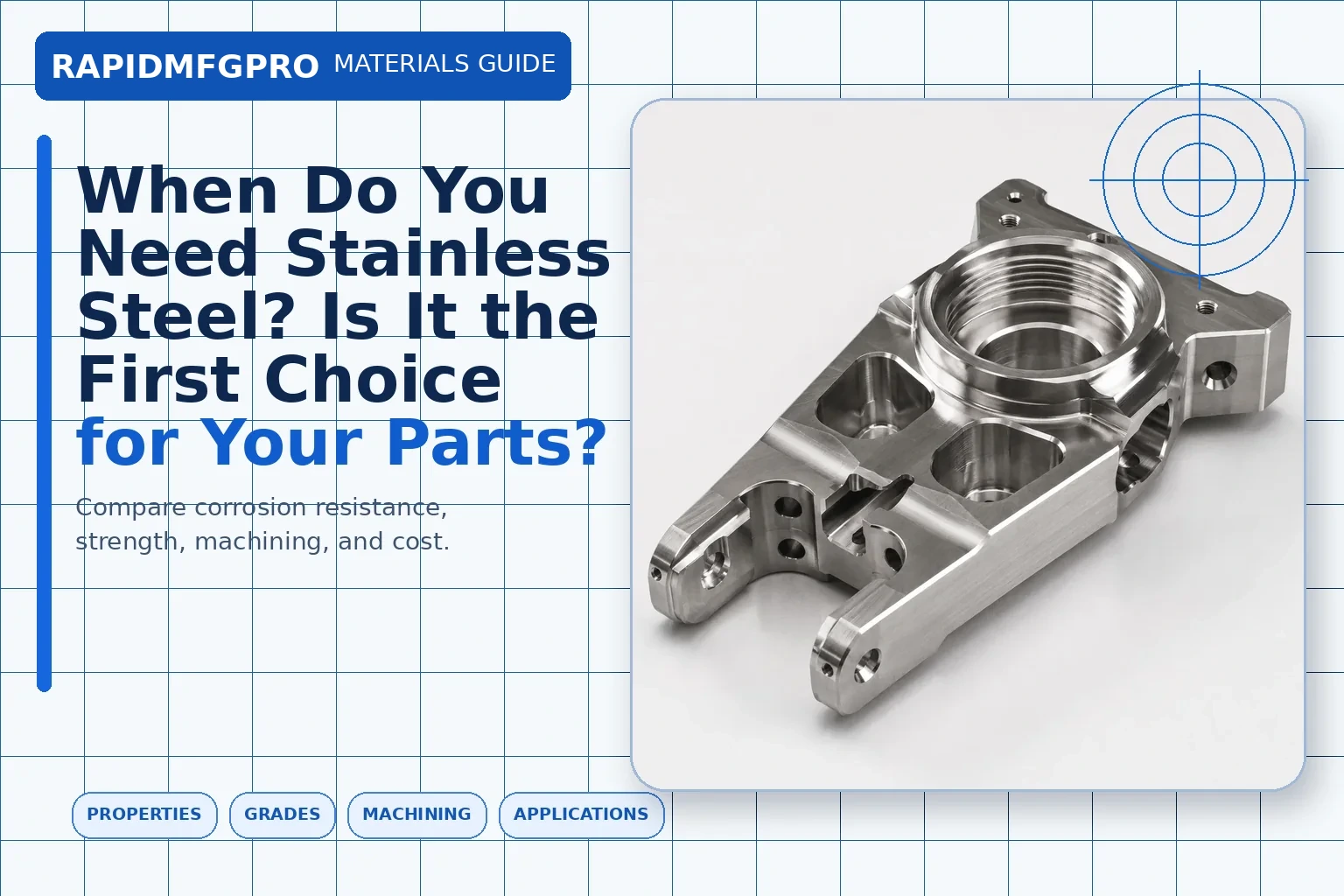
Stainless steel is often treated as the safe default for parts that must resist corrosion, remain clean, or maintain an attractive appearance. It is used in food-processing equipment, medical devices, chemical systems, marine hardware, automotive assemblies, industrial machinery, electronics, and consumer products.
However, stainless steel is not automatically the first choice for every part. It is heavier than aluminum, usually more expensive than carbon steel, and often more difficult to machine than both. Some stainless grades are easy to weld but difficult to harden. Others can reach high hardness but offer lower corrosion resistance. A grade that performs well in a kitchen enclosure may be unsuitable for a bearing, a marine fitting, or a high-temperature valve component.
RapidMFGPro evaluates stainless steel projects from a manufacturing supplier-matching perspective. The review begins with the actual service requirement, then considers grade, product form, geometry, quantity, process, finish, inspection, and documentation. This helps avoid choosing stainless steel only because it sounds durable or premium.
This guide explains when stainless steel is necessary, when another material may be more practical, how common grades differ, what manufacturing risks should be expected, and how to prepare a stainless steel project for supplier evaluation.
When Do You Need Stainless Steel?
Stainless steel is most useful when a part must resist corrosion, tolerate cleaning, maintain mechanical performance, or provide a stable visible surface over a long service life. The material should solve a defined operating problem rather than serve as a general upgrade.
Corrosive Service
Stainless steel is often needed when carbon steel would rust quickly or require frequent coating maintenance. Water, humidity, cleaning chemicals, food products, process fluids, and outdoor exposure can all justify a stainless grade.
The exact grade still matters. 304 may perform well indoors, while 316 may be preferred when chloride exposure is more severe. Duplex stainless steel may be considered when corrosion resistance and higher strength are required together.
Frequent Cleaning
Stainless steel is suitable for equipment that is washed, wiped, sanitized, or exposed to repeated cleaning cycles. A smooth stainless surface can resist staining and can be finished for easier cleaning.
Common examples include food equipment, laboratory fixtures, medical equipment, pharmaceutical machinery, and commercial kitchen components.
Visible Product Surfaces
Stainless steel can provide a durable metallic appearance without paint. Brushed, polished, bead-blasted, and electropolished finishes are used on consumer, architectural, medical, and industrial products.
Appearance requirements should be defined before production because grain direction, weld blending, forming, handling marks, and finishing sequence can change the final result.
Long Service Life
Stainless steel may reduce coating repair, corrosion replacement, and maintenance in products that must operate for many years.
Higher initial material cost can be justified when replacement is difficult, downtime is expensive, or corrosion could affect safety.
| Operating Requirement | Stainless Steel Suitability | Reason |
|---|---|---|
| Indoor dry bracket | Low to conditional | Carbon steel or aluminum may be more economical |
| Repeated washdown | High | Corrosion resistance and cleanability are valuable |
| Chloride exposure | Conditional | The correct stainless grade must be selected |
| Decorative bare-metal surface | High | Brushed or polished finish can remain visible |
| High-wear sliding contact | Conditional | Hardness, galling, and lubrication must be reviewed |
| Very lightweight moving component | Low to conditional | Aluminum or titanium may reduce mass |
When Is Stainless Steel Not the First Choice?
Stainless steel can add cost and manufacturing difficulty without improving function when the service environment is mild. It should be compared with carbon steel, aluminum, titanium, brass, and engineering plastics before the drawing is finalized.
Low-Cost Indoor Parts
Carbon steel may be more suitable for indoor brackets, machine bases, guards, and frames that can be painted, plated, or powder coated.
Stainless steel may still be chosen for appearance or maintenance reasons, but the premium should be justified by the service requirement.
Weight-Sensitive Parts
Stainless steel has a relatively high density. Aluminum is often better for moving assemblies, portable products, aerospace structures, and equipment where weight reduction improves performance.
A stronger stainless grade does not eliminate the weight difference if the design remains similar.
High-Conductivity Parts
Stainless steel conducts heat and electricity poorly compared with aluminum and copper. It is generally not the first choice for heat sinks, busbars, electrical conductors, or thermal spreading plates.
It may still be used where strength, hygiene, or corrosion resistance is more important than conductivity.
Simple High-Volume Parts
Stainless steel can be economical at high volume when the process is well designed, but difficult machining, tool wear, forming force, and material cost can make it less attractive than another material.
The production method should be considered early. Stamping, investment casting, powder metallurgy, or a coated alternative may reduce cost.
What Is Stainless Steel?
Stainless steel is an iron-based alloy containing enough chromium to form a protective surface film. Different grades use additional elements to change corrosion resistance, strength, hardness, formability, weldability, and temperature performance.
Chromium Content
Chromium is the element that gives stainless steel its basic corrosion resistance. When exposed to oxygen, chromium at the surface forms a thin oxide layer.
This passive film is invisible and much thinner than paint or plating. It reduces the rate at which the underlying metal reacts with the environment.
Alloying Elements
Nickel, molybdenum, manganese, nitrogen, carbon, copper, titanium, niobium, and other elements may be added to create specific properties.
Nickel can stabilize the austenitic structure. Molybdenum can improve resistance to pitting in chloride environments. Carbon can increase hardness in martensitic grades but may reduce corrosion resistance if not controlled properly.
Material Structure
Stainless steel is divided into families according to its metallurgical structure. These families behave differently during machining, welding, heat treatment, forming, and service.
The family is often more important than the word stainless itself because it determines which manufacturing route is realistic.
How Does the Passive Film Protect Stainless Steel?
The passive film is the main reason stainless steel resists corrosion. It is self-forming in suitable environments, but it can be damaged or locally broken down.
Film Formation
The film forms when chromium in the alloy reacts with oxygen. A clean stainless surface can passivate naturally in air.
Manufacturing contamination, embedded iron, scale, oil, or residue can interfere with the surface condition and reduce corrosion performance.
Film Repair
Minor surface damage can repassivate when oxygen is available. This is one reason stainless steel performs well after normal scratches that do not introduce severe contamination.
Crevices, deposits, stagnant liquid, or oxygen-starved locations may prevent effective repair.
Film Breakdown
Chlorides can attack the passive film and initiate localized pitting. Temperature, concentration, surface roughness, grade, and crevice geometry influence the risk.
Stainless steel should not be described as rust-proof. It is corrosion resistant within a defined service range.
Which Stainless Steel Family Fits the Part?
Stainless steel families provide different balances of corrosion resistance, strength, hardness, weldability, magnetism, and cost. Family selection should occur before comparing individual grades.
Austenitic Stainless Steel
Austenitic grades include many 300-series stainless steels. They offer good corrosion resistance, formability, and weldability.
Common examples include 304, 304L, 316, and 316L. These grades are generally not hardened by conventional heat treatment, although cold work can increase strength.
Ferritic Stainless Steel
Ferritic grades are chromium-containing stainless steels with little or no nickel. They are magnetic and generally offer moderate corrosion resistance.
They are used in appliances, automotive exhaust systems, decorative trim, and applications where cost and oxidation resistance matter.
Martensitic Stainless Steel
Martensitic grades can be heat treated to high hardness. They are used for shafts, blades, valve components, tools, wear parts, and bearings.
Their corrosion resistance is generally lower than that of common austenitic grades.
Duplex Stainless Steel
Duplex stainless steel contains both austenitic and ferritic structures. It can provide higher strength and improved resistance to chloride stress-corrosion cracking.
Welding, heat input, forming, and machining require suitable process control.
Precipitation-Hardening Stainless Steel
Precipitation-hardening grades can achieve high strength through controlled heat treatment. 17-4 PH is a common example.
These grades are used for aerospace, valves, shafts, tooling, energy equipment, and high-strength precision components.
| Family | Corrosion Resistance | Heat-Treatable Hardness | Typical Magnetism | Common Use |
|---|---|---|---|---|
| Austenitic | Good to very good | Low | Usually low in annealed condition | Food, medical, chemical, general fabrication |
| Ferritic | Moderate | Low | Magnetic | Appliances and exhaust systems |
| Martensitic | Moderate | High | Magnetic | Wear parts and blades |
| Duplex | High | Not the primary strengthening route | Magnetic | Marine and process equipment |
| Precipitation hardening | Good | High | Often magnetic | High-strength precision parts |
Which Stainless Steel Grades Are Common?
Common grades are not interchangeable. Each grade should be selected according to corrosion exposure, mechanical load, hardness, welding, forming, machining, and certification.
303 Stainless Steel
303 is an austenitic free-machining grade. Sulfur additions improve chip breaking and machining performance.
It is used for fittings, shafts, fasteners, spacers, connectors, and turned parts. Its corrosion resistance and weldability are generally lower than those of 304.
304 Stainless Steel
304 is one of the most widely used stainless grades. It provides good corrosion resistance, formability, weldability, and availability.
Typical applications include food equipment, enclosures, brackets, tanks, fasteners, tubing, and general industrial parts.
304L Stainless Steel
304L has lower carbon content than standard 304. It is commonly selected for welded components where reducing sensitization risk is important.
The drawing and purchasing specification should identify 304L explicitly when the lower-carbon grade is required.
316 Stainless Steel
316 contains molybdenum and generally provides better resistance to chloride pitting than 304.
It is used in marine hardware, chemical equipment, food-processing systems, pharmaceutical equipment, and outdoor components.
316L Stainless Steel
316L is the lower-carbon version of 316. It is widely used for welded process equipment, medical components, laboratory systems, and corrosion-sensitive assemblies.
Surface finish and fabrication cleanliness remain important because the grade alone does not guarantee hygienic or corrosion-free performance.
410 Stainless Steel
410 is a martensitic stainless grade that can be heat treated for higher strength and hardness.
It is used for shafts, fasteners, valve parts, blades, and moderately corrosion-resistant wear components.
420 Stainless Steel
420 contains more carbon than 410 and can reach higher hardness after heat treatment.
It is used for cutting instruments, molds, tools, shafts, and wear parts.
440C Stainless Steel
440C is a high-carbon martensitic stainless steel capable of high hardness and wear resistance.
It is used for bearings, valve components, precision wear parts, and high-hardness tools. Machining is easier before final hardening.
17-4 PH Stainless Steel
17-4 PH combines useful corrosion resistance with high strength after precipitation-hardening heat treatment.
It is used for aerospace parts, shafts, valves, pump components, tooling, and energy-industry equipment.
2205 Duplex Stainless Steel
2205 is a commonly used duplex grade with higher strength than standard austenitic stainless steel and good resistance to chloride stress-corrosion cracking.
It is used in marine, chemical, oil and gas, desalination, and process equipment.
| Grade | Main Advantage | Main Limitation | Typical Process | Typical Part |
|---|---|---|---|---|
| 303 | Improved machinability | Lower corrosion resistance than 304 | CNC turning | Fittings and shafts |
| 304 | Balanced general performance | Limited chloride resistance | Fabrication and machining | Enclosures and equipment |
| 304L | Welded fabrication | Not intended for high hardness | Welding | Tanks and assemblies |
| 316 | Improved chloride resistance | Higher cost than 304 | Machining and fabrication | Marine and process parts |
| 316L | Corrosion-sensitive weldments | Machining can be demanding | Welding and machining | Medical and process equipment |
| 420 | Heat-treatable hardness | Lower corrosion resistance | Machining plus heat treatment | Tools and wear parts |
| 440C | High hardness | Difficult after hardening | Soft machining plus hardening | Bearings and precision wear parts |
| 17-4 PH | High strength | Heat-treatment control required | Machining plus aging | Valves and aerospace parts |
| 2205 | High strength and chloride performance | Process control is important | Fabrication and machining | Marine and chemical equipment |
How Strong Is Stainless Steel?
Stainless steel strength varies widely. Annealed austenitic grades, hardened martensitic grades, duplex grades, and precipitation-hardening grades should not be compared as though they share one strength level.
Yield Strength
Yield strength determines when permanent deformation begins. Standard annealed austenitic grades have moderate yield strength, while duplex and precipitation-hardening grades can provide much higher values.
Yield strength is important for brackets, pressure parts, shafts, fasteners, and structural components.
Tensile Strength
Tensile strength indicates the maximum tensile stress before fracture. It helps compare grades but does not replace fatigue, wear, corrosion, or stiffness analysis.
Heat treatment and cold work can significantly change tensile strength.
Hardness
Hardness affects wear, indentation resistance, cutting performance, and bearing behavior. Martensitic and precipitation-hardening grades are selected when hardness is important.
A high-hardness condition can make final machining and thread production more difficult.
Fatigue Strength
Repeated loading can cause fatigue failure below the static strength limit. Surface condition, notches, inclusions, welds, and residual stress influence fatigue performance.
High-cycle parts should use suitable geometry, material condition, and inspection.
How Stiff Is Stainless Steel?
Stainless steel is much stiffer than aluminum and titanium. This can help control deflection in frames, shafts, plates, brackets, and precision assemblies.
Elastic Modulus
Most stainless steels have an elastic modulus near that of carbon steel. Grade changes do not normally create dramatic stiffness differences.
Geometry remains the main way to change deflection.
Thin-Wall Stability
Thin stainless walls can still vibrate or deform during machining, welding, forming, and clamping.
Ribs, local support, balanced machining, and controlled heat input can improve stability.
Precision Assemblies
Stainless steel is useful when a component must maintain alignment under load. Its stiffness can support bearing locations, instrument frames, and mounting interfaces.
Thermal expansion and residual stress must still be included in the tolerance strategy.
How Does Stainless Steel Behave at Temperature?
Stainless steel is used across a broad temperature range, but grade, time, load, oxidation, and thermal cycling determine whether performance remains acceptable.
Elevated Temperature
Selected stainless grades resist oxidation and retain useful strength at temperatures that exceed the practical range of many aluminum alloys.
Exhaust systems, furnaces, heat shields, process equipment, and engine components may use ferritic, austenitic, or heat-resistant stainless grades.
Low Temperature
Austenitic stainless steels can retain toughness at very low temperatures. They are used in cryogenic tanks, valves, piping, and laboratory equipment.
Other stainless families may not provide the same low-temperature toughness.
Thermal Expansion
Austenitic stainless steels expand more with temperature than carbon steel. Mixed-material assemblies and long components may experience dimensional shift or thermal stress.
The drawing should define operating temperature when fits or alignment are temperature-sensitive.
Why Is Stainless Steel Difficult to Machine?
Stainless steel machining difficulty depends on family, grade, condition, geometry, and process. Austenitic grades are known for work hardening and heat concentration, while hardened martensitic grades create high cutting forces and tool wear.
Work Hardening
Austenitic stainless steel can harden locally when the tool rubs instead of cutting. The next tool pass then encounters a harder surface.
Sharp tools, positive cutting action, sufficient feed, and stable engagement help reduce work hardening.
Cutting Heat
Stainless steel conducts heat less effectively than carbon steel. Heat can remain near the cutting edge and shorten tool life.
Coolant delivery, tool material, coating, cutting speed, and chip evacuation must be controlled.
Chip Control
Ductile stainless grades can create long, stringy chips. These chips may scratch the part, wrap around the tool, or interfere with automated production.
Chip-breaker geometry and suitable feed are important for turning and drilling.
Galling
Stainless steel surfaces can gall during sliding or threaded assembly. Austenitic stainless-to-stainless contact is particularly sensitive.
Lubrication, coatings, material pairing, thread design, and controlled torque can reduce the risk.
How Is Stainless Steel CNC Milled?
CNC milling is used for stainless steel housings, brackets, manifolds, valve bodies, medical components, fixtures, and precision structures. Stable cutting and heat control are essential.
Tool Selection
Carbide tools with suitable coatings and geometry are commonly used. The tool must remain sharp enough to cut rather than rub.
Tool choice should reflect grade, hardness, engagement, coolant method, and required surface finish.
Toolpath Strategy
Consistent engagement reduces sudden heat and load changes. Adaptive toolpaths may help manage radial engagement in deep pockets.
Repeated light rubbing passes should be avoided where work hardening is likely.
Workholding
Stainless parts can move when clamps are released, especially after heavy material removal or welding.
Balanced stock removal, roughing allowance, intermediate inspection, and stable datums can improve accuracy.
How Is Stainless Steel CNC Turned?
CNC turning produces shafts, fittings, sleeves, connectors, fasteners, valve parts, bushings, and medical components. Grade selection strongly affects chip control and cycle time.
Turning Grade Selection
303 is often chosen for turned parts because its free-machining additions improve chip breaking. 304 and 316 may be selected when corrosion or welding requirements are more important.
The material should not be changed only to improve machining without engineering approval.
Long-Part Support
Slender shafts can deflect or vibrate. Tailstocks, steady rests, guide bushings, and controlled cutting forces may be required.
The manufacturing plan should account for final straightness after release from the machine.
Thread Production
Threads may be turned, tapped, rolled, or milled depending on size and process. Stainless threads require attention to galling and burr formation.
Go/No-Go gauges and mating-part tests may be required for critical threads.
How Is Stainless Steel Sheet Fabricated?
Stainless sheet is used for enclosures, tanks, panels, covers, guards, medical equipment, kitchen equipment, and process machinery. Forming and finishing should be planned together.
Sheet Cutting
Laser cutting, punching, shearing, waterjet cutting, and routing may be used according to thickness, quantity, edge condition, and hole requirements.
Heat tint, burrs, oxide, and edge contamination should be considered before welding or finishing.
Sheet Bending
Stainless steel requires higher forming force than many aluminum alloys. Springback, grain direction, bend radius, and tool wear affect the result.
The bend allowance should be based on actual grade, thickness, and process.
Sheet Hardware
Press-fit fasteners, weld nuts, rivet nuts, studs, and inserts may be installed in stainless sheet.
Hole size, sheet hardness, edge distance, and installation force should be defined.
How Is Stainless Steel Welded?
Many stainless grades can be welded successfully, but heat input, filler selection, shielding, distortion, sensitization, and post-weld cleaning affect performance.
Weld Grade Selection
Low-carbon grades such as 304L and 316L are commonly selected for welded fabrications. The lower carbon content helps reduce sensitization risk.
Duplex and martensitic grades require different welding controls.
Heat Distortion
Stainless steel expands during welding and can retain significant residual stress. Thin sheet may warp, twist, or pull out of alignment.
Weld sequence, fixturing, tack placement, heat input, and post-weld straightening should be planned.
Heat Tint
Heat tint is an oxide discoloration formed near the weld. It can reduce corrosion resistance if the surface condition is not restored.
Mechanical cleaning, pickling, passivation, or electropolishing may be required depending on the application.
Weld Inspection
Welds may require visual inspection, penetrant testing, radiography, leak testing, pressure testing, or dimensional verification.
Acceptance criteria should be defined before fabrication.
How Is Stainless Steel Cast?
Stainless steel casting can produce complex valve bodies, pump housings, impellers, fittings, and structural components with less material removal than machining from solid stock.
Investment Casting
Investment casting is widely used for complex stainless parts with relatively detailed geometry.
Critical holes, threads, sealing faces, and datums normally require secondary machining.
Sand Casting
Sand casting is suitable for larger parts and lower quantities. It provides more design freedom than some wrought forms but normally has wider tolerances and rougher surfaces.
Machining allowance and nondestructive testing may be required.
Casting Defects
Porosity, shrinkage, inclusions, hot tearing, incomplete filling, and dimensional variation can occur.
The inspection method should match the defect risk and service requirement.
How Is Stainless Steel Forged?
Forging is used when a component requires favorable grain flow, high structural integrity, or a strong near-net-shape blank.
Open-Die Forging
Open-die forging produces bars, rings, discs, shafts, and large blanks. It is suitable for lower-volume or large structural components.
Final machining is needed to establish precise dimensions and surfaces.
Closed-Die Forging
Closed-die forging produces shapes closer to the final geometry and is suitable for repeated high-load parts.
Tooling cost must be justified by quantity, material savings, and performance.
Heat Treatment
Some stainless forgings require solution treatment, quenching, tempering, aging, or stress relief.
The process record should match the grade and required mechanical properties.
Which Stainless Steel Process Fits the Quantity?
Quantity influences whether the part should be machined from stock, fabricated from sheet, cast, forged, stamped, or produced through another near-net-shape process.
Prototype Production
CNC machining is often suitable for prototypes because it avoids production tooling and supports rapid design changes.
Sheet fabrication may be faster for enclosure-style parts.
Pilot Production
Pilot production can validate machining time, distortion, welding, finishing, inspection, and assembly.
This stage can identify whether a casting or forging is needed before full production.
Volume Production
Higher volume may justify stamping dies, investment casting tooling, forgings, automated turning, or dedicated fixtures.
The correct comparison includes tooling, scrap, material utilization, cycle time, finishing, and inspection.
| Process | Typical Quantity | Main Advantage | Main Limitation |
|---|---|---|---|
| CNC machining | Prototype to medium volume | No production mold | Tool wear and cycle time |
| Sheet fabrication | Low to high volume | Efficient thin structures | Welding distortion |
| Investment casting | Low to medium volume | Complex near-net shape | Tooling and casting qualification |
| Forging | Medium to high volume | High structural integrity | Tooling investment |
| Stamping | High volume | Fast repeated production | Die cost |
How Should Stainless Steel Parts Be Designed?
Stainless steel design should account for machining difficulty, springback, welding distortion, galling, finish direction, and corrosion-sensitive details.
Reduce Unnecessary Stock Removal
Large solid blanks can create long cycle time and high tool cost. Tube, plate, near-net castings, forgings, or welded fabrications may reduce waste.
Material utilization becomes more important as part size and annual volume increase.
Avoid Deep Narrow Pockets
Deep pockets require long tools and increase vibration, heat, chip evacuation difficulty, and work hardening.
A wider opening, shallower cavity, alternate tool direction, or divided assembly may be more practical.
Use Achievable Radii
Larger internal radii allow stronger milling tools and more stable cutting.
Small radii should be reserved for features that require them functionally.
Control Thin Sections
Thin sections can distort during machining, welding, bending, or heat treatment.
Ribs, balanced geometry, controlled weld sequence, and finishing allowances can improve stability.
Define Drainage
Crevices and trapped liquid can increase localized corrosion risk. Drainage and cleanable geometry are important in washdown and process equipment.
Hygienic assemblies should avoid inaccessible gaps and residue traps.
How Should Stainless Steel Threads Be Designed?
Stainless threads can gall, seize, or distort during assembly. Thread design should consider material pair, lubrication, engagement, surface finish, and tightening torque.
Thread Engagement
Engagement length should be based on load and material strength. Excessively deep threads add machining time and may complicate chip removal.
Mating Material
Stainless-to-stainless contact can increase galling risk. A different mating alloy, coated fastener, insert, or approved lubricant may improve reliability.
Assembly Torque
High friction can produce misleading torque readings. The joint may reach the target torque without the intended clamping force.
Lubrication condition and torque specification should be controlled together.
Which Surface Finish Suits Stainless Steel?
Stainless steel may be used as machined or finished for corrosion resistance, cleanability, appearance, friction, or contamination control. The required finish should be stated on the drawing.
As-Machined Finish
An as-machined surface is suitable for internal parts when tool marks do not affect function, cleaning, or corrosion.
Burrs, embedded contamination, and damaged edges still require control.
Brushed Finish
Brushing creates a directional grain used on appliances, panels, enclosures, and visible industrial equipment.
Grain direction should be defined because adjacent parts with different directions may look inconsistent.
Mechanical Polishing
Polishing reduces roughness and improves appearance. It may also support easier cleaning.
Excessive polishing can round edges or alter dimensions.
Passivation
Passivation removes free iron and supports a clean passive surface. It is used on precision, medical, laboratory, food, and corrosion-sensitive parts.
Passivation does not remove heavy scale or replace proper cleaning.
Electropolishing
Electropolishing removes a controlled amount of surface material and can reduce microscopic roughness.
It is used for hygienic equipment, medical components, semiconductor equipment, and high-cleanliness parts.
Bead Blasting
Bead blasting creates a uniform matte appearance. Media cleanliness is essential because iron-contaminated media can damage corrosion performance.
| Finish | Main Purpose | Typical Appearance | Main Control Point |
|---|---|---|---|
| As machined | Functional production | Visible tool pattern | Burrs and contamination |
| Brushed | Decorative grain | Directional satin | Grain consistency |
| Polished | Smoothness and appearance | Bright or mirror-like | Edge preservation |
| Passivated | Surface cleanliness | Minimal visible change | Cleaning chemistry |
| Electropolished | Low roughness and cleanability | Bright smooth surface | Material removal |
| Bead blasted | Uniform matte texture | Matte gray | Media contamination |
Where Is Stainless Steel Used?
Stainless steel is used where corrosion resistance, cleanability, appearance, strength, or temperature capability provides a practical advantage.
Food Equipment
Food-processing applications include tanks, mixers, conveyors, nozzles, housings, work surfaces, and packaging equipment.
Surface roughness, weld quality, cleanability, drainage, and contamination control may be critical.
Medical Equipment
Medical applications include surgical instruments, equipment housings, laboratory fixtures, diagnostic components, and sterilization hardware.
Grade, surface condition, cleaning, traceability, and regulatory controls should be confirmed.
Chemical Equipment
Chemical systems use stainless steel for valves, pumps, vessels, tubing, fittings, and heat exchangers.
Grade selection should reflect the exact chemical, concentration, temperature, flow, and crevice conditions.
Marine Equipment
Marine applications include fasteners, fittings, brackets, rails, pump parts, shafts, and deck hardware.
316 is commonly considered, but chloride exposure can still cause pitting or crevice corrosion.
Automotive Equipment
Automotive uses include exhaust components, fuel-system parts, trim, fasteners, sensors, and structural brackets.
Ferritic, austenitic, martensitic, and precipitation-hardening grades serve different functions.
Industrial Machinery
Industrial parts include shafts, manifolds, guards, fixtures, valves, fasteners, enclosures, and automation components.
The best grade depends on wear, corrosion, cleaning, load, and production quantity.
What Should Be Specified on a Stainless Steel Drawing?
A stainless steel drawing should define material, condition, finish, dimensions, datums, and inspection. General notes that leave these items open can produce inconsistent quotations.
Material Grade
State the exact grade and applicable standard. 304, 304L, 316, and 316L should not be treated as equivalent unless engineering approval allows substitution.
Material Condition
Specify annealed, cold-worked, hardened, tempered, solution-treated, or aged condition where it affects properties.
Surface Roughness
Roughness should be defined on sealing, sliding, hygienic, bearing, or cosmetic surfaces.
Finish Direction
Brushed or polished visible surfaces should identify the required grain direction and cosmetic area.
Inspection Scope
Identify dimensions requiring full reporting, first-article inspection, nondestructive testing, leak testing, or functional checks.
What Should Be Included in a Stainless Steel RFQ?
A complete RFQ helps suppliers quote the same material, process, finish, and quality scope.
CAD Files
Provide a 3D model and controlled 2D drawing. The model defines geometry, while the drawing defines acceptance.
Order Quantity
State prototype quantity, initial order quantity, and annual demand. These values affect process selection and tooling.
Material Documentation
Specify whether material certificates, heat numbers, country-of-origin statements, or traceability records are required.
Finish Requirement
Define polishing, brushing, passivation, electropolishing, blasting, coating, or as-machined condition.
Quality Requirement
Identify dimensional reports, first-article inspection, certificates of conformity, weld records, nondestructive tests, or pressure tests.
How Does RapidMFGPro Evaluate Stainless Steel Projects?
RapidMFGPro evaluates stainless steel projects by determining which supplier capabilities are necessary for the actual grade, geometry, process, finish, quantity, and quality requirement.
Application Review
The review begins with corrosion exposure, load, temperature, cleaning, appearance, and service life.
This helps confirm whether stainless steel is necessary and which family should be considered.
Process Review
The process review compares machining, sheet fabrication, casting, forging, stamping, and welding routes.
The goal is to avoid using an expensive billet process for geometry that is better produced near net shape.
Supplier Matching
Suppliers are compared according to stainless grade experience, machine capability, forming equipment, welding control, heat-treatment access, finishing resources, inspection equipment, and capacity.
A supplier suitable for 303 turned parts may not be suitable for 316L hygienic weldments or hardened 440C bearing parts.
Quality Review
The quality review confirms material records, dimensional inspection, finish verification, weld inspection, heat-treatment documentation, and packaging.
The required scope should be agreed before production.
How Should Stainless Steel Parts Be Inspected?
Inspection should confirm grade, condition, dimensions, surface, finish, weld quality, and function. The method should match the application risk.
Material Verification
Material verification may include certificate review, heat number, hardness, and positive material identification.
Traceability is especially important for pressure, medical, food, chemical, aerospace, and safety-critical parts.
Dimensional Inspection
Calipers, micrometers, gauges, optical systems, and coordinate measuring machines may be used.
Critical features should be measured from the drawing datums.
Surface Inspection
Inspect burrs, scratches, dents, heat tint, embedded iron, tool marks, polishing lines, and handling damage.
Cosmetic criteria should identify viewing conditions and acceptable defect limits.
Weld Inspection
Weld inspection may include visual checks, penetrant testing, radiography, dimensional verification, and leak testing.
Functional Inspection
Functional checks may include thread assembly, pressure testing, leak testing, fit verification, torque testing, or trial assembly.
What Problems Commonly Occur With Stainless Steel Parts?
Stainless steel failures are often linked to the wrong grade, contamination, work hardening, galling, welding heat, poor drainage, or unclear finish requirements.
Surface Rust
Rust staining may come from embedded carbon steel particles, contaminated tools, handling, or damaged passivity.
The source should be identified rather than assuming the base stainless grade has failed.
Pitting
Chloride exposure can produce localized pits. Grade, temperature, surface condition, and stagnant liquid influence risk.
Weld Discoloration
Heat tint may reduce corrosion resistance near the weld. Cleaning and passivation may be required.
Machining Distortion
Residual stress, clamping, and asymmetric material removal can cause flatness or position change.
Roughing allowance, balanced machining, and intermediate inspection can reduce the problem.
Thread Seizure
Galling can lock stainless fasteners or damage internal threads.
Lubrication, coatings, material pairing, and controlled torque should be considered.
Frequently Asked Questions About Stainless Steel
These questions address common stainless steel decisions during product design and sourcing.
Is Stainless Steel Always Corrosion Resistant?
No. Stainless steel can pit, crevice corrode, stress-corrosion crack, or rust from contamination. Performance depends on grade and environment.
Is 316 Always Better Than 304?
No. 316 generally provides better chloride resistance, but it costs more and may not be necessary for a dry indoor application.
Is Stainless Steel Magnetic?
Some grades are magnetic and others have low magnetic response in the annealed condition. Cold work can also increase magnetism in some austenitic grades.
Can Stainless Steel Be Hardened?
Martensitic and precipitation-hardening grades can be hardened through heat treatment. Standard austenitic grades such as 304 and 316 are not hardened by conventional quench-and-temper treatment.
Is Stainless Steel Easy to Machine?
Machinability varies. 303 machines more easily than 304 or 316, while hardened 440C is significantly more difficult.
Does Stainless Steel Need Passivation?
Passivation may be specified when removing free iron and restoring a clean passive surface is important. It is not required for every stainless part.
Conclusion
Stainless steel should be the first choice when corrosion resistance, cleanability, appearance, strength, temperature performance, or long service life clearly justify it. It should not be selected automatically for low-load, dry, weight-sensitive, or high-conductivity parts that another material can produce more economically. A successful stainless steel project requires the correct family, grade, condition, process, finish, geometry, inspection scope, and supplier capability. RapidMFGPro supports this decision by reviewing the application and matching the project with suppliers whose machining, forming, welding, finishing, and quality resources fit the actual requirement.
Need Help Reviewing a Custom Part?
Share your CAD file and requirements to request supplier matching. Supplier capability and commercial terms must be verified before order placement.
Request Supplier Match