Time to read: 8 min
Zinc Plating vs Black Oxide: Which Surface Treatment Is Better for Steel Parts?
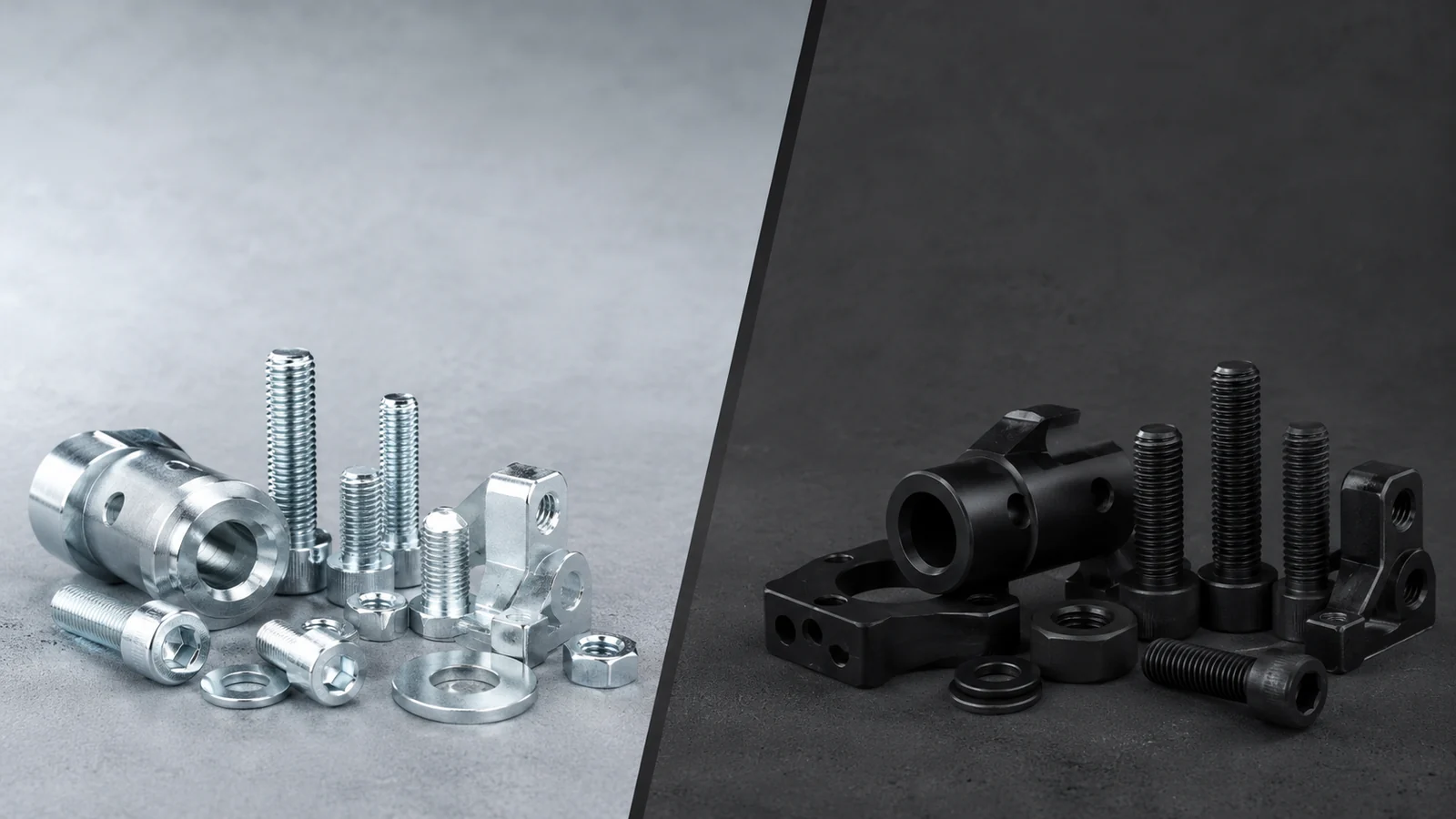
Zinc plating and black oxide are two common surface treatments for steel CNC parts, but they solve different problems. Zinc plating is primarily selected for sacrificial corrosion protection, while black oxide is usually selected for minimal dimensional change, dark appearance, reduced glare, and light-duty corrosion resistance when combined with oil, wax, or another sealant.
The two finishes should not be compared only by color or price. Zinc plating adds a metallic coating to the steel surface and can continue protecting exposed steel through sacrificial action. Black oxide chemically converts the outer steel surface into a dark oxide layer, but the conversion layer alone provides limited protection in wet or outdoor environments.
The better finish depends on the steel grade, part hardness, corrosion exposure, coating thickness, thread fit, electrical contact, appearance, hydrogen-embrittlement risk, assembly friction, quantity, service life, and maintenance plan. A zinc-plated outdoor bracket and a black-oxide precision fixture may both perform correctly because their functional requirements are different.
RapidMFGPro evaluates steel surface-treatment projects from a supplier-matching perspective. The review considers the base material, heat-treatment condition, machining geometry, finish standard, corrosion requirement, dimensions after finishing, masking, baking, inspection, packaging, and production quantity before identifying suppliers with suitable plating, black-oxide, testing, and quality capabilities.
This guide compares zinc plating and black oxide for steel CNC parts and explains how engineers and buyers can select the more suitable treatment for each project.
Which Finish Is Better for Steel Parts?
Zinc plating is generally better when corrosion protection is the main requirement. Black oxide is generally better when minimal dimensional change, dark appearance, and low-cost indoor protection are more important.
Choose Zinc Plating for Corrosion
Zinc plating creates a sacrificial metallic layer that protects the steel beneath it. It is commonly used for fasteners, brackets, fittings, housings, stamped parts, and outdoor hardware.
The final corrosion performance depends on zinc thickness, passivation, sealer, steel condition, edge coverage, handling damage, and service environment.
Choose Black Oxide for Dimensional Control
Black oxide creates a very thin conversion layer and causes minimal dimensional change. It is useful for precision fixtures, tooling, machine components, fasteners, and parts with close fits.
Oil, wax, or another supplementary seal normally provides the practical corrosion protection.
Choose by Service Conditions
An indoor adjustment screw may perform well with black oxide, while an outdoor mounting bracket usually needs zinc plating or a more durable coating.
The operating environment should be defined before appearance or unit price is compared.
| Steel Part | Recommended Starting Finish | Main Control Point |
|---|---|---|
| Outdoor mounting bracket | Zinc plating | Thickness, passivation, and edge coverage |
| Machine-tool fixture block | Black oxide | Oil sealing and dimensional stability |
| High-strength spring clip | Application review required | Hydrogen embrittlement and corrosion exposure |
| Adjustment screw | Black oxide | Thread friction and oil retention |
| Exterior threaded fastener | Zinc plating | Torque-tension control and baking |
| Dark outdoor fastener | Black zinc | Do not substitute black oxide |
| Part Requirement | Better Initial Choice | Main Reason |
|---|---|---|
| Outdoor steel bracket | Zinc plating | Stronger sacrificial corrosion protection |
| Precision fixture component | Black oxide | Minimal dimensional change |
| High-volume threaded fastener | Zinc plating | Corrosion protection with controlled passivation |
| Dark nonreflective machine part | Black oxide | Uniform dark appearance and low glare |
| Part exposed to salt spray | Zinc plating | Black oxide provides insufficient protection |
| Tight sliding fit | Black oxide | Lower coating buildup |
What Is Zinc Plating?
Zinc plating is an electrochemical process that deposits a controlled zinc layer onto steel. The zinc acts as both a barrier and a sacrificial metal.
Metallic Deposit
Zinc ions are reduced onto the steel surface using electrical current in a plating bath.
The finished layer physically covers the substrate and changes the part dimensions.
Sacrificial Protection
Zinc is more electrochemically active than steel. When the coating is scratched, the surrounding zinc can corrode preferentially and help protect the exposed steel.
This sacrificial behavior distinguishes zinc plating from barrier-only coatings.
Post-Plating Conversion Layer
Zinc is normally treated with a passivation or conversion coating after deposition.
The passivation improves corrosion resistance and may create clear, blue, yellow, black, or other appearances.
What Is Black Oxide?
Black oxide is a chemical conversion treatment that forms a dark iron-oxide layer on ferrous metal. It is not a thick deposited coating.
Conversion Surface
The process chemically changes the steel surface into a controlled black oxide.
Because the treatment converts the surface rather than adding a thick layer, dimensional change is very low.
Dark Appearance
Black oxide produces a dark gray to black finish that reduces glare and gives steel parts a uniform industrial appearance.
Final gloss depends on the original surface finish and the supplementary oil or wax.
Supplementary Seal
The oxide layer is porous and normally absorbs oil, wax, lacquer, or another sealant.
Without a supplementary finish, corrosion protection is limited.
How Do the Protection Mechanisms Differ?
Zinc plating and black oxide protect steel through different mechanisms, which explains why they perform differently after scratches, wear, and outdoor exposure.
Zinc Provides Sacrificial Protection
Zinc corrodes preferentially when steel is exposed through a scratch or small defect.
Protection continues until the nearby zinc has been consumed.
Black Oxide Relies on Barrier Assistance
Black oxide changes the steel surface but provides little sacrificial protection.
Its corrosion performance relies heavily on retained oil, wax, or another seal.
Damage Behavior
A damaged zinc coating may continue to protect a small exposed area. A damaged black-oxide surface exposes steel directly and can rust if the protective oil is absent.
Wear frequency and maintenance access should therefore influence finish selection.
How Does Corrosion Resistance Compare?
Zinc plating normally provides much stronger corrosion resistance than black oxide, especially in humid, outdoor, or salt-containing environments.
Indoor Dry Service
Oiled black oxide may be sufficient for tools, fixtures, knobs, and machine components stored indoors.
Condensation and handling can still create rust if oil coverage is poor.
Outdoor Service
Zinc plating is usually more appropriate for outdoor brackets, fasteners, mounts, and hardware.
Thickness and passivation should reflect the intended exposure.
Salt Exposure
Black oxide is generally not suitable as the primary corrosion treatment for salt spray or marine exposure.
Zinc-nickel plating, hot-dip galvanizing, stainless steel, paint systems, or other finishes may be considered.
Chemical Exposure
Neither finish should be selected from a general corrosion ranking when the part contacts acids, alkalis, solvents, fuels, or process chemicals.
Compatibility testing should match the actual fluid and temperature.
How Does Dimensional Change Compare?
Dimensional impact is one of the clearest differences between zinc plating and black oxide.
Zinc Adds Thickness
Zinc plating builds outward from every plated surface.
External diameters become larger, while holes and internal grooves become smaller.
Black Oxide Adds Minimal Buildup
Black oxide creates negligible dimensional change compared with zinc plating.
This makes it attractive for precision fits, tooling, gauges, and assembled mechanisms.
Tolerance Planning
Zinc-plated parts need pre-plate allowance for threads, shafts, bores, press fits, and sealing features.
Black-oxide parts still require final inspection, but coating allowance is usually less significant.
How Does Surface Appearance Compare?
Zinc plating and black oxide create distinct visual results. Neither finish hides poor machining or base-material defects completely.
Zinc-Plated Appearance
Zinc plating can appear silver, blue, yellow, black, or iridescent depending on passivation.
Brightness depends on bath chemistry, base finish, and post-treatment.
Black-Oxide Appearance
Black oxide produces a dark metallic appearance without creating an opaque paint film.
Grinding marks, machining texture, and polishing remain visible.
Batch Variation
Both finishes can vary in shade, gloss, and uniformity between batches.
Cosmetic parts should use approved samples and controlled viewing conditions.
How Does Wear Resistance Compare?
Neither standard zinc plating nor black oxide should be treated as a heavy-duty wear coating.
Zinc Wear Behavior
Zinc is relatively soft and can wear away on sliding or repeatedly assembled surfaces.
Once the zinc is removed, corrosion protection decreases.
Black Oxide Wear Behavior
Black oxide is thin and follows the base steel hardness.
It can reduce glare and retain oil but does not create a thick wear-resistant layer.
Heavy-Wear Alternatives
Nitriding, carburizing, hard chrome, electroless nickel, PVD coating, or hardened steel may be more suitable for high-contact wear.
The wear mechanism should be defined before selecting a finish.
How Does Friction Compare?
Surface friction depends on coating chemistry, roughness, sealant, lubrication, load, and mating material.
Oiled Black Oxide
Oiled black oxide can provide a low-friction feel for fasteners, tools, hinges, and moving mechanisms.
The benefit decreases as the oil is removed.
Zinc-Plated Threads
Zinc plating and passivation change thread friction and therefore affect torque-tension relationships.
Sealer and lubricant should be controlled for critical fasteners.
Assembly Validation
Torque specifications developed for bare steel should not automatically be applied to zinc-plated or black-oxide fasteners.
The finished fastener system should be tested.
Which Steel Grades Can Be Zinc Plated?
Carbon steel, alloy steel, spring steel, and selected hardened steels can be zinc plated when pretreatment and hydrogen control are suitable.
Low-Carbon Steel
Low-carbon steel is commonly zinc plated for brackets, fasteners, clips, housings, and stamped parts.
It generally presents lower hydrogen-embrittlement risk than high-strength steel.
Medium-Carbon Steel
Medium-carbon steel can be plated, but hardness and heat-treatment condition should be reviewed.
Pre-cleaning and baking may require additional control.
High-Strength Alloy Steel
High-strength alloy steel is more sensitive to hydrogen embrittlement.
Alternative coatings or qualified low-embrittlement processes may be required.
Spring Steel
Spring clips and washers can be zinc plated, but residual stress and high hardness increase cracking risk.
The plating specification should define embrittlement-relief requirements.
Which Steel Grades Can Be Black Oxided?
Black oxide is widely used on carbon steel, alloy steel, tool steel, and selected cast irons.
Carbon Steel
Low- and medium-carbon steels commonly receive black oxide for tools, fixtures, fasteners, and machine parts.
Final color depends on surface condition and alloy chemistry.
Alloy Steel
4140, 4340, and similar alloy steels can be black oxided after machining and heat treatment.
Tempering temperature and final hardness should be confirmed before processing.
Tool Steel
Tool steels may be black oxided for glare reduction, appearance, and light corrosion protection.
Precision tools benefit from minimal dimensional change.
Cast Iron
Selected cast-iron components can receive black oxide, but porosity and graphite affect appearance and oil retention.
A production sample may be required.
Can Stainless Steel Receive These Finishes?
Standard zinc plating and black oxide processes are primarily associated with carbon and alloy steel. Stainless steel requires specialized pretreatment or alternative processes.
Zinc Plating Stainless Steel
Stainless steel can be zinc plated after activation and strike plating, but this is not a standard first choice.
The functional reason should justify covering a corrosion-resistant substrate with zinc.
Blackening Stainless Steel
Stainless steel uses specialized blackening processes rather than ordinary ferrous black oxide.
Appearance and corrosion performance differ by process and grade.
Alternative Stainless Finishes
Passivation, electropolishing, PVD, paint, powder coating, or specialty black oxide may be more suitable.
The base alloy and application should guide selection.
What Zinc Plating Types Are Common?
Zinc-plating systems differ in bath chemistry, passivation color, sealer, thickness, friction, and environmental compliance.
Acid Zinc Plating
Acid zinc processes can produce bright deposits and are common for decorative and general industrial parts.
Geometry and hydrogen risk should still be considered.
Alkaline Zinc Plating
Alkaline zinc can provide useful thickness distribution and is widely used for fasteners and complex steel parts.
Bath selection depends on supplier capability and specification.
Barrel Plating
Small fasteners, clips, and hardware are commonly barrel plated in bulk.
Part-to-part contact can create cosmetic marks and thread damage.
Rack Plating
Larger, cosmetic, delicate, or precision parts are individually fixtured on racks.
Rack marks and electrical-contact areas should be approved.
What Black Oxide Types Are Common?
Black oxide can be produced through hot, mid-temperature, cold, and specialty low-temperature processes.
Hot Black Oxide
Hot black oxide is the traditional process for carbon and alloy steel.
It generally provides a more durable and consistent conversion layer than simple room-temperature blackening.
Mid-Temperature Black Oxide
Mid-temperature processes reduce operating temperature while creating a comparable dark conversion finish.
Process chemistry and appearance vary by supplier.
Cold Blackening
Cold blackening often deposits or converts a thin dark layer at room temperature.
It may not provide the same durability or appearance as hot black oxide.
Black Oxide with Wax
Wax sealing improves corrosion resistance and produces a drier touch than heavy oil.
Heat, friction, and cleaning chemicals can remove the wax.
How Does Zinc Passivation Affect Performance?
Passivation protects the zinc surface and changes appearance, corrosion life, friction, and environmental compliance.
Clear Passivation
Clear or blue passivation produces a silver-colored finish.
It is common for fasteners, brackets, and industrial hardware.
Yellow Passivation
Yellow passivation creates an iridescent yellow appearance and has historically been associated with strong corrosion performance.
Modern trivalent systems differ from older hexavalent systems in color and performance.
Black Passivation
Black zinc provides a dark appearance while retaining zinc’s sacrificial protection.
It should not be confused with black oxide.
Sealers and Topcoats
Sealers can improve corrosion resistance and control friction.
The exact topcoat should be included in the specification.
How Does Black Zinc Differ from Black Oxide?
Black zinc and black oxide can look similar, but their structure, thickness, corrosion protection, and dimensional impact differ.
Black Zinc Is a Metallic Coating
Black zinc includes a deposited zinc layer plus dark passivation or topcoat.
It provides sacrificial protection.
Black Oxide Is a Conversion Layer
Black oxide converts the steel surface without adding a substantial zinc layer.
It relies on oil or wax for practical corrosion resistance.
Selection Difference
Black zinc is better for dark outdoor hardware, while black oxide is better for precision indoor parts with minimal buildup.
The drawing should name the exact process.
How Does Zinc Plating Work?
A typical zinc-plating process includes cleaning, oxide removal, electroplating, rinsing, passivation, sealing, drying, baking when required, and inspection.
Cleaning
Oil, coolant, polishing compound, scale, and contamination are removed.
Poor cleaning causes skips, blisters, pits, and peeling.
Pickling or Activation
Oxide and rust are chemically removed before deposition.
Aggressive acid treatment can increase hydrogen risk and alter precision surfaces.
Electrodeposition
Electrical current deposits zinc onto the steel surface.
Current density, bath chemistry, geometry, rack position, and time affect thickness.
Passivation
The plated part receives a conversion coating that improves zinc corrosion resistance.
Color and environmental compliance depend on the selected system.
Baking
High-strength steel may require prompt baking to reduce hydrogen-embrittlement risk.
The bake cycle should follow the applicable specification.
How Does Black Oxide Work?
A typical black-oxide process includes cleaning, oxide removal, chemical conversion, rinsing, sealing, drying, and final inspection.
Cleaning
Oil, coolant, dirt, and residue are removed.
Surface contamination creates uneven color and poor oil absorption.
Surface Preparation
Rust and scale are removed before conversion.
Polished, ground, blasted, and machined surfaces develop different final appearances.
Chemical Conversion
The steel surface is chemically converted into a black oxide.
Time, temperature, chemistry, and alloy influence color and uniformity.
Oil or Wax Sealing
The porous oxide absorbs a supplementary seal.
The seal provides most of the useful corrosion resistance.
What Is Hydrogen Embrittlement?
Hydrogen embrittlement is a major concern when high-strength steel is acid cleaned or electroplated. Absorbed hydrogen can cause delayed cracking under stress.
Susceptible Parts
Hardened fasteners, springs, clips, gears, shafts, aerospace parts, and high-strength steel components are more vulnerable.
Material hardness and tensile stress should be reviewed before zinc plating.
Hydrogen Sources
Pickling, cleaning, electroplating, and corrosion reactions can introduce hydrogen.
Process selection should minimize hydrogen generation.
Relief Baking
Baking after plating helps remove diffusible hydrogen.
Delay before baking, temperature, and duration affect effectiveness.
Black Oxide Comparison
Black oxide generally presents lower hydrogen-embrittlement risk than electroplated zinc because it does not require the same electroplating step.
Acid pretreatment and part condition must still be controlled.
How Does Each Finish Affect Threads?
Threads are sensitive to coating buildup, friction, burrs, passivation, and sealant.
Zinc-Plated Internal Threads
Zinc reduces thread clearance and can cause assembly interference.
Oversize tapping, masking, or post-plating gauging may be required.
Zinc-Plated External Threads
External pitch diameter increases after plating.
Thread allowance should be calculated before machining.
Black-Oxide Threads
Black oxide causes minimal dimensional change and is well suited to close-tolerance threaded mechanisms.
Oil changes assembly friction and should be controlled.
Final Thread Gauging
Go/No-Go gauges should normally be applied after the final finish.
The drawing should define any permitted masking.
How Does Each Finish Affect Press Fits?
Press fits depend on final dimensions, friction, coating damage, substrate hardness, and assembly force.
Zinc-Coated Fits
Zinc buildup can make a press fit too tight.
The soft zinc layer can also shear or transfer during assembly.
Black-Oxide Fits
Minimal dimensional change makes black oxide more predictable for dowels, bushings, and locating components.
Oil on the surface can reduce insertion force.
Masked Fits
Critical bores and shafts may be masked before zinc plating.
Exposed steel then needs corrosion consideration.
How Does Each Finish Affect Fastener Torque?
Surface treatment changes the coefficient of friction between threads and under the fastener head.
Zinc and Sealer
Zinc passivation and topcoat can be engineered for a target friction range.
Automotive and structural fasteners often require controlled torque-tension performance.
Black Oxide and Oil
Oiled black oxide lowers friction compared with a dry rough steel surface.
Oil type and quantity affect the result.
Torque Validation
The final finish and lubricant should be included in joint testing.
Torque values should not be copied from a different coating system.
How Should Masking Be Used?
Masking prevents coating or conversion on selected features where finish would affect assembly, welding, electrical contact, or dimensional fit.
Zinc-Plating Masks
Threads, bearing seats, grounding areas, sealing faces, and weld zones may be masked.
Masking adds labor and can create visible transition edges.
Black-Oxide Masks
Black oxide often needs less masking because the dimensional change is very small.
Bonding or electrical areas may still require controlled bare metal.
Masking Boundaries
The drawing should identify dimensions and acceptable transition zones.
A note such as mask critical areas is insufficient.
How Do Surface Preparation and Roughness Matter?
Both finishes reproduce the underlying steel texture. They do not remove deep scratches, pits, chatter, grinding burns, or poor deburring.
As-Machined Surface
Tool marks remain visible after zinc plating and black oxide.
Cosmetic surfaces need controlled machining before finishing.
Ground Surface
Ground steel develops a smooth directional texture.
Zinc thickness can alter the final roughness, while black oxide follows the ground surface closely.
Blasted Surface
Blasting creates a matte appearance and improves visual uniformity.
Embedded media and contamination must be removed before finishing.
Polished Surface
Polished steel creates a brighter zinc-plated or black-oxide finish.
Polishing compound can cause plating or conversion defects if not removed.
How Do Sharp Edges Behave?
Sharp edges are vulnerable to thin coverage, mechanical damage, burrs, and early corrosion.
Zinc Edge Coverage
Electroplating can create higher current density at sharp edges, but handling and assembly may remove the soft zinc.
Edge condition should be controlled before plating.
Black-Oxide Edges
Black oxide follows the steel edge closely and does not strengthen it.
Burrs remain sharp after finishing.
Chamfers and Radii
Small chamfers and radii improve handling, coating durability, and visual consistency.
They should be included before finishing.
How Do Blind Holes and Recesses Behave?
Blind features can trap cleaning solution, plating chemicals, conversion chemicals, rinse water, oil, or wax.
Zinc-Plated Blind Holes
Electroplating thickness may be lower in deep shielded holes because current density is reduced.
Complete coverage should not be assumed.
Black-Oxide Blind Holes
Chemical conversion can reach recesses when solution circulation is adequate.
Trapped rinse water can later cause staining or rust.
Drainage Features
Vent and drain holes improve cleaning and drying.
Internal cleanliness should be included in inspection.
How Should CNC-Milled Parts Be Finished?
CNC-milled steel housings, brackets, fixtures, plates, and tooling require finish selection based on exposure, dimensional control, appearance, and assembly.
Outdoor Milled Brackets
Zinc plating generally provides better protection for exposed brackets and mounts.
Paint or powder coating may provide longer life for large outdoor structures.
Precision Fixture Plates
Black oxide is often preferred for fixtures with dowel holes, locating surfaces, and close-tolerance features.
Oil maintenance should be planned.
Machine Housings
Zinc plating protects small steel housings, while black oxide provides a dark industrial appearance for indoor use.
Large cosmetic faces may show rack or barrel marks.
Mold Components
Black oxide can reduce glare and provide light protection without changing fit.
Nitriding, PVD, or electroless nickel may be better for wear and corrosion.
How Should CNC-Turned Parts Be Finished?
Turned shafts, pins, spacers, fittings, fasteners, and rollers are sensitive to diameter buildup, thread clearance, friction, and runout.
Turned Shafts
Zinc plating changes bearing and seal diameters.
Black oxide preserves close dimensions more easily.
Pins
Outdoor or agricultural pins may benefit from zinc plating.
Hardened precision pins may use black oxide, phosphate, nitriding, or grinding depending on wear.
Spacers
Zinc-plated spacers provide corrosion resistance in assemblies.
Black oxide is suitable when stack dimensions are sensitive.
Threaded Fittings
Final thread fit and sealing performance should be checked after zinc plating.
Black oxide adds less dimensional risk but lower environmental protection.
How Should Sheet-Metal Parts Be Finished?
Steel sheet-metal brackets, covers, clips, and enclosures commonly use zinc plating, black oxide, powder coating, paint, or pre-coated sheet.
Small Stamped Brackets
Zinc barrel plating is economical for high-volume small brackets.
Part nesting and contact marks should be reviewed.
Spring Clips
Zinc plating provides corrosion protection but may introduce hydrogen risk in hard spring steel.
Black oxide or mechanical zinc processes may be considered.
Large Enclosures
Powder coating or paint often provides better appearance and corrosion protection than standard zinc plating or black oxide.
Zinc may be used as an undercoat in a duplex system.
Formed Edges
Finish should normally be applied after forming so cut and bend edges are treated.
Welding and hardware installation sequence must be planned.
How Should Fasteners Be Finished?
Fasteners require finish selection based on corrosion life, torque, hydrogen risk, appearance, and assembly environment.
General Hardware
Zinc plating is widely used for screws, bolts, nuts, and washers.
Passivation and sealer determine corrosion and friction.
Precision Adjustment Screws
Black oxide is common where thread feel and minimal buildup are important.
Indoor storage and oil maintenance are usually required.
High-Strength Bolts
Hydrogen embrittlement can cause delayed failure.
Qualified coatings and baking procedures are critical.
Black Fasteners
Black zinc provides stronger corrosion protection than black oxide while maintaining a dark appearance.
Finish terminology should be precise.
How Should Welded Parts Be Finished?
Welding should normally occur before zinc plating or black oxide so weld zones receive the final treatment.
Weld Scale
Heat tint, oxide, slag, and spatter must be removed before finishing.
Poor cleaning creates color and adhesion problems.
Weld Porosity
Porous welds can trap chemical solution and later bleed or rust.
Weld quality should be checked before finishing.
Distortion
Welding can move critical dimensions before coating.
Final machining should occur after stress relief when required.
Post-Finish Welding
Welding zinc-plated parts produces zinc fumes and destroys the local coating.
Black oxide also burns away at the weld and must be restored.
How Does Electrical Conductivity Compare?
Both finishes influence electrical contact, but neither should be assumed ideal for high-current interfaces without validation.
Zinc Conductivity
Zinc is metallic and conductive, but passivation and corrosion products increase contact resistance.
Stable high-current contacts may require tin, nickel, silver, or bare steel.
Black Oxide Conductivity
Black oxide is not a reliable low-resistance electrical contact surface.
Oil and oxide interfere with predictable conductivity.
Grounding Areas
Critical grounding faces can be masked or machined after finishing.
Exposed steel then needs corrosion consideration.
How Does Paint Adhesion Compare?
Zinc plating and black oxide can both be used beneath other coatings, but pretreatment and compatibility determine adhesion.
Paint over Zinc
Zinc plating can support paint when the passivation, sealer, cleaning, and primer are compatible.
Some sealers reduce paint adhesion.
Paint over Black Oxide
Oil-filled black oxide is not an ideal paint base unless oil is removed.
Phosphate conversion is often more suitable beneath paint.
Duplex Systems
Zinc plus paint or powder coating can provide strong corrosion protection.
Coating compatibility and edge coverage must be controlled.
How Does Cost Compare?
Black oxide is often less expensive for indoor precision parts, while zinc plating may provide lower life-cycle cost when corrosion exposure is significant.
Processing Cost
Black oxide generally has a short process and low coating-material cost.
Oil, wax, packaging, and maintenance still add cost.
Zinc-Plating Cost
Zinc cost depends on thickness, passivation, sealer, masking, rack or barrel method, baking, and testing.
High-strength parts require more process control.
Maintenance Cost
Black-oxide parts may need periodic oiling and dry storage.
Zinc-plated parts generally require less maintenance in moderate exposure.
Failure Cost
A cheaper finish becomes expensive if corrosion causes assembly failure, field replacement, or warranty claims.
Total service cost should guide selection.
| Selection Factor | Zinc Plating | Black Oxide |
|---|---|---|
| Corrosion protection | Moderate to high by system | Low without oil or wax |
| Dimensional buildup | Measurable | Minimal |
| Outdoor suitability | Generally suitable | Generally unsuitable alone |
| Dark appearance | Available with black passivation | Standard result |
| Hydrogen risk | Important for high-strength steel | Generally lower |
| Maintenance | Lower in moderate exposure | Oil renewal may be required |
| Typical part | Bracket or fastener | Fixture or tooling component |
Which Finish Is Better for Indoor Parts?
Indoor parts may use either finish depending on humidity, handling, dimensional sensitivity, and appearance.
Climate-Controlled Equipment
Black oxide is often sufficient for precision components inside dry machines.
Oil or wax should remain on the surface.
Humid Indoor Areas
Zinc plating provides better protection in workshops, warehouses, washdown zones, and non-climate-controlled buildings.
Condensation should be treated as outdoor-like exposure.
Handled Components
Fingerprints and sweat can cause rust on black-oxide parts.
Zinc plating tolerates frequent handling better.
Which Finish Is Better for Outdoor Parts?
Zinc plating is normally the better of the two for outdoor steel parts.
Rain Exposure
Zinc protects steel after wetting and minor scratches.
Black oxide loses protection quickly when oil washes away.
UV Exposure
Zinc passivation and sealer can degrade over time, but the metallic zinc remains sacrificial.
Black oxide itself is not damaged by UV in the same way as paint, but it lacks moisture protection.
Severe Outdoor Service
Hot-dip galvanizing, zinc-nickel plating, mechanical zinc, powder coating, paint, stainless steel, or duplex systems may outperform standard zinc plating.
Required service life should be defined.
Which Finish Is Better for Precision Parts?
Black oxide is often preferred when dimensions and fits are extremely sensitive, but corrosion exposure may still justify zinc.
Gauges
Black oxide maintains gauge dimensions with minimal buildup.
Precision measuring surfaces may remain ground and oiled.
Fixtures
Black oxide is common on locating blocks, clamp components, and machine fixtures.
Zinc may be selected for fixtures used in wet or corrosive environments.
Close-Fit Assemblies
Zinc-plated fits require coating allowance and final inspection.
Black oxide reduces dimensional uncertainty.
Which Finish Is Better for Cosmetic Parts?
The better cosmetic finish depends on desired color, gloss, uniformity, corrosion exposure, and handling.
Bright Metallic Appearance
Clear or blue zinc provides a bright silver appearance.
Decorative nickel or chrome may provide a more premium finish.
Dark Industrial Appearance
Black oxide creates a traditional dark steel appearance.
Black zinc provides a similar color with stronger corrosion protection.
Uniform Opaque Color
Powder coating or paint provides more consistent opaque color on large visible surfaces.
Zinc or phosphate may be used beneath the organic coating.
What Defects Occur in Zinc Plating?
Zinc-plating defects can originate from cleaning, substrate condition, current distribution, bath contamination, passivation, baking, handling, and packaging.
Blistering
Poor cleaning or activation can cause coating separation.
Oil, oxide, and scale should be removed before plating.
Peeling
Peeling can occur after forming, impact, poor adhesion, or excessive coating stress.
The failure interface should be examined.
Burned Deposits
Excessive current density can create rough or dark deposits at high-current areas.
Rack position and electrical control are important.
Thin Recess Coverage
Deep holes and shielded surfaces may receive less zinc.
Geometry should be reviewed before specifying internal corrosion protection.
Passivation Stains
Poor rinsing, drying, handling, or chemical control can create stains.
Cosmetic standards should define acceptance.
What Defects Occur in Black Oxide?
Black-oxide defects commonly include red rust, uneven color, brown areas, rub-off, stains, incomplete conversion, and poor sealing.
Red Rust
Rust appears when oil or wax coverage is insufficient or the part is exposed to excessive humidity.
Storage and packaging should be reviewed.
Uneven Color
Alloy variation, heat treatment, scale, polishing, and cleaning can create different shades.
Surface condition should be consistent.
Brown or Gray Areas
Incomplete conversion or incorrect bath control can create off-color regions.
Chemistry and temperature should be checked.
Poor Oil Retention
Insufficient oxide formation or improper sealing reduces corrosion resistance.
The sealant and drying process should be controlled.
Rub-Off
Some cold-blackening systems can leave a less durable surface that rubs off.
The process type should be specified.
| Quality Risk | Zinc Plating | Black Oxide |
|---|---|---|
| Early red rust | Thin coating, damaged passivation, or poor sealer | Insufficient oil, wax, or dry storage |
| Thread interference | Coating buildup reduces clearance | Usually minor dimensional effect |
| Uneven appearance | Current distribution, passivation, or rack variation | Alloy, heat treatment, or surface-preparation variation |
| Delayed cracking | Hydrogen embrittlement in high-strength steel | Generally lower risk but pretreatment still matters |
| Finish rub-off | Weak adhesion or damaged passivation | Cold blackening or inadequate conversion |
| Internal-feature residue | Trapped plating or rinse solution | Trapped rinse water, oil, or conversion chemicals |
How Is Zinc Plating Inspected?
Zinc inspection should confirm appearance, thickness, adhesion, passivation, corrosion performance, dimensions, threads, and embrittlement controls.
Visual Inspection
Inspect blistering, peeling, stains, bare areas, roughness, rack marks, and passivation color.
Cosmetic surfaces should be identified.
Thickness Measurement
Magnetic, X-ray fluorescence, cross-section, or other methods may be used.
Measurement locations should represent critical surfaces.
Adhesion Testing
Burnishing, bending, thermal shock, or other methods may be specified.
The test should match the standard and part geometry.
Corrosion Testing
Salt-spray testing is often used for process qualification and comparative quality control.
Laboratory hours should not be treated as a direct prediction of outdoor service life.
Baking Records
High-strength steel may require documented bake temperature, duration, and timing.
Records should be traceable to the plating lot.
How Is Black Oxide Inspected?
Black-oxide inspection should confirm color, coverage, corrosion protection, residue, dimensions, and finish uniformity.
Visual Appearance
Inspect uniform black color, stains, red rust, bare areas, and handling marks.
Alloy-related shade variation should be considered.
Coverage Inspection
Threads, recesses, edges, and blind holes should receive complete conversion where required.
Rack or contact areas should be defined.
Corrosion Checks
Humidity, water-displacement, or customer-specific corrosion tests may be used.
The supplementary oil or wax must be included in the test.
Dimensional Inspection
Critical dimensions should be checked after the final oil or wax process.
Excess sealant should not interfere with small holes or mechanisms.
What Should Be Specified on a Zinc-Plating Drawing?
A zinc-plating drawing should define the deposited metal, thickness, passivation, sealer, baking, masking, and final dimensions.
Zinc Thickness
State the required minimum or range.
Thicker zinc generally improves corrosion life but increases dimensional buildup.
Passivation Type
State clear, yellow, black, or another defined system.
Include trivalent or other environmental requirements where necessary.
Sealer or Topcoat
Define the required sealer and friction characteristics.
Topcoats affect corrosion, appearance, paint adhesion, and torque.
Hydrogen-Relief Baking
State baking requirements for susceptible steel.
The base hardness should be included in the RFQ.
Final Dimensions
Identify dimensions and threads that apply after plating.
Masking should be shown clearly.
What Should Be Specified on a Black-Oxide Drawing?
A black-oxide drawing should define the conversion process, supplementary finish, appearance, and corrosion requirement.
Process Type
State hot black oxide, mid-temperature black oxide, or another approved process.
Cold blackening should not be substituted without approval.
Supplementary Finish
State oil, wax, lacquer, or another seal.
Dry-to-touch and oily finishes perform differently.
Appearance
Define acceptable shade, gloss, stains, and visible surfaces.
Approved samples help control cosmetic expectations.
Corrosion Requirement
State any humidity, handling, or storage test.
Black oxide should not be specified for severe exposure without additional protection.
What Should Be Included in the RFQ?
A complete RFQ allows machining and finishing suppliers to compare the same steel, process, quantity, dimensions, inspection, and packaging requirements.
Base Material
State steel grade, hardness, heat-treatment condition, product form, and certification.
Hydrogen risk and finish appearance depend on the base material.
Service Environment
Describe indoor, outdoor, humid, salt, chemical, temperature, and handling conditions.
This determines whether black oxide is sufficient.
Quantity
State prototype quantity, first order, and annual demand.
Quantity influences barrel, rack, masking, and inspection cost.
Functional Requirement
State corrosion life, appearance, friction, conductivity, dimensional, and maintenance needs.
Avoid selecting a finish by color alone.
Quality Documentation
Specify thickness reports, baking records, corrosion tests, certificates, final dimensions, and visual inspection.
How Does RapidMFGPro Compare the Two Finishes?
RapidMFGPro compares zinc plating and black oxide by connecting the steel condition, service environment, dimensional requirement, appearance, assembly, testing, and supplier capability.
Application Review
The review begins with moisture, salt, handling, wear, glare, maintenance, and expected service life.
This determines whether sacrificial protection or minimal buildup is more important.
Material Review
Steel grade, hardness, residual stress, heat treatment, and hydrogen sensitivity are checked.
High-strength parts may require a different coating route.
Geometry Review
Threads, fits, blind holes, recesses, sharp edges, cosmetic surfaces, and masking are reviewed.
This reduces dimensional and coverage problems.
Supplier Matching
Suppliers are compared according to zinc bath type, passivation, black-oxide process, barrel or rack capacity, baking, friction control, masking, testing, and lot traceability.
A supplier suitable for bulk zinc-plated fasteners may not be suitable for cosmetic rack-plated precision housings.
Quality Review
The quality review confirms material traceability, coating thickness, final dimensions, appearance, passivation, sealant, baking, corrosion testing, and packaging.
The agreed scope should be documented before production.
How Should Supplier Capability Be Evaluated?
Surface-treatment quality depends on pretreatment, bath control, racking, passivation, sealing, inspection, handling, and process traceability.
Steel-Grade Experience
The supplier should have experience with the exact low-carbon, alloy, spring, hardened, or tool steel.
Material hardness changes process risk.
Hydrogen-Control Capability
Zinc suppliers processing high-strength steel need controlled cleaning, prompt baking, documented cycles, and suitable testing.
General plating experience is not enough.
Passivation Control
Zinc color, corrosion resistance, friction, and topcoat depend on passivation and sealer control.
Batch consistency should be demonstrated.
Black-Oxide Sealing
Black-oxide suppliers should control conversion, rinsing, oil or wax loading, drying, and packaging.
Inadequate sealing leads to early rust.
Inspection Equipment
Thickness measurement, thread gauging, corrosion testing, visual inspection, and bake-record control may be required.
Outsourced tests should be identified.
How Should the Final Decision Be Made?
The final decision should be based on failure risk and service conditions rather than finish familiarity.
Start with Corrosion Exposure
Outdoor, humid, frequently handled, and salt-exposed parts generally favor zinc plating.
Dry indoor service may allow black oxide.
Check Dimensional Sensitivity
Tight threads, press fits, gauges, and locating features generally favor black oxide.
Zinc remains possible with coating allowance and final gauging.
Check Steel Hardness
High-strength steel requires hydrogen-embrittlement review before electroplating.
Black oxide or a non-electrolytic coating may reduce risk.
Check Maintenance
Black oxide may need oil renewal and controlled storage.
Zinc is more suitable when maintenance access is limited.
Check Appearance
Black oxide provides a natural dark steel appearance.
Black zinc provides a dark finish with stronger corrosion protection.
Frequently Asked Questions
These questions address common decisions when comparing zinc plating and black oxide for steel CNC parts.
Is Zinc Plating Better Than Black Oxide?
Zinc plating is better for corrosion protection. Black oxide is better for minimal dimensional change and dark indoor machine parts.
Does Black Oxide Prevent Rust?
Black oxide alone provides limited rust protection. Oil, wax, lacquer, or another seal is normally required.
Does Zinc Plating Change Dimensions?
Yes. Zinc adds measurable thickness to external surfaces and reduces internal clearances.
Does Black Oxide Change Dimensions?
Dimensional change is minimal because the process converts the steel surface rather than adding a thick coating.
Can Zinc Plating Be Black?
Yes. Black zinc uses a zinc deposit with black passivation or topcoat. It is different from black oxide.
Which Finish Is Better for Threads?
Black oxide creates less buildup. Zinc plating offers better corrosion protection but requires thread allowance, friction control, and final gauging.
Which Finish Is Better for High-Strength Steel?
The answer depends on environment and strength level. Zinc plating can create hydrogen-embrittlement risk, while black oxide provides weaker corrosion protection.
Can Black-Oxide Parts Be Used Outdoors?
Standard oiled black oxide is generally not recommended as the sole outdoor corrosion treatment.
Conclusion
Zinc plating is generally the better treatment when steel parts need sacrificial corrosion protection, outdoor durability, or reduced maintenance. Black oxide is generally better when minimal dimensional change, dark appearance, low glare, and precise mechanical fit are more important than strong environmental protection. The correct decision also depends on steel grade, hardness, hydrogen-embrittlement risk, threads, press fits, friction, passivation, sealant, inspection, and packaging. RapidMFGPro supports this selection by reviewing the actual service and manufacturing requirements and matching the project with suppliers whose plating, black-oxide, baking, masking, testing, and quality capabilities fit the steel part.
Need Help Reviewing a Custom Part?
Share your CAD file and requirements to request supplier matching. Supplier capability and commercial terms must be verified before order placement.
Request Supplier Match